
WORLDTEMPUS - 20 September 2011
Kristian Haagen
The “Cartier Time Art” exhibition is taking place in Zurich's Museum Bellerive from 26 August to 6 November 2011; this is an exceptional exposition offering a unique view into the history of Cartier's watchmaking. The Museum Bellerive – home to the Applied Arts Collection of the Zurich Museum of Design – is the first location in a series of exhibitions making up a worldwide touring event for the horological division of the famed jewelry and watch brand.
The exhibition
The exhibition is split into two parts: the historic timepieces are showcased on the ground floor with watches dating back to 1874, while the current fine watchmaking collection on the second floor shows the impressive manufacture models manufactured under the supervision of the talented Carole Forestier-Kasapi, who has lifted Cartier into a whole new sphere of haute horlogerie.
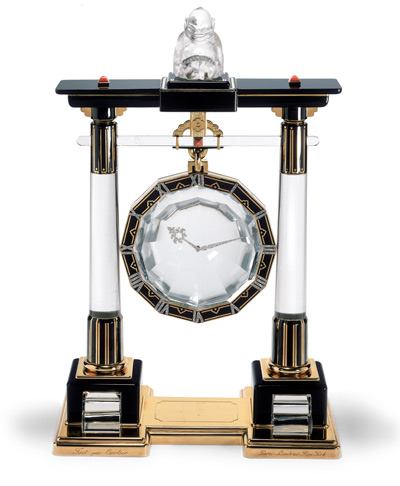
For the first time ever, Cartier offers a stunning look at no less than 156 vintage watches from its collection. This exhibition displays chatelaine watches (attached by chain), wristwatches, travel clocks and an impressive number of the legendary mystery clocks, whose hands seemingly display time without any mechanical help.
These fascinating mystery clocks were developed with the aid of Maurice Cüet and the famous French illusionist Jean-Eugene Robert-Houdin. Robert-Houdin's first mystery clock was displayed at the Exhibition of French Industry in 1839 according to the brand's recently published book "Cartier Time Art."
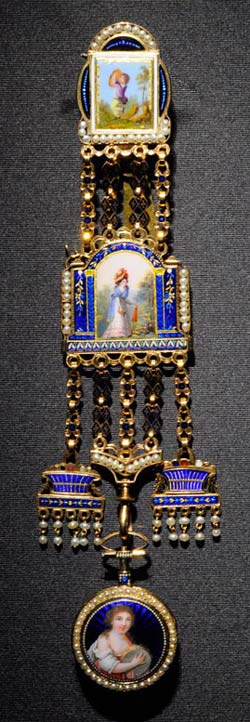
The oldest watch in the exhibition dates from 1874: a fascinating enameled timepiece on a chatelaine, it is decorated with pearls and a combination of yellow and rose gold. A hinged crystal opens to allow one to set the time and wind the movement.
The Santos-Dumont
The vintage collection also exhibits early versions of the legendary Santos-Dumont wristwatch that was made for and named after Brazilian aviation pioneer Alberto Santos-Dumont. He was in need of a wristwatch – as opposed to a pocket watch, which would require two hands to utilize – as he transported himself through the Paris skies in the early days of the twentieth century. A pocket watch would force him to remove at least one hand from his aircraft's instruments.
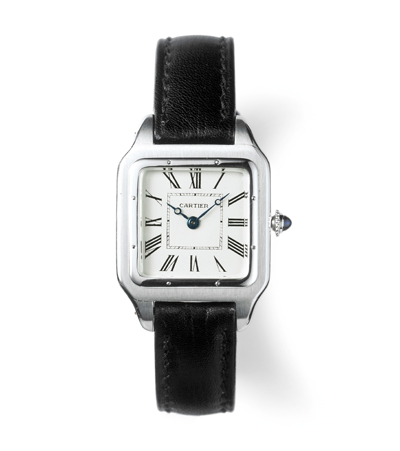
His friend Louis Cartier designed the Santos-Dumont watch for him in 1904 and a single unique piece of platinum was manufactured for the wrist of the daring pilot. However, the serial watch was not launched commercially until 1911.
The manufacture
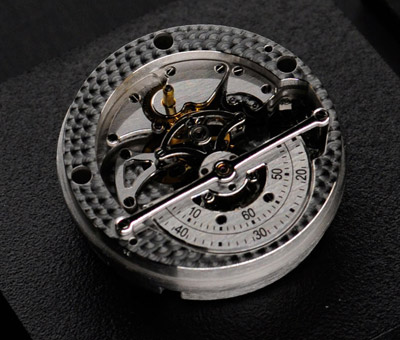
Carole Forestier-Kasapi personally toured the press through the upstairs exhibition, which displays the last four years of Cartier's manufacture horology. Seventeen watches powered by twelve in-house movements are to be seen here, one more complicated than the other – not least the conceptual timepiece Cartier ID One, a spectacular watch of cutting-edge materials and technology that will never need adjusting.