WORLDTEMPUS - 14 February 2013
Elizabeth Doerr
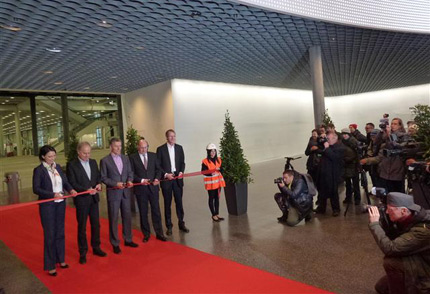
Five years in the planning and execution, yet only 22 months of actual construction work: this is what I would call Swiss precision. When Baselworld's parent company MCH announced two years ago that it would renovate and rebuild the main halls, most people just shook their heads: no construction project ever comes in on time – and if it didn't, would that mean that Baselworld 2013 would not take place?
Well, the construction began in 2011, and by the 2012 edition of the fair (which was pulled back to the beginning of March to leave plenty of time for the work to be done), the construction was easy to see. Fair business went on as usual, but this time under much speculation – which has heated up as we have gotten closer to the 2013 edition of the fair, which opens its doors (much later than usual) on April 25.
Yesterday, MCH invited the media to come take a look at the finished halls; the construction, it would seem, has not only finished on time (February 8), but has remained within the announced budget of 430 million Swiss francs – which, by the way, is the largest sum ever spent on a Swiss fair. Obviously, the fair has worked with at least as much precision as a quality Swiss watch this time. The lion's share of this money was financed by the MCH group itself as the administrative president of the MCH Group, Ulrich Vischer, explained.
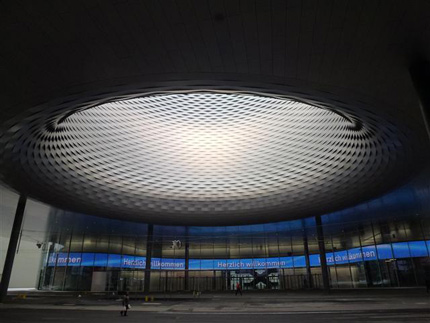
What's changed?
Now that the halls are done, their new functions (such as lighting, plumbing and electricity) will go through a testing phase and the brands will begin building their booths – some of which are very elaborate, sophisticated, expensive and – like the new fair hall, which was created by Herzog & de Meuron – designed by famous architects. Every single booth at the 2013 edition of Baselworld will be new, and some of them will have two and even three floors.
Naturally, some of these booths and brands will also be in locations that are different from where one may be used to seeing them. Yes, there has been a reorganization of the halls, precipitated by their physical changes.
The main change has occurred in Hall 1, where another floor has been added that forms an overpass over and across the Messeplatz to connect it to what was formerly Hall 3 across the street. The street as such has disappeared to become what the fair now calls the City Lounge, though the trams still come through (but not traffic), and it is now covered by a large roof with an opening in the center to allow for light. The halls on either side of this are both Hall 1 – one “north” and one “south.” The ground floor of Hall 1 south has been earmarked as an event hall to be used for press conferences and functions. It would appear that the Swatch Group has claimed it for use for its press conferences and such at Baselworld 2013.
Not visible to the public is the new underground complex, which makes deliveries and other behind-the-scenes infrastructure of the fair much easier. It, too, connects both sides of the hall. The four corners of the hall that border the City Lounge will each hold a gastronomic amenity: a Japanese restaurant, a Käfer-run restaurant, a shop with a bistro, and the MCH Lounge, which used to be housed in one of the little huts out on Messeplatz.
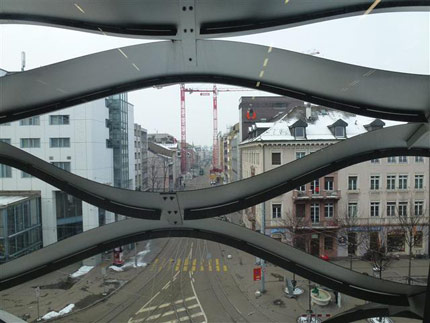
The rest
What used to be Hall 5 (just in front of the Musical Theater) is now Hall 3, and the former left side of Hall 3, which borders the parking structure, is now Hall 5. Hall 4 remains Hall 4, though it will no longer house Bulgari, who has moved into the first slot inside the door of Hall 1 north. Hall 2 also remains in place, though it will no longer be exclusively for jewelry. The watch and jewelry brands will mix a little better according to needs.
Lastly, the Palace Hall – which formed a safe haven and less expensive alternative for the independents to exhibit during Baselworld – will once again be in place and is slated to house a great number of independent watchmakers. The A.H.C.I., however, has elected to move to Hall 2.
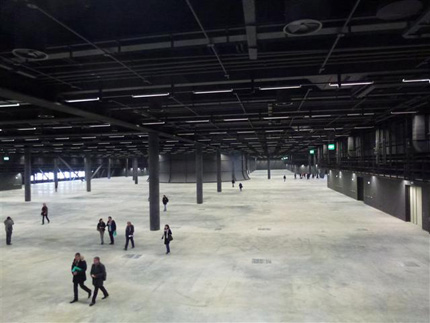
The fair now has a total of 140,600 square meters of exhibition space, and a full 2,500 people can sit in the new Event Hall in chairs.
While there is no doubt that Baselworld is more beautiful than ever in a conventional sense, it has certainly lost a bit of the atmosphere that made it feel intimate and like a having a drink and a chat among friends – though that feeling was already lost after the 2000 construction. What remains to be seen is if the fair can become more efficient for its professional visitors and media's reporting needs.
However, as Martin Kull, co-owner and CEO of HRS Real Estate AG (the optimization company in charge of the efficiency side of the construction) said, “This was not an ordinary project; it was extraordinary in many ways and something that many involved had never seen before.” When you consider some of the statistics, it actually takes your breath away: 1,000 workers per day for the 22 months of construction, 150 trucks visiting the site per day, 12 tower cranes in operation, 6,800 tons of steel used, and 450,000 square meters of concrete. When you consider that 89 percent of the work was done by Swiss companies (66 percent from the Basel region), the timeliness and efficiency of the project boggles the mind.
I look forward to the first day of the fair, when all is up and running. I'll let you know how it is in case you can't make it.