WORLDTEMPUS - 14 May 2012
Carlos Torres
The day before visiting Lisbon, Sotheby´s New York had made a historic mark in the world of auctions: the magnificent painting by Edvard Munch, “The Scream,” had achieved a new world record for any work of art when it sold for $119.9 million (€91 million) following an enthusiastic battle involving at least eight bidders lasting for more than 12 minutes. It therefore came as no surprise that Sotheby's head of watches Joanne Lewis and Jonathan Hills, director for clocks and barometers, received me with a broad smile when I entered the Ritz in Lisbon that morning for my meeting.
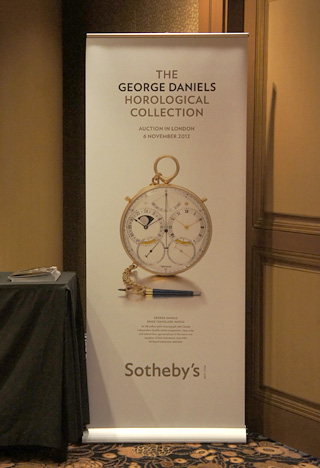
SEE THE PHOTO GALLERY
The occasion for my visit was unusual as Sotheby's does not normally include the Portuguese capital when touring with an important watch and clock collection. The fact is that both Lewis and Hills were greatly pleased by the success of the cocktail party held the prior evening, which was attended by more than 200 potential buyers. They even seemed surprised by the in-depth knowledge demonstrated by a fair number of collectors regarding the exhibited items comprising some of the most important pieces owned by the late George Daniels. His collection includes not only pieces he made and retained for his own pleasure, but also fine and rare examples of both clocks and watches by some of the most famous makers of the seventeenth, eighteenth and nineteenth centuries. Valued at more than 5 million pounds, the collection consists of approximately 130 lots, whose sale will actually be a deserved tribute to a life devoted to horology.
The fact that many of these special pieces have not been seen in public for many years only contributed to my sense of being treated as a privileged watch enthusiast since I was allowed the rare opportunity to closely examine them. The 16 items displayed at the Ritz Hotel in Lisbon included examples by Abraham-Louis Breguet, Thomas Tompion, John Arnold and Benjamin Hill – all beautifully restored by George Daniels's own hands. Exceptional as they may be, my eyes were nevertheless continuously drawn toward the pieces Daniels signed himself. It was a true feast for the senses to hold four exquisite pocket watches that will undoubtedly be the highlight of the upcoming November auction in London. The Grand Complication Watch, a remarkable 18-karat yellow gold one-minute tourbillon with Daniels's slim co-axial escapement includes a minute repeater striking on two gongs, an instantaneous perpetual calendar (a mechanism of Daniels's own design with retrograde date), the equation of time, moon phases, a bimetallic thermometer and a power reserve indication displaying the power for up to 36 hours. This is a masterpiece that he completed in about 1987; its estimate lies between 500,000 and 800,000 pounds Sterling.
The second most astounding piece is the famous Space Traveller Watch (second version). This is an 18-karat yellow gold chronograph with Daniels's independent double-wheel escapement, mean-solar and sidereal time, age and phase of the moon and equation of time indications. Made in about 1982, the watch experts at Sotheby´s estimate that it will certainly exceed the 400,000 to 600,000 pound mark. In Daniels's auto biography, “All in Good Time,” he describes the piece as “the first oil-less escapement watch completed in tribute to the American astronauts' moon landing.” The watch was actually made for the successful first – and only – exhibition of the Worshipful Clockmakers Company in 1987 in order to encourage individual artists to exhibit their work to the public.
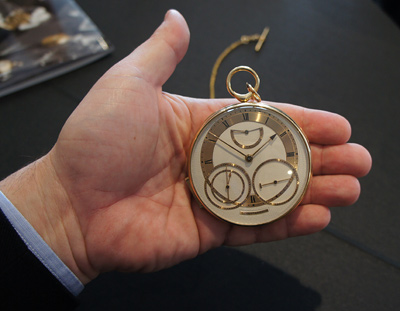
Third in line to fall under my scope was another incredible piece: a stunningly beautiful chronograph with a four-minute tourbillon comprising a big monometallic, stainless steel, four-arm balance wheel with gold adjusting weights and a free-sprung overcoil balance spring. As expected, it is outfitted with a co-axial escapement accompanied by Daniels's compact chronograph mechanism. The fourth pocket watch by George Daniels on show was a one-minute tourbillon with an Earnshaw spring detente chronometer escapement. Mounted under a polished steel bridge, the tourbillon carriage is outfitted with an overcoil balance spring with isochronal adjusting weights.
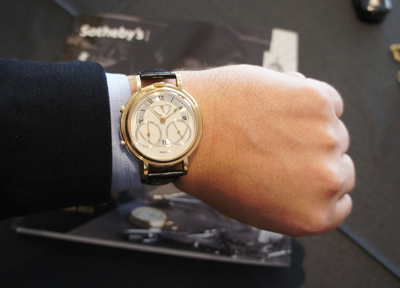
Last but not least, I was awed by the presence of the first wristwatch made by George Daniels: an 18-karat yellow gold four-minute tourbillon wristwatch with Daniels's slim co-axial escapement and compact chronograph mechanism. This is a watch from the 1990s that includes an experimental chronograph, whose components were compressed to fit the available space at the right side of the watch, thus diminishing its overall thickness. A watch, Daniels said, that “was made to capture the attention of the Swiss industry” with regard to the co-axial escapement. The chronograph on this piece was included only to add interest to the watch. With an estimate between 150,000 and 250,000 pounds, this is an historical wristwatch that will certainly demand a much higher premium from serious collectors. Unexpectedly, I was allowed to put this exceptional piece on my wrist for some brief but memorable moments.
The Sotheby´s exceptional sale comprising George Daniels's entire personal collection will truly be a tribute to an outstanding life almost entirely devoted to horology. Of additional interest will also be the fact that all proceeds from the sale of the collection will go to the recently established George Daniels Educational Trust: a non profit organization with the purpose of making funds available to students to further their education in the disciplines of horology, medicine, engineering, building or construction.
Next November, after the auction, I am certain that I will again find the same pleasant smile on the faces of Lewis and Hills that I saw in Lisbon. Although the Daniels pieces will not be able to compete with the €91 million garnered by Munch´s “Scream,” they will be satisfied to know that these pieces will continue their existence in the hands of some fortunate collector aware of what they truly represent to every watch and clock enthusiast.