WORLDTEMPUS - 3 March 2011
Ian Ellery
It may be a cliché, but we are all the sum of our experiences, and while there may be a myriad of small events that define us, it is those things into which we put our effort and passion that make the real difference. The horology enthusiast must search hard to gain an insight into the world of the watchmaker, and any discovery is greatly treasured.
Given this, why does such a search begin in a cramped and slightly damp basement? Well first of all, after ten years designing and making watches in the small Swiss town of Rolle, Peter Speake-Marin is moving his atelier from two rather snug converted apartments to a dedicated set of offices 15 minutes closer to Geneva. As a result there are a lot of things to be packed and moved: papers, files, promotional literature and ten years' worth of “stuff”. Naturally, acquaintances are called upon to help. After a long morning Peter suggests that the contents of an old wine box might be interesting. “Take it home and have a look –there might be some cool stuff”, he said.
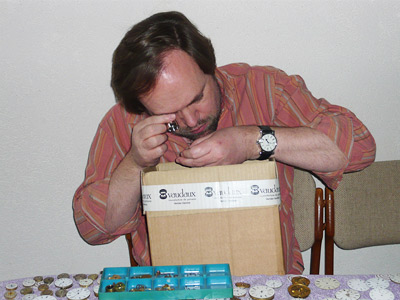
Expectation resulted in a rather-too-quick trip home; once there the curiosity became too much. What does one of the best watchmakers in the world today keep in an old wine box? After rapidly removing the tape from the top of the box, an initial look inside was daunting. On one side was a set of watch-part trays, on the other, a mass of that “stuff” Peter was talking about. The trays wouldn't come out without moving the “stuff”, so that had to be tackled first. Out came a movement, then another, next a dial, then a ladies enamel watch, and so it went on. And on. And on.
After two hours there was a table-top full.
Outstanding enamelling
The variety and sheer number of watch movements that came out of that one box was staggering: pocket and fob watch movements, gold and enamel dials, even one or two complete watches, all ranging from the 1850s to about 1930. The large pocket-watch movements were typical mid-nineteenth century: gilt brass and steel, with lots of layers separated by columns and multi-level bridges, powered by large barrels and fusee chains. There were even some repeaters.
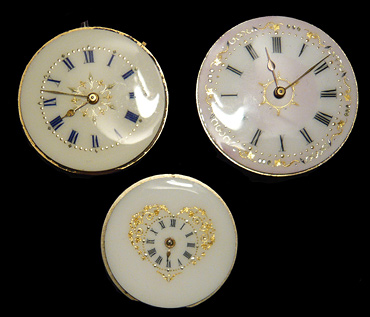
The ladies' dials were the real surprises – though sadly, while they look wonderful, they have little monetary value. They date from the late nineteenth to the early twentieth century, and have relatively simple movements, with plain three-arm gilt balances; more complex are the dials, some made from tin but most from enamel. The quality of this enamel work is simply outstanding: it is hand painted using multiple colours and plenty of gold. The most beautiful dial has a bright white enamel background, with no numbers but instead a heart surrounding the centre, lovingly painted in gold – stunning.
What next?
After the initial analysis, the challenge was whether anything could be done with the movements. To be of any use, they all needed to be cleaned and oiled, including the individual bridges and cogs – a Herculean task. So for now they will have to stay as they are. A few could be used for practising techniques – disassembly, oiling and reassembly – the rest go back in the box.
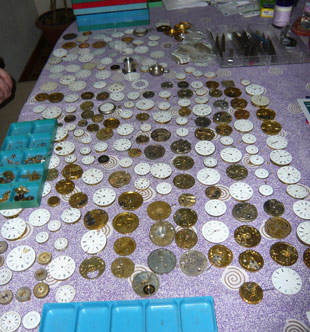
Aside from the movements, the dials themselves have some interesting characteristics: Roman numerals, patterned centres, gold, silver and some engine-turned dials. However, they aren't of the highest quality as during this period dials were pressed rather than engraved; the industrial revolution was already compromising traditional skills. Here, though, was something that could be used in a modern context – perhaps one of these antique dials could be put into a Speake-Marin case.
These watches were collected by Peter Speake-Marin over a number of years; they may or may not have contributed to his style, but this search has shown that his watches are an integral part of a long and illustrious English watchmaking tradition.
Now for the next project… there was a box of vintage Jacot tools buried somewhere in another pile.