WORLDTEMPUS - 11 December 2012
Miguel Seabra
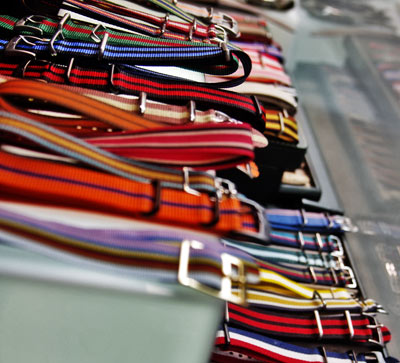
Niche brands such as Switzerland's Maurice de Mauriac have also jumped on the trend. The Zurich-based brand's owner, Daniel Dreifuss, is known to be a strap fanatic and not only chooses innovative bracelets but also has turned his brick-and-mortar shop into a Mecca for those seeking NATO straps. “It all started a bit with Tudor, but I was already one of the first to invest in NATO straps,” says Dreifuss. “We have them in 54 different colors and patterns and four widths from 18mm to 24mm. We also make them in Hermès Barenia leather. They are individual and chic, you can change them like you change a tie. And they attract new customers to the shop. Solid colors are more popular with clients buying Maurice de Mauriac timepieces, while the stripes are favored by Rolex owners.”
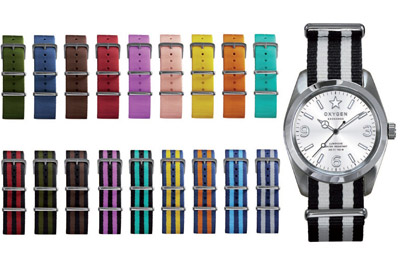
It was precisely the Rolex-plus-NATO-strap combination that led Eric d'Hauteville to revolutionize his Paris-based Oxygen brand: right now the entire collection comprises quartz watches featuring the inevitable interchangeable nylon bracelets. “My girlfriend kept telling me how she loved vintage Rolexes with NATO straps. So I had the idea to adapt that look,” he confides. Considering his price range, his straps are made in China.
The level of the finishing and nylon webbing (and the respective price) can be quite different between suppliers. Strap Code is a brand based in Hong Kong that makes straps there. While it sells globally, it is “Mostly Rolex and Tudor collectors” that buy the straps, the company told Worldtempus. “The James Bond and military colors are our bestseller types.”
“The prerequisites to make a good NATO strap are heavy nylon material, high quality 316 stainless steel keepers and buckles. The edges and holes of the NATO straps are welded ultrasonically to ensure that they are free from frills and rough, sharp edges.” This includes not only NATO straps, but Zulu straps as well. “The material of the Zulu type is more durable and thicker, up to 1.40-1.50mm, while the NATO is approximately 0.90-1.00mm. Besides, the Zulu type usually has a stitched design and all the keepers and buckles are heavier.”
Gnomon is a Singapore-based brand that confirms the trend. “Our bestsellers are the James Bond and Regimental series, plus the solid colors,” the company revealed. “We sell mainly to professionals and adults in the 20-to-40 age bracket. The prerequisites to making a fine NATO strap are good seals and hardware; it makes a lot of difference in the overall quality. There are cheaper NATO straps out there using glue and brass hardware, but we only use laser welding and 316L stainless steel. Most customers put their expensive watches in the $3,000 to $10,000 price range on NATOs. There's no point in buying a $5 cheaper NATO and making your watch look cheap.”
My verdict
I am so obsessed with straps and bracelets that when Tudor unveiled its Heritage Chronograph on a fabric woven band at Baselworld 2010, I got several calls and text messages from colleagues in the media teasing me about it even before I got to the fair.I am a fan of NATO straps and have a few to prove it (21 striped, 10 unicolor, 2 leather), but one has to be clever regarding the use because they are not suitable for all watches and occasions.
First, in my opinion they look better on timepieces between the sizes of 38 and 43 mm – bigger than that and the watch will be too chunky for the strap, while the smaller watch cases will be eclipsed by it. The combination works best with timepieces with shorter lugs, especially those with a cushion shape. NATO straps are also more suited for sporty and military watches and chronographs, especially re-issues like the TAG Heuer Autavia. And they are perfect for the summer heat and sweat. I also love how easy it is to change the strap without removing the pins and, thus being able to completely change the look of the watch within seconds. One last and important detail: it may be sacrilegious to some, but I usually cut the extra strapping off for a cleaner look; I don't want all the extra metalware to detract from the watch itself.
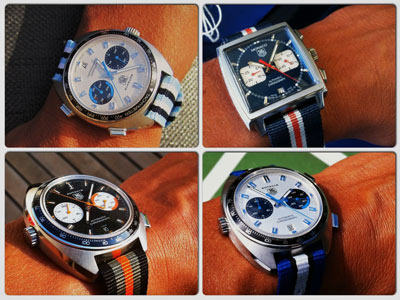
Here are a few more thoughts on the subject, courtesy of some of my colleagues.
Kristian Haagen reveals, “I must admit I have more NATO straps than watches. And I am neither a James Bond buff nor military romantic, but merely thrilled by the fact that you can dress up your vintage Rolex with simple means, as this is a watch that otherwise has a very conservative and monochromatic look. Wanna dress your double red Sea-Dweller in an orange, red and white-striped strap that cost 1/100th of your watch? Go ahead. People will applaud your choice. But do beware: the nylon in the strap will leave marks on the case back of your precious vintage critter. So take my advice: apply a sticker before you peacock your watch. Once this trend is over, you will be happy that no marks are left.”
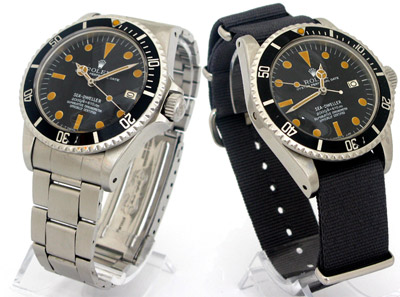
Hodinkee founder Benjamin Clymer is another fan. Here's what he has to say, “The first NATO straps were issued by the British Ministry of Defense, and were nicknamed G10 straps by the soldiers wearing them because of the requisition form they had to fill out to request them. They were cheap, easy to take on and off, and a soldier could easily cut the nylon should it get caught on something during an emergency. Though you can find NATOs in any color and pattern these days, the real deal only comes in "Admiralty Grey" with chrome-plated brass hardware. Oddly enough, as case sizes have generally grown over the last few decades, the official spec G10 has recently gone from 20mm to 18mm. After soldiers (and that most famous spy, James Bond), Rolex collectors were some of the first to go crazy for NATOs. A Rolex Mil Sub on a genuine G10 strap is enough to get any watch nerd excited. These collectors' influence has trickled down over the years, and a few years ago NATO straps became a marker of hip urbanity. Now you can find brightly colored nylon straps in shopping malls across the world and people are wearing them on everything from Patek Philippe to Timex. In fact, both Casio and Timex recently released digital watches on NATO straps, to the chagrin of many serious watch collectors. It could be said that within the serious watch-wearing community, the NATO strap has experienced a bit of backlash due to the overexposure of this one-time niche strap choice.”
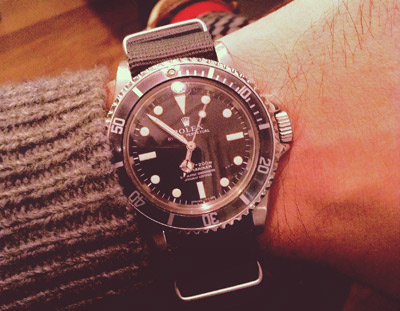
Worldtempus editor Elizabeth Doerr has a different take on them, naturally. “NATO straps seem to be a really appealing sporty addition,” she reveals. “Added to a sports watch, a textile strap can greatly enhance the ‘watch wardrobing' effect and comfort factor of a sports watch. What I personally disagree with is wearing a NATO strap with a dress watch. I find this look far less appealing. And, naturally, since I am not a Rolex-wearer, I don't personally buy into them. However, for the moment they are the ‘it' item in men's watch fashion.”
NATO STRAPS - A casual trend (Part 1)