Worldtempus - 30 July 2012
Elizabeth Doerr
The day I received the UR-110 TTH for a month's worth of test wearing, I felt like a little kid in a candy store. I couldn't believe anyone would lend me such a unique and precious watch. Somehow, too, I had a hard time believing that its creators, Felix Baumgartner and Martin Frei, were picturing my little wrist when they conceived this masculine beauty.
No matter, I could hardly contain myself, so I ripped open the packaging and went about the business of winding and setting the time. This was far easier than I had ever dreamed it could be. Some complicated watches take a little more brain grease than others to set, and fumbling with small crowns can be quite tricky, particularly – and please excuse this aspect of feminine hands – if you want to keep your fingernails intact. The UR-110's crown is as easy to manage as they come. Placed at the 12 o'clock position, it is eminently simple to get to, and simply swiping the forefinger across it is enough to wind the balance into motion. The unidirectionally rotating rotor regulated by double turbines (visible through two little windows placed on the back of the case) takes over quickly. Setting the time is equally as easy: just pulling the little crown flap forward and swiping the forefinger across the crown until the correct position is shown by the satellites was all it took.
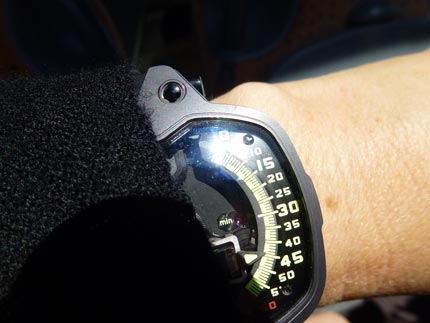
When wearing long sleeves the time is very easy to see; note the beautiful sheen of the tantalum “hull” © Worldtempus/Elizabeth Doerr
Weighty metal
The 47 x 51 x 16 size of the case made strapping it to my admittedly small wrist a bit of a daunting venture. However, I was pleasantly surprised when I discovered that the architectural design of the “Torpedo” case had it perched absolutely perfectly there. In fact, I would say that after a month solid of wearing the UR-110 TTH, it had really grown to be part of my wrist. One of the reasons is certainly the amazing materials that went into its making. The case itself is blackened titanium, while the bezel – which Urwerk calls the “hull” on this model, a fitting name – is made of a rare metal: tantalum. Tantalum possesses a gorgeous grey hue that is unlike pretty much any other metal. Heavy, aesthetic and unusual, it is however not scratchproof. So, like gold or steel, it will soon possess a certain patina when worn on a regular basis. Urwerk worked the tantalum by sandblasting and satin-finishing to enhance the metal's natural beauty and, indeed, I can say it was appropriately “oohed” and “aahed” by every male to cross my path during these 30 days.

The almost military look of the greys and blacks is offset by the highly visible mechanics and awesomely luminous display of all the functions indicating something, including a day/night indicator, an “oil change” display that alerts the wearer to service intervals, and subsidiary seconds in addition to the all-encompassing display of hours and minutes. If you happen to be wearing a long-sleeved shirt, only the time display will peek out. If you're not, then you may become totally mesmerized by the depth of the watch underneath the extremely thick sapphire crystal. I know I did. Since the hull is thicker than a normal bezel at 4.1 mm (as opposed to 2.4 mm on the other UR-110 models), the sapphire crystal also had to become just as thick.
Fashion forward
I rarely wear so-called women's watches anyway. But, somehow the UR-110 TTH is so masculine that even I at times debated heavily on my wardrobe during my pleasurable month with it. “Regular” evening clothes were going to clash unspeakably with this strapped to my left wrist, so I tried my hardest to look out edgier clothing that still remained within the constraints of being considered formal. This worked really well when I went to events chiefly populated by people working in the watch industry. Within my personal circle of friends, this timepiece was widely ogled and appreciated, though I did have to explain how to read the unfamiliar display every time.
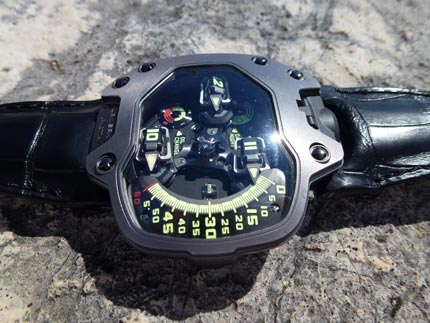
This was not an uncommon question, and the answer is easier than one would ever think. Others were at first mildly confused by the visible mechanics of all three of the satellites, so I generally used a sleeve to cover the left side of the deep sapphire crystal to help properly explain that it was the right side that one only needed to pay attention to in order to see what time it is. Personally, it only took about 24 hours to retrain my eye to stop looking for the conventional circular rotations that watch hands usually make. Once I did that, reading the minutes and hours was superbly easy and pleasurable. Because the seconds aren't eminently visible, however, something strange begins to happen: you stop worrying about it. To-the-minute schedules became sort of moot, and I discovered that I kind of liked the feeling.
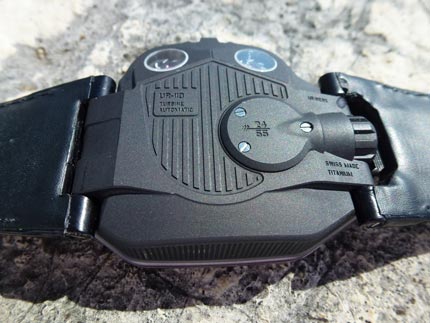
The fascinating mechanics were a distinct pleasure to view, though the satellites displaying the hour move so slowly that there are basically no moving parts to observe. One of my favorite features was the high luminosity of the timekeeping elements, which somehow seemed brighter than other watches. Surely this was not the case, but perhaps the wide chasm of the sapphire crystal displaying the many elements made it seem so. Either way, it was possible to see the time on this imposing timepiece far into the night.
At a retail price of 100,000 Swiss francs, the price of entry for this particular boys club is not inexpensive, but you will never, ever run out of things to talk about with your friends.