It was in 1961 that Vulcain presented one of the very first diver's watches ever to be outfitted with an alarm movement that was genuinely audible under water. The Nautical with its triple case back was loud enough to be heard by a diver in the depths of the seas, an important function that could have meant the difference between life and death at the time. When the alarm went off, it was time for the diver to head back to the surface.
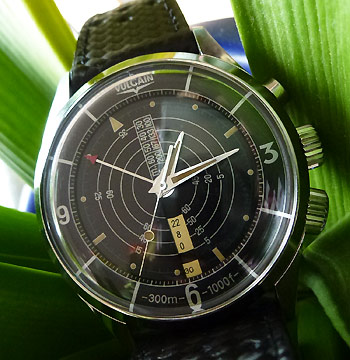
Last year, Vulcain reissued the legendary model using the contemporary manufacture Cricket movement to celebrate its 50th anniversary. I wore the Nautical Heritage Limited Edition for the last month to see how it would hold up in a daily life situation.
No dives
Unfortunately, I'm not a diver. And in the hectic period between this year's SIHH and Baselworld there was not even one chance for me to get the timepiece wet unless I would have taken it into the shower with me (which I do not do as a matter of principle).
In chatting with a friend who does dive with all manner of watches, I was excited to hear that he was impressed with the modern 42 mm stainless steel model. “In the old days before dive computers, people would dive specific profiles, in which case an alarm would have been useful,” he said to me. “Nowadays, it's a quaintly vestigial complication. Like a tourbillon.” That makes sense to me. In this modern era, digital machines seem to do everything better, but for a passionate diver the faithfully designed reissue of this timepiece seems like it would be a great addition to the wrist. I would recommend it highly in any case.
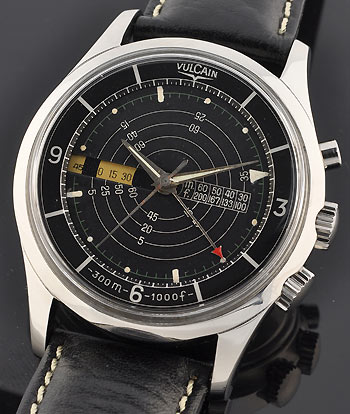
One of the elements I really like about this watch is the nostalgic look of the domed Plexiglas crystal. It is marvelous and really adds retro chic character to reissued greats of days gone by. In the same vein, I absolutely adore the stamped leather strap, which ends up looking a bit like carbon fiber thanks to the resulting pattern. The calfskin has been specially treated to hold up well in water. Though I never was able to test that particular element, I cannot stress enough how I liked the design and feel of the robust strap altogether.
For me, the low-key business of the dial, which seems surprisingly clean when worn, was actually a welcome change from my own (usually classically designed) watches. The dive grid seemed more like an interesting design element and did not hamper the time reading or the alarm setting at all. The interaction of the black dial with the silver elements against the steel frame of the case is exceedingly attractive and appealed to me instantly. My only gripe in this respect would be the lack of luminescence on the dial. If I were a diver and actually wore this watch to dive, I am certain I would not be able to see the elements well under water. Then again, I would have the alarm to remind me acoustically. And, being me, if I were to pick I would definitely retain the low dial luminescence, which adds to the aura of the general dial design, but does not allow to be seen well at night.
Loud Cricket
The faithfulness of the re-edition (the manufacturer assures me that it has also been enhanced with today's demands on sturdiness and reliability) explains the sound and volume of the Cricket alarm: it needs to be audible under water. The Cricket got its name from the sound it originally made when the first one came out in 1947. Despite small case dimensions of the original, the alarm was “as loud as a cricket” due to an extra-thick membrane embedded in the case back. The alarm's characteristic noise is what gave this wristwatch its emblematic name.
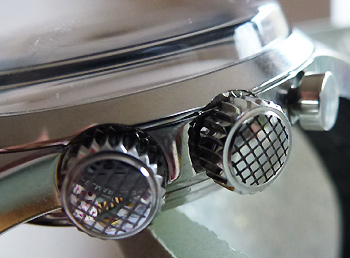
Using the Cricket is also easier than one might assume when first looking at the two crowns and button on the right side of the case. The crown positioned at the “normal” spot is used to set and wind the time and the alarm. However, to set the alarm, you first need to press the button at 2 o'clock. Then you just turn the crown. This same crown winds both spring barrels – one is for the movement and the other for the alarm. Turning the crown clockwise winds the alarm barrel, counterclockwise winds the movement, which boasts about 42 hours of power reserve. As far as I could tell, this was pretty accurate. The screw-down crown positioned at 4 o'clock must be unscrewed in order to set the dial's diving scale. This I only did in order to get an idea of how the design of the dial changed as the grid moved. As I said above, I never used the watch in the water. Because of the movement layout, it is also impossible to turn the hands backward, so if you overshoot the time when setting, you have to keep going forward until you get the right setting.
One thing that you need to get used to when you wear an alarm watch is that it will occasionally go off in unexpected places, particularly if you are not yet used to which barrel you are winding when you wind the watch. The first time it went off unexpectedly, I was driving a car and I will admit that I jumped out of my skin. It is very loud and it rings for about 20 seconds. Once you have the winding under control, the alarm is a welcome addition, though by its very nature it cannot be to-the-minute precise in its ringing. You have to calculate plus-minus 15 minutes or so. Also, manufacture Caliber V-10 has one small weakness: when the alarm has spent itself, the barrel rattles a little loosely within the caliber. This is not a problem or a detraction in my estimation, but if you are not aware of this fact it can provide a moment of panic:“Oh my God, I broke it!” I lamented into the phone the first time the alarm went off.
Neat addition
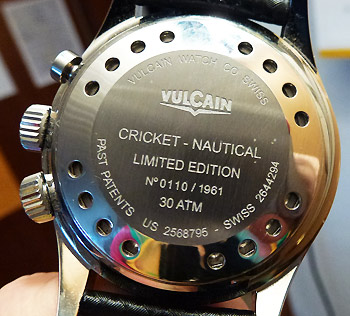
The engraved triple case back of the Nautical Heritage Limited Edition bears the Swiss and U.S. patent numbers of the original, a really nice touch, particularly since the back, with its resonance holes and 300 meters of water-resistance, must remain closed. The very informative instruction booklet that comes with the watch also goes into quite in-depth explanation of the decompression tables and how to use them and the watch properly as an instrument. Certainly a diver and/or vintage enthusiast will find this to be a wonderful addition. My only gripe here is that the translation of the booklet into English is “bumpy,” but this is standard fare in the Swiss watch industry. Many official documents read like they have been translated by a machine, which is a shame when we're talking about expensive luxury products. In my estimation, the same attention should be paid to the accompanying documents as to the watch itself.
Limited to just 1,961 pieces, it retails for the very exceptional price of $5,875 in the United States. This model should be selling like the proverbial hotcake.