WORLDTEMPUS - 12 January 2010
Elizabeth Doerr
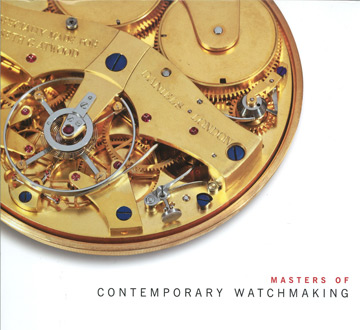
Michael Clerizo's new coffee table book Masters of Contemporary Watchmaking launched late in the fall of 2009 and celebrates the art of eleven renowned watchmakers in great detail. The reader will delight in the in-depth histories of these courageous horologists, told in order of their age and thus beginning with the “father” of the modern independent scene, George Daniels. The story of Svend Andersen, a multilingual watchmaker settling in Geneva is closely tied to that of the following chapter's subject, Vincent Calabrese since these two are the founders of the celebrated A.H.C.I. (Academy of Independent Horological Creators). The next chapter focuses on one of watchmaking's most famous names: Philippe Dufour's humble horological beginnings come to light in this lively chapter spiked with colorful quotes.
Clerizo also takes on the lesser well-known stories of Antoine Preziuso and autodidact Aniceto Jiménez Pita, thereby giving readers the chance to get to know some of watchmaking's most interesting timepieces without having to travel to Geneva and Barcelona respectively.
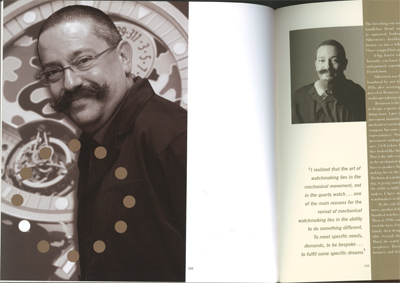
The chapter on Franck Muller—one of watchmaking's biggest names—allows personal insight into Muller's dynamic past thanks to his own vivacious way of speaking English, but does lack reference to the high-profile scandals widely reported by the Swiss press over the last few years.
The colorful ideas of Alain Silberstein, a designer at home in the French Jura, is the subject of another chapter, while the following one focuses on Dresden-based traditionalist Marco Lang.
Perhaps the most interesting chapter concerns French whirlwind Vianney Halter: Clerizo captures the essence of Halter's science fiction thoughts well, ably stringing them to form a number of vibrant scenes.
The final chapter concerns Roger Smith, who shared a workshop with Daniels on the Isle of Man before setting out to found his own on the scenic island.
All eleven of these well-told, complete stories, only two of which are originally Swiss in nature, are accompanied by an in-depth pictorial retrospective of timepieces.
Clerizo's order of things then continues with eighteen more brief chapters, each of which pictorially features the work of other independent watchmakers from Switzerland, Hungary, Austria, Ireland, Finland, Germany, and Holland. Masters of Contemporary Watchmaking's 292 pages end with an extensive glossary, once again proving its suitability for newcomers to the arena.