An original dial for a uniquely designed case
Source: Bovet
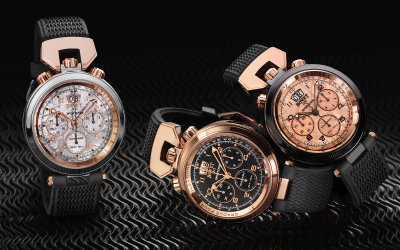 The style of the Sportster chronograph evokes the futuristic contours of chronographs produced during the Art Deco period by BOVET.
The symmetry of the case is accentuated by the push-pieces of the chronograph arranged on either side of the bow. This layout has the advantage of making the piece easier to operate than the side arrangement usual on conventional chronographs.
The new Sportster Saguaro Meteorite collection in 46mm is available in steel, 18K gold or in steel black PVD.
Celestial time: in 2009, the Saguaro offers a part of the sky through a series of meteorite dials. Coloured black, white or rose, each fragment of meteorite is unique. From the Greek “meteoron” meaning “celestial phenomenon”, the term “meteor” is used to describe the ray of light produced by matter coming from the solar system which falls into the earth's atmosphere and creates a temporary incandescence caused by atmospheric friction. This phenomenon occurs typically at altitudes of between 80 and 110 kilometres (50 to 68 miles) above the earth' surface. Remaining virtually intact after impacting with the earth, the Gibeon meteorite, used on the dials of the Saguaro, is renowned for its incomparable quality, beauty and workability.
The meeting of space and time: the Gibeon meteorite, more than four billion years old, was discovered in 1836 in the region of Great Namaqualand in Namibia, Africa. It has its origins in the asteroid belt situated between Mars and Jupiter, the fourth and fifth planets of the solar system in order of distance from the sun. Meteorites, veritable time capsules of the solar system, provide answers as to how the latter was formed, its evolution and its age. Composed of 90% steel, 8% nickel, 0.4% cobalt and 0.04% phosphorus, the Gibeon meteorite is the densest example available, with a density of around 8. For the dials of the Saguaro, its finish consists of several stages. The material must firstly be sawn, then polished, and finally treated with acid. This gives rise to a characteristic interlaced ribbon structure, called Widmanstätten figures.
This very decorative motif is aesthetically much sought after by collectors and gives the timepiece an original architecture accentuated by reflected light.
Featured brand