Chaumet began in 1780 and its story is closely linked to the history of France
Chaumet began in 1780 and its story is closely linked to the history of France. Exceptional skills have been channeled through the generations, seamlessly, from one master jeweller to another.
CHAUMET, JEWELLER OF EMPEROR NAPEOLEON THE FIRST
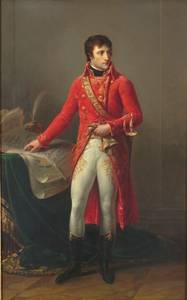 The story begins with an encounter between a brilliant Parisian jeweller, Marie-Étienne Nitot - a former employee of Aubert, the jeweler of Queen Marie-Antoinette – and Napoleon Bonaparte. Nitot caught the Emperor's runaway horse by its bridle and, as an expression of Napoleon's interest and gratitude,the young jeweller was made the official Imperial jeweller.The new Emperor was ambitious to transform France into the European centre of creativity, luxury and fashion. He was insistent that the ImperialCourt should appear at official ceremonies brilliantly bejewelled and Chaumet's founder and his fabulous creations helped to enhance the myth of the Emperor.
In 1802, he produced the Consular sword on which he mounted the Regent, a 140-carat diamond now on display in the Louvre. Two years later, he designed the Imperial sword, the jewels for both the Consecration of the Emperor and the Coronation of Joséphine. For Napoleon and the women in his life, Empress Joséphine, then Empress Marie-Louise, he created luxurious jewellery sets which symbolised the power and splendor of the Empire.
In 1815 the House was inherited by the master jeweller Jean-Baptiste Fossin, an artist and a poet.He interpreted flowers, fruit and foliage motifs with sentimental connotations in a visionary marriage of precious stones and enamels. Forget-me-not personified the memory of the beloved, and pansy, myrtle or ivy leaves symbolized eternal love.Chaumet attracted a new clientele composed of painters, sculptors, actors and writers like Honoré de Balzac.
CHAUMET, MASTER OF ROMANTICISM

CHAUMET, MASTER OF NATURALISM
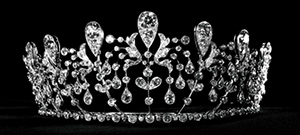 Chaumet distinguished itself for the bold creativity of its Head Jewellery, considered as much a social emblem as a fashion accessory. More than 2,000 tiaras were created for the aristocracy and royal families. The 1885 Colibri Aigrette in rubies and diamonds and the “Bourbon Parma tiara” produced in 1919 for the wedding of Edwige de la Rochefoucauld to Prince Sixtus of Bourbon Parma, demonstrated exceptional techniques.
Naturalism is still a source of inspiration for contemporary designs. The motifs of dew and web, the spider and the bee are the underlying theme of the Chaumet Collection Attrape-moi… si tu m'aimes (Catch me… if you love me).
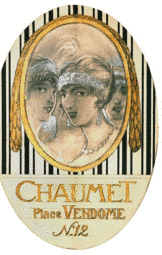
CHAUMET, FROM INDIAN STYLE TO ART DÉCO
Chaumet drew its inspiration from Cubist paintings, the motifs of ancient Egypt and the exoticism of the Orient, which influenced French fashion in the 1930's. The new uncluttered line called for imposing jewellery: headbands withgeometric motifs, belts, epaulettes, clips and brooches.
The jeweller took part in the 1925 Decorative Arts Exhibition in Paris and became a leading master in the style known as “Art Déco”.
12 PLACE VENDOME, THE HEART AND SOUL OF CHAUMET
The Grand Salon, listed as a historic monument since 1927
Situated on the first floor, Chaumet's master salon was commissioned in 1777 from the architect Bélanger by King Louis XVI's Treasurer General of the Navy. In perfect harmony with Mansart's facades, the Corinthian columns are multiplied into infinity by means of mirror effects. The memory of the first maître des lieux is still present, thanks to the many references to the maritime theme in the woodwork, marquetry and painted medallions. It was in this salon, too, that Frédéric Chopin composed and played his last Mazurka Opus 68 No. 4.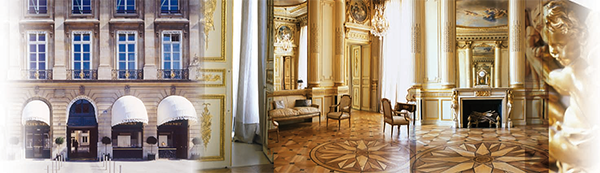
The Salon des Diadèmes, The Tiaras' Salon, Showcase of Chaumet's historic collections
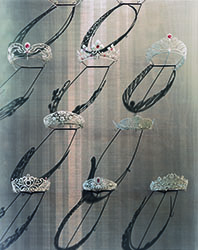 Chaumet's historic collections decorate the walls of the Salon des Diadèmes, where hundreds of “maillechorts” illustrate Chaumet's prestigious past.These tiara models, in nickel silver, are the final concept prior to the jewel being made with precious metals and stones. The heritage of Chaumet is exceptional within the history of jewellery: several hundred thousand gouaches and drawings made by winners of the “Grand Prix de Rome”, almost 300,000 photographic prints, 35,000 glass plates, account books and correspondence are all archived and stand witness to the accomplishments of the House of Chaumet through the generations.
Chaumet's heritage is displayed in major international exhibitions, at the instigation of Béatrice de Plinval, Museum Curator in charge of Chaumet's patrimony.
Featured brand