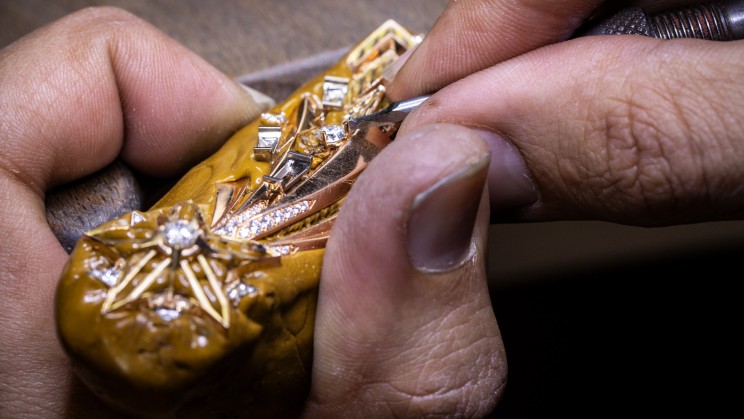
It has already traveled to the four corners of the globe since Watches and Wonders revealed it to the world. On the day of our visit, the Planétarium Automaton was temporarily back in its birthplace, albeit for a short time only before shooting off like a star to other skies. In the secrecy of Van Cleef & Arpels' Art Mechanics workshop, it is a rare privilege to get a backstage look at the creation of this Extraordinary Object, which whispers its poetry to contemplative souls, those who allow themselves to take time to read time differently, to appreciate its cosmic slowness.
FIVE YEARS OF DEVELOPMENT
Head in the stars, the field of possibilities salways seems much broader. Based on this premise, Van Cleef & Arpels unleashes its fantastic creativity through the prism of poetry, with Poetic Complications and Extraordinary Objects exploring the themes that have accompanied the Maison since 1906. Alongside Enchanted Nature, Love, Fairies and Ballerinas, Poetic Astronomy presides over creations with strong technical content, yet which always allow emotion to shine through. However complex they may be, the mechanical movements developed in-house by Van Cleef & Arpels have the inherent elegance to be able to fade into the background and place visual wonderment front and center. Following the Midnight Planetarium watch created in 2014 in collaboration with watchmaker Christiaan Van der Klaauw, followed by the Lady Arpels Planetarium in 2018, Van Cleef & Arpels presented its very first Planétarium Automate in 2022, after five years of in-house research and development. That was the time required by the Maison to develop a handful of patented mechanisms reproducing the planets' exact movement within the solar system as seen with the naked eye from Earth.
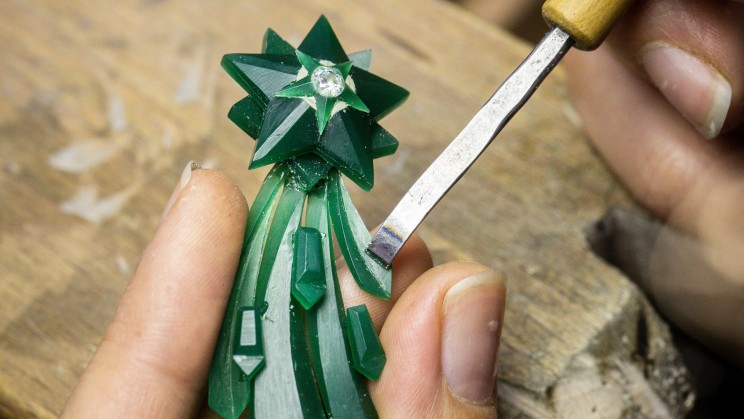
CELESTIAL BALLET
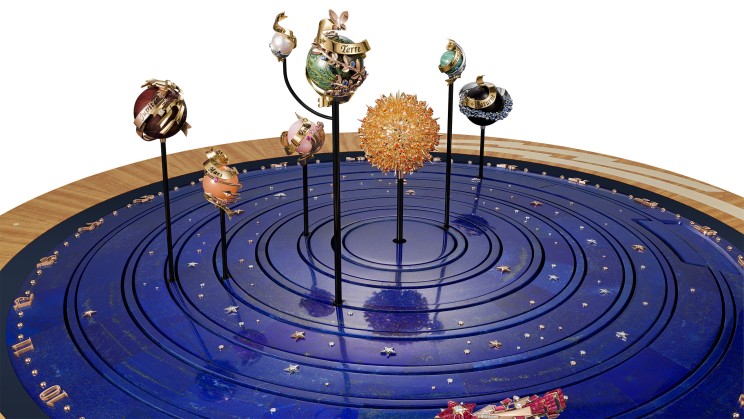
With this Planétarium Automaton, featuring wood marquetry and bejewelled décor entirely redesigned this year, Van Cleef & Arpels literally makes the stars dance. The center of the lapis lazuli dial is lit up by the Sun. Orbiting around the latter are Mercury, Venus, Earth - escorted by its satellite the Moon - as well as Mars, Jupiter and Saturn. Each does so at a speed depending on its distance from the Sun, ranging from 88 days for Mercury to 29.5 years for Saturn. On demand animation makes the passing hours appear to stand still, giving way to a celestial ballet of planets twirling in one direction and then the other, gliding horizontally and vertically across the dial. This dance is performed to the tune of a melody composed by Geneva based musician Michel Tirabosco and played on 15 bells specially made in Switzerland by a craft company that has specialized in bell making for 650 years.
JEWELRY STAGING
During this animation, a shooting star attired in Mystery Set diamonds and rubies emerges from a hatch to circle the moving planets before pointing to the time or rather to the nearest quarter hour. This deliberately poetic 'approximation' gives no hint of the movement's astronomical precision. Despite the dance, each planet systematically returns to its exact position in the sky thanks to the use of differential gears. This process is long since perfectly mastered by the workshop's watchmakers and engineers, unlike the system for opening and closing the shooting star's hatch that proved much less straightforward. A year and a half of development was required to ensure that no detail was left to chance. Nothing could be more natural at Van Cleef & Arpels, where technique is very much a means rather than an end in itself and the Maison prefers to delight aesthetes' discerning gaze with an infinite number of precious details crafted in its Parisian jewelry workshops. Like all of the Extraordinary Objects and Poetic Complications, the Planétarium Automaton is part of a collective approach uniting rare traditional crafts to weave a poetic and consistently moving narrative.