WORLDTEMPUS - 26 December 2010
Elizabeth Lilly Doerr
Though the DeWitt brand has always stood for innovative mechanics, these have not been manufactured in-house until December 2007 when the little company took a decisive step and opened its new factory in Meyrin. One of the main considerations in taking this step was independence and optimal control over the quality of the brand's own products.
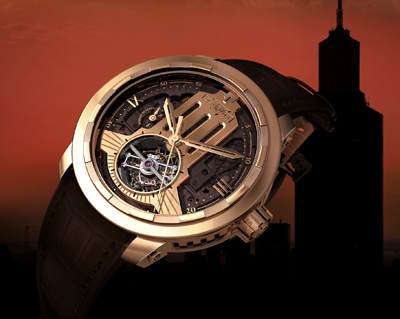
This independence has now resulted in Caliber DW8014, DeWitt's very first in-house movement. This caliber was pre-introduced at Baselworld 2010 and now debuts in the first full watch: the Twenty-8-Eight Regulator A.S.W. The aesthetically pleasing caliber with its demanding surface finishes also boasts quite a bit of innovation. An automatic movement with 72 hours of power reserve (the status of which is displayed on the dial) beating at a vintage frequency of 18,000 vph, it measures 37 mm in diameter and 6.35 mm in height. Its balance comprises a variable inertia glucydur balance outfitted with a Straumann balance spring with a Phillips terminal curve. It is outfitted with deadbeat seconds, which are uniquely connected directly to the tourbillon cage. In order to avoid hiding its mechanical beauty inspired by the Art Deco period—which is characterized by pure, geometric shapes—the rotor has been designed in a peripheral manner, making it barely noticeable. Of the movement's 320 components, it is perhaps the patented Automatic Sequential Winding (A.S.W.) that most deserves special mention here: this mechanism enables the distribution of constant energy to the gear train through “sequenced” winding of the barrel. Thus, one single spring barrel can boast an ideal range of function by not using the energy provided by both ends of the mainspring. This system fully avoids all the running defects observed when slip springs are used on conventional automatic calibers, according to DeWitt.
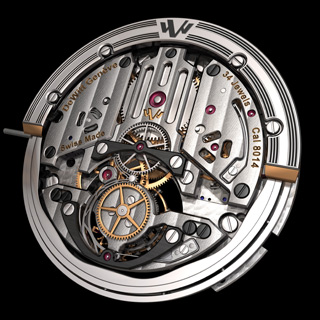
Peripheral Winding
The bidirectionally rotating peripheral rotor is attached to a ring with an inside sinusoidal profile. It engages the A.S.W system which sees to it that the movement to always operates in the ideal functioning range, between 92 and 96% of the mainspring torque. Indeed, two little arms, rocking up and down the sinusoidal profile, ensure the barrel is wound until it reaches 96% of a fully wound state. At that moment, a lever disengages the pawl from winding the barrel, and thus it continues its empty motion without engaging the wheel. The movement then runs on its reserves of energy, until it reaches 92%, at which point the pawl once again engages. The gear train is therefore guaranteed to receive a constant and stable flow of energy—all thanks to this “sequenced” winding.

Deadbeat Tourbillon
The name of the 250-piece limited edition Twenty-8-Eight Regulator A.S.W is very slightly misleading as the watch is not really a regulator but rather a tourbillon with a conventional time display. The word regulator in the name refers to its deadbeat seconds.
“I could not call my watch a regulator and then have it only superficially resemble a regulator,” says company founder Jérôme de Witt. “In order for this watch to truly be a regulator, it had to bring a new level of chronometric performance to the tourbillon.” De Witt explains that as long as the watch is worn with regularity, the combination of the superefficient winding system and the automatic stop means that the power reserve remains within the optimal state of winding. The result is consistent power delivered to the tourbillon, providing for excellent chronometric performance.