WORLDTEMPUS - 17 October 2011
Timm Delfs
On the evening of October 6, a celebration was held at the ETH's main building in Zurich to inaugurate an exhibition of Hannes Wettstein's work and to launch the book “Hannes Wettstein Seeking Archetypes,” published by Lars Müller Publishers. The exhibition, which displays a selection of the designer's most memorable products and his working desk - filled with objects of his personal collection of curiosities - will continue until November 3. Accompanying exhibitions in Zurich shops that sell objects designed by him can be found at www.studiohanneswettstein.com.

Hannes Wettstein, who died at the age of 50 in 2008, was an industrial designer in the true sense of the word in that he was universal and capable of designing virtually anything that can be industrially manufactured. Unlike most of the designers active in the watch business, his portfolio spanned objects as diverse as furniture, lamps, bicycles, writing instruments, loudspeakers and, of course, watches. “Wettstein was one of the few who in the 1980s resisted the temptation of confusing design and art,” said Professor Volker Albus, one of Wettstein's colleagues at the Staatliche Hochschule für Gestaltung in Karlsruhe in one of the lectures given at the opening ceremony. “He invariably saw design as serving the utility of an object.”

True industrial designer
In 1982, Wettstein invented a lighting system for Belux that would become famous and has been copied in manifold ways: Metro. It comprises two spanned steel ropes to which a number of 12V lamps can be freely attached. In 1987, he reached international fame with a lightweight stackable chair by the name of Juliette for Baleri Italia. Apart from furniture and lamps, he was also active in the field of architecture, creating interiors for representative spaces such as television studios. He redesigned the corporate interiors of Kurz Jewellers in Switzerland. Wettstein abhorred stardom and always sought collaboration with other creators. It was in this spirit that he created the design office zed in 1991, which has evolved into today's Studio Hannes Wettstein.
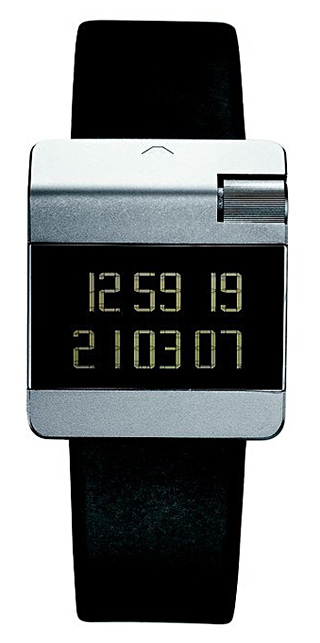
It was through Pierre Nobs, owner of the Zurich-based watch brand Ventura, that Wettstein's interest in watches was piqued in 1994. He had taken note of the brand's revolutionary model “watch,” which was created in 1989 by Danish designer Flemming Bo Hansen. Henceforth, Wettstein's designs shaped the character of Ventura. The V-matic models with mechanical movements were pioneers in using hardened titanium for their cases as early as 1996. One of Wettstein's main concerns with watch design was the link between case and strap or bracelet. The v-matic models are characterized by their conical shape, which hides the gap between the strap and case. For Ventura he continued what Flemming Bo Hansen had begun with his “watch” design: a contemporary interpretation of the digital timekeeper.
One of his last designs was created for Nomos shortly before his premature death by cancer in 2008: this watch was called Zürich in his honor and is a typical example of his talent in recognizing and interpreting a brand's identity. This watch remains faithful to his typical conical shape, but is immediately recognizable as a genuine Nomos product.