Why is it that when major construction expansion occurs, enterprises around the world rush to broadcast statistics? The number of square meters. The percentage increase in space. Years consumed with the project. And, of course, the cost. Certainly, to a degree numbers have their place, but that misses most of what is vital. What really matters is what the project enables, that is to say, what goes on inside the shimmering new building.
That is our story here. Breguet has just completed a major new addition to its workshops in L’Orient, Switzerland. L’Orient is located in the famed Vallée de Joux, the historical cradle of fine watchmaking. Beyond the tranquility that marks life here—dairy, cheese-making, and small ski lifts visually in evidence nearly everywhere—it is the ideal location for modern Breguet. Out of the question to imagine locating in the historical small workshop on Paris’ Quai de l’Horloge where the founder Abraham-Louis Breguet began his career in 1775. Indeed, it is here, in this tiny valley, nestled in the Jura mountains just minutes from the French border, that complicated watchmaking was born and flourished. Watchmaking sprang up in the Vallée de Joux as an answer to the region’s forbidding winter climate. Unable to farm or graze their cows during these months, many of the inhabitants turned to watchmaking, working by natural light in rooms built above their winter-sheltered cows. As their talents matured over the years, complicated watches became the regional specialty. Despite the fame and commercial prominence achieved by the large Geneva brands, beginning in the latter half of the 1800’s, for their omplicated timepieces, the Geneva houses were dependent upon the specialized skills of the watchmakers in the Vallée de Joux. The movements for those watches were built in these mountains, sent to Geneva where they were cased up and sold under the name of the Geneva marques. Thus, the savoir-faire and traditions for watchmaking run deep around this small lake with family trees of many of today’s watchmakers extending back 150 years. It is drawing from these families that Breguet has assembled the watchmaking talent to conceive and build its timepieces and, today, all of Breguet’s watchmaking is done in this valley.
Although a gleaming new wing of the workshops was just completed, expansion has been ongoing steadily since the commencement of Breguet’s new era which began with the acquisition in 1999 of the then Breguet group, which included the renowned movement manufactures Lemania and Valdar. As he installed himself as Breguet’s new President and CEO following the purchase, Nicolas G. Hayek had a vision for Breguet that was no less than a transformation and re-birth enabled by massive investment. Core to his plan was expansion and modernization of facilities. The first step was a mammoth addition to the pre-existing Lemania L’Orient workshop. This first expansion, inaugurated in 2002, brought with it not only a doubling of space, but new state of the art equipment. This was almost immediately followed in 2003 by the merging of Lemania into Breguet to create today’s Manufacture Breguet. Two further expansions followed, setting the stage for the latest new wing. Of course, Breguet’s pre-existing administration building, located 10 minutes away in a stunning location on the shore of the Lac de Joux in L’Abbaye, continues as the home for those functions.
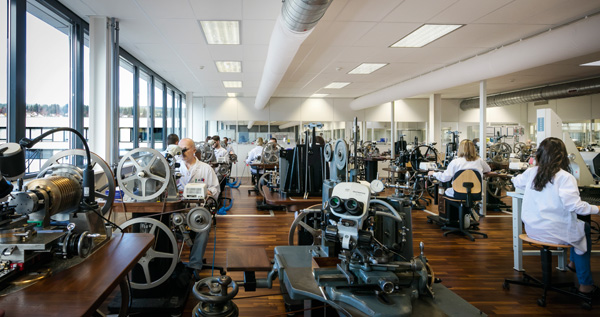
Prior to the recent inauguration of the new space—not- withstanding the full decade of construction that preceded it—navigating among the dispersed mini-workshops, it was many times difficult for those not deeply immersed in horology to grasp fully all the subtleties of Breguet’s methods. Watchmakers performing similar tasks were often working in widely separated rooms, some in the original Lemania facilities, others in newer space. This spread of work made it challenging to see clearly and follow the stages of fabrication, finishing, and assembly. With the luxury of vastly more space, groups are now united allowing one to comprehend more easily the fanatical attention to details which were not as readily seen before.
Case in point. Anglage. This is the fine polish work applied to the edges of a wide variety of components. Of course Breguet has been lovingly applying anglage to components all along. However, the scale with which this finishing was taking place and Breguet’s dedication to it could not be easily seen when it was spread over several different rooms. Now, thirty plus craftsmen are grouped in a single room practicing this traditional art. Not only is the number impressive, it is the methods. Modern watch houses have a selection of techniques from which to choose for the finishing of the edges of movement components. The first is to do nothing, leaving the part in whatever form it may possess after it has been cut to its shape. Second, is a highly industrialized approach where the edge finish is 100% machine-generated. Third, much more labor intensive, is hand polishing of the edges with an electric rotary tool called a touret, which is a tool fitted with a rotating tip that applies the finish. However, the method that is practiced in this room is hand-applied anglage, achieved using a file. A series of files actually. Grasping the components, in some cases with a tool specially adapted to the particular component being worked upon, Breguet’s craftsmen painstakingly round and polish each edge using a succession of ever finer files, followed by burnishing with wood. The benefits of this classic Breguet approach are dramatic and readily apparent to connoisseurs. Not only is the sheen unmatched, but only by using a file does it become possible to form sharp interior and exterior angles on an edge (to imagine interior and exterior angles, think of the letter “Z”; on the right side of the letter at the underside of the top there is a sharp interior angle; at the far left on the outside bottom, a sharp exterior angle).
Those with experienced eyes can spy at once whether a part has had its anglage finish achieved with traditional hand filing, followed by wood burnishing. Naturally, bringing those practiced eyes to examine a Breguet often reveals those telltale sharp angles, leaving no doubt about the fine file work and burnishing that is practiced at the manufacture. Knowing that in advance is impressive, but seeing for the first time so many artisans practicing the craft together in one room is awe inspiring. Breguet is secure in the knowledge that there is no other watch house that can boast having a similar room with 30 plus craftsmen engaged in hand-filed anglage as is now found in the new building wing.
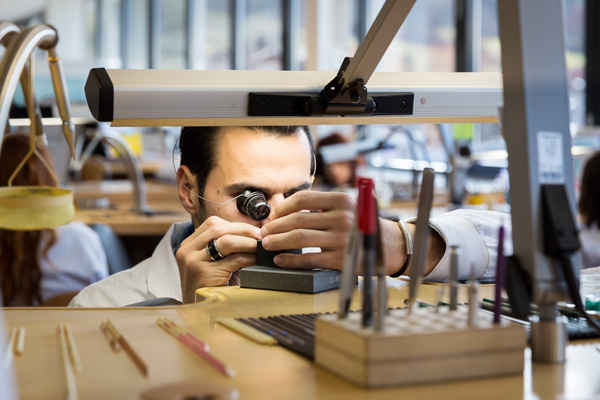
In like fashion, Breguet’s guillocheurs are now to be brought together. Keep in mind that fine guilloche work is one of the signatures of Breguet. This dates back to its founder, Abraham-Louis Breguet, who was the first to introduce guilloche carving to watch dials. Although a handful of other watch houses may boast of having one, perhaps two, persons equipped with such a machine, Breguet’s devotion to this art form runs far deeper with teams of skilled artisans working with traditional hand-turned rose engine machines crafting the multitude of motifs that decorate Breguet’s solid gold dials, gold winding rotors, and cases. For years there has been one main room dedicated to dials and housing the most senior of the guillocheurs, those who work upon the development of new patterns and the realization of the most difficult dial designs. Other guillocheurs were placed in different rooms, some working upon the gold dials, others guilloche patterns for winding rotors and cases. With new quarters, all of these craftsmen can be housed in a single room, united in their art form.
Touring of the movement assembly areas in the new building wing brings front and center some of Breguet’s techniques that have been practiced for years, but which were secreted away in less visible surroundings. Placed before each watchmaker is a unique collection of screw drivers. That, in and of itself, is far from unusual as it would be expected that every watchmaker would assemble a collection of this vital tool on the workbench. What is not ordinary, however, is the type of screwdrivers drivers that Breguet furnishes to its watchmakers. For each screw in the movement, Breguet’s movement designers have precisely specified the torque to be applied for tightening. Classically, watchmakers tighten screws by feel. In that there is a degree of error or imprecision that inevitably occurs. For a higher order of exactitude, Breguet has developed a system of special screwdrivers that are calibrated to the specific torques called for by the movement designers. The collection of different screwdrivers reflects the diversity of torques for different screw used in the movement. Not only is each of these special screwdrivers drivers orders of magnitude more costly than the traditional types, there is the addition- al expense of calibrating each screw driver on a dyno meter to validate that the torque is correct.
Other special tools are also seen the main movement assembly area. Oiling critical parts of movements is practiced industry wide and surveying watchmaker benches in Switzerland one usually sees an oiling diagram which is used to identify where the oil drops are to be placed. Customarily, watchmakers simply dab drops where the diagram instructs. The difficulty with this standard approach is that, as with the tightening of screws by feel, there is variability in the amount of oil that is dosed. Too much oil and it migrates to places in the movement where it does not belong; too little and service may be required sooner than expected. Eliminating these risks called for Breguet to develop an oil dosing machine. Each oiling location on a movement now receives the precisely measured quantity of oil that it requires.
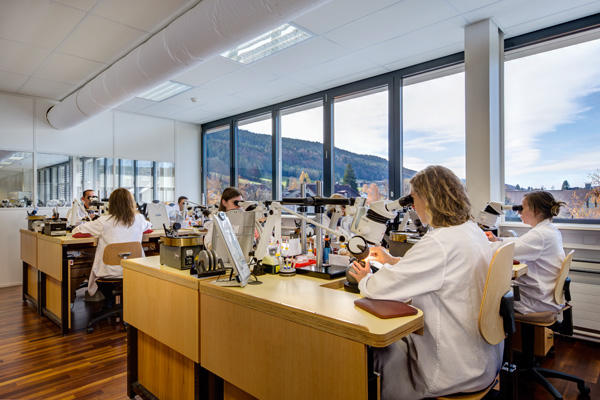
Quality control testing is now grouped on the same floor as movement assembly. Thus, just around the corner from one of the main movement assembly areas is the machine that is used to validate the penetration of the palette jewels on the escape wheel. All Breguet movements are subjected to this test. The tolerances are infinitesimal, measured in microns. Many other tests are performed as well in this sector such that each movement will spend 6-10 weeks here for its quality control.
For watch aficionados, it is the new aggregation of watchmakers crafting complications that excites the most. The new space allowed Breguet not only to bring complicated watchmaking activities together onto the same floor, but to group the horlogers into sections according to the particular complication. Breguet uses the term “cellule ” (“small workgroup”) to describe the clusterings. Thus, there is a workgroup for the Musicale watch, another for minute repeaters, another for tourbillons, and so forth for the other complications. Not only does this cellule organization greatly facilitate training, it helps maintain the feeling among the watchmakers that they are working as an artisanal team in a small intimate workshop. As well this atmosphere promotes exchanges and ideas among the members of each watchmaking team on ways to improve the assembly of the timepieces.
There is one unique facility associated with the minute repeater area. Immediately adjacent to the watchmaker workbenches is the antiecohique chamber. Every minute repeater undergoes testing in this specially conceived quiet room. When the watch is placed within the room and the door closed all extraneous noises are eliminated. Perfect measurement of the repeater’s sound can thereupon be made. Since minute repeater sound should not be evaluated with the watch placed right next to one’s ear (is that really how an owner wants to enjoy the sound?) but rather from a distance, Breguet’s testing for sound is done from a distance of 20 cm.
What emerges from a survey of these new quarters is not the implementation of new methods, for these Breguet practices have been steadily evolving over time and have previously been in place. Instead, it is groupings that vividly showcase these techniques and underscore the intense dedication to quality that is a hallmark of modern Breguet.