WORLDTEMPUS - 6 August 2012
Bhanu Chopra
“Desh Ki Dhadkan” was the tagline for HMT hand-wound mechanical watches, which translates into “Pulse of a Nation” from Hindi, one of India's 22 official languages. HMT's goal was to make affordable mechanical watches, thereby providing each Indian citizen with an opportunity to own a watch. The prices of these hand-wound timepieces ranged from $7 to $18 U.S. dollars.
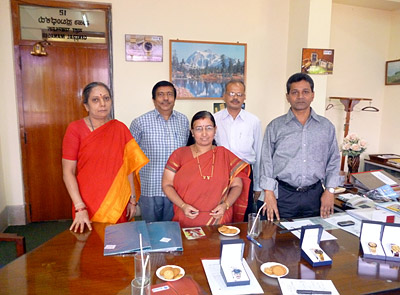
I recently visited the original factory in Bangalore and spoke at length with General Technical Manager V.A. Kulkarni, about the past, present, and future of HMT watches.

Machine tools, tractors, and watches
Hindustan Machine Tools (HMT) was founded in the 1950s as a government-owned subsidiary and expanded into manufacturing tractors, printing machinery, metal-forming presses, die-casting and plastic-processing machinery, CNC systems, bearings – and watches.
The first watch factory was erected in 1961 in Bangalore, now an information technology hub, in technical cooperation with Japan's Citizen Watch Company. At its peak, HMT manufactured watches in three factories and had a specialized watch case division in Bangalore.
Cooperation with Citizen Watch Company
In July of 1961, one hundred employees of HMT Watches went to the Citizen factory in Tokyo and learned every aspect of manufacturing watches for one year. Upon their return, employees of Citizen Watch Company spent a year in India assisting with the setup of manufacturing. Production of watches began in 1962, with first batch released by then Prime Minister Nehru.

HMT began manufacturing mechanical movements under license from Citizen. Some of the most popular models like Janata, Sona, and Pilot are powered by hand-wound Caliber HMT 020. The HMT 020 movement is based on the ébauche of Citizen's 0201 caliber. The movement itself is a bit crude, but it is a workhorse that keeps on ticking: Caliber 020 contains 17 jewels and boasts a glucydur balance with Citizen Parashock protection.
From market leader to staying afloat
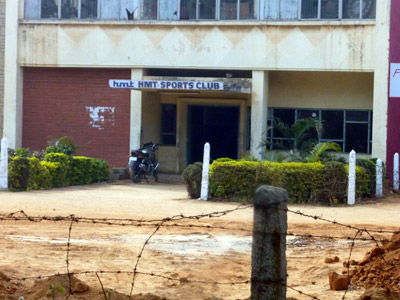
HMT has produced over 110 million watches since the 1960s; it expanded its production facilities with two additional factories, one in Tumkur, near Bangalore, and another in Ranibagh in Northern India. During that time HMT employed 3,000 women in its factories and all components were made under a single roof. Being a government subsidiary, HMT provided housing, built schools, and even had a movie theater and a health club for its employees. During my visit, I observed a deserted self-contained city around the Bangalore factory.
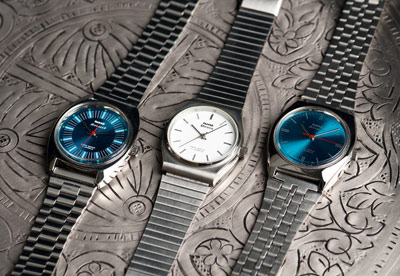
HMT dominated the Indian market until the late 1990s with inexpensive mechanical watches. Popular men's models were hand-wound watches with variants including white, yellow, blue, brown, red, and black dials.
One of the most popular ladies' models was powered by a Citizen movement beating at 36,000 vph. HMT also made custom dials and watches. The single largest order was for 86,000 custom watches for BHEL (Bharat Heavy Electricals Ltd.). Finally, HMT manufactured large, specialized clocks for public display commissioned by both government and private entities.
Then came an onslaught of quartz watches from Titan, a subsidiary of Tata Corporation. HMT could look back at more than 70 percent market share in the previous two decades, which dwindled as Titan and Timex introduced trendy quartz watches. Titan currently has 60 percent share of the Indian watch market. Titan acquired the Swiss brand Favre-Leuba in 2011 to expand into international markets.
Keeping mechanical tradition alive
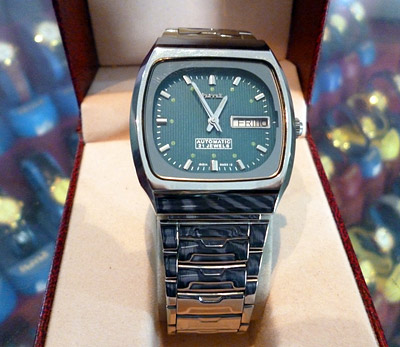
Even with the erosion of market share, HMT is still producing more mechanical than quartz watches, currently at a 3:1 ratio. HMT stopped production of hand-wound HMT Caliber 020 about eight years ago. The factories now mostly assemble automatic watches with Citizen Miyota 8205 and 6500 movements. In order to compete in current markets, HMT has adapted a larger case size on its most popular models.
While HMT is still keeping the prices of these mechanical watches comparatively low, Kulkarni hopes to move toward high-end watches in the Indian market with fresh designs, complications, and of course, mechanical movements.