


A royal wrist
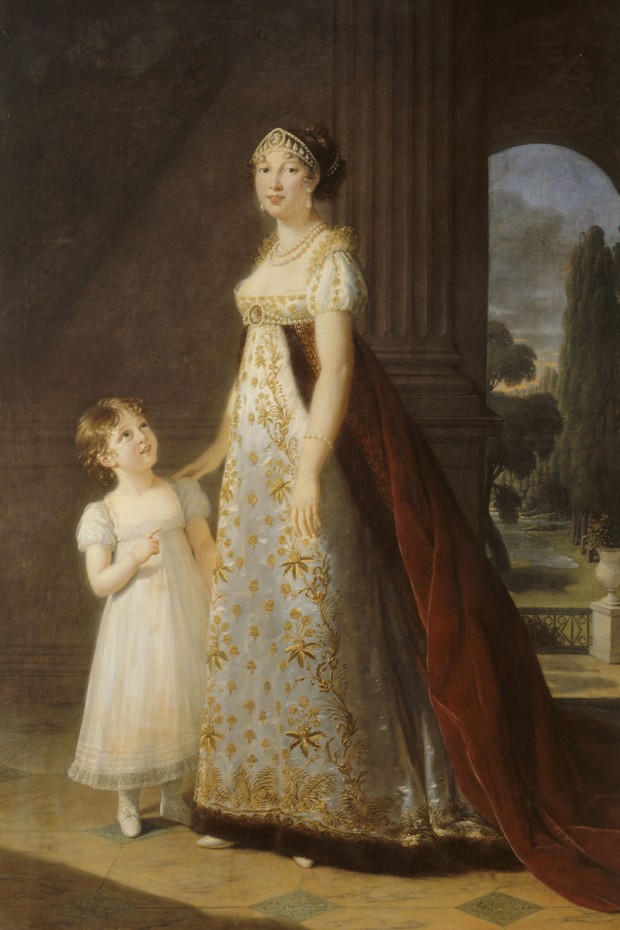
Barely a decade into the 19th century, Abraham-Louis Breguet received an unusual – and industry-defining – commission. In 1810, Caroline Murat, Queen of Naples and younger sister of Napoleon Bonaparte, tasked Breguet with creating something that challenged watchmaking’s conventions. The result, completed and delivered in December 1812, was a thin, oblong-shaped repeating watch designed specifically to be worn on the wrist. And now, more than two centuries later, this remarkable commission remains the inspiration for one of Breguet's most stylish and evocative collections.
Murat was no casual patron. Between 1808 and 1814, she acquired 34 clocks and watches from the Maison, establishing a relationship that encouraged Breguet to explore new forms and functions. Her wristwatch, recorded in the Manufacture's archives as number 2639, combined technical sophistication with an unconventional mode of wearing time. It was equipped with a repeating mechanism, a thermometer and a wristlet woven from hair and gold thread. At a time when pocket watches dominated, the concept was genuinely pioneering.
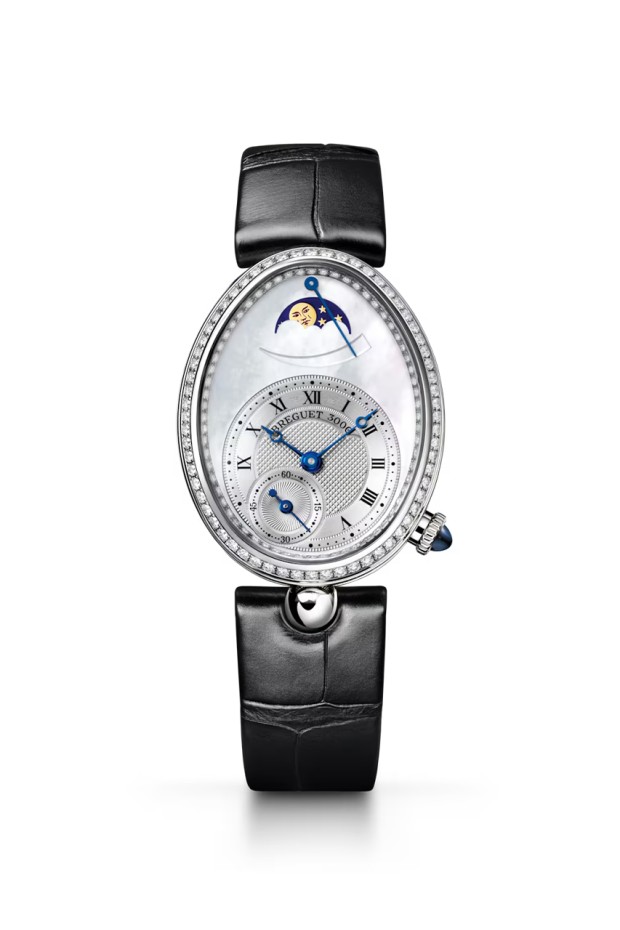
The original watch has since been lost to the very time it was intended to measure, but its story survives in the meticulous records preserved by Breguet. These provide the foundation for the contemporary Reine de Naples, a collection launched in 2002 that reinterprets the historical commission through an elongated case, an off-centred dial and a distinctive blend of horology and jewellery.
As Breguet celebrates its 250th anniversary, the collection offers a particularly touching insight into the Manufacture’s heritage – all at once intimate in its nature, while groundbreaking in its ripple effect on watchmaking trends at large. Its latest additions, References 9935 and 8925, interpret the Reine de Naples silhouette in Breguet gold – a first for this instantly-recognisable silhouette. One explores the poetic possibilities of a moon phase display, while the other embraces a more pared-back time-only approach. Together, they reaffirm a legacy that began with an aristocrat’s challenging request and continues to shape the way a watch can be conceived, crafted and worn – all while remaining fit for a queen.
A historic commission
Caroline Murat was one of Breguet's most important early patrons, acquiring 34 clocks and watches from the Maison between 1808 and 1814. Her wristwatch, recorded in the archives as number 2639, was an unusually elaborate creation: a repeating mechanism chimed the hours, while a thermometer added a practical complication. Even its bracelet, woven from hair and gold thread, distinguished it from conventional timepieces. Although the original watch has disappeared, the Manufacture's detailed records preserve evidence of a commission that challenged established ideas about how a watch should be worn. Its significance lies not only in its royal provenance, but in the idea, it introduced: timekeeping designed around the wearer.
An archive brought to life
When Breguet introduced the Reine de Naples collection in 2002, it translated its archival research into a distinctly contemporary design. The elongated, egg-shaped case established an unmistakable identity, while the off-centred dial and refined decorative details set the collection apart. Subsequent interpretations introduced a variety of complications, materials and dial treatments, demonstrating the versatility of the original concept. From moon phases to striking mechanisms, the collection has continued to explore the relationship between technical ingenuity and jewellery design, establishing a recognisable aesthetic that can accommodate considerable variation without losing its identity. Its enduring appeal lies in this balance between continuity and reinvention: a delicate design rooted in the early nineteenth century, yet open to the possibilities of modern watchmaking.
The Reine de Naples 9935

A celestial display
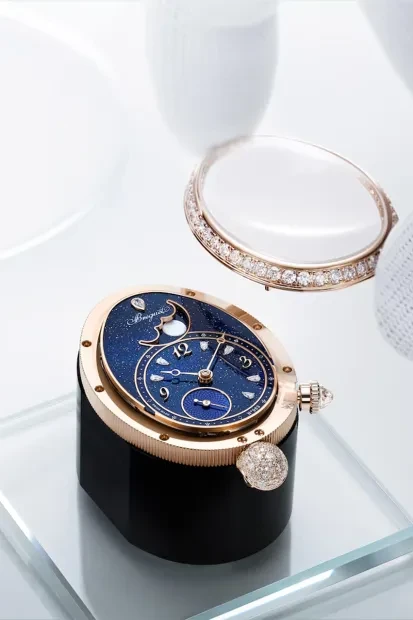
The 9935 reimagines the collection's moon-phase complication, introducing a larger display and removing the power-reserve indicator to create a more streamlined arrangement. Hours and minutes, small seconds and the lunar indication take centre stage. Six pear-shaped diamonds sit between the applied Breguet Arabic numerals, bringing a new dimension to the dial's composition.
A dial with depth
The blue aventurine glass dial is layered over Tahitian mother-of-pearl, whose iridescence creates subtle changes in colour as the light shifts. The moon itself is crafted from white mother-of-pearl and set against a blue aventurine disc. The result evokes a night sky, with the natural variation of the materials ensuring that each dial has its own character.
Gold, reimagined
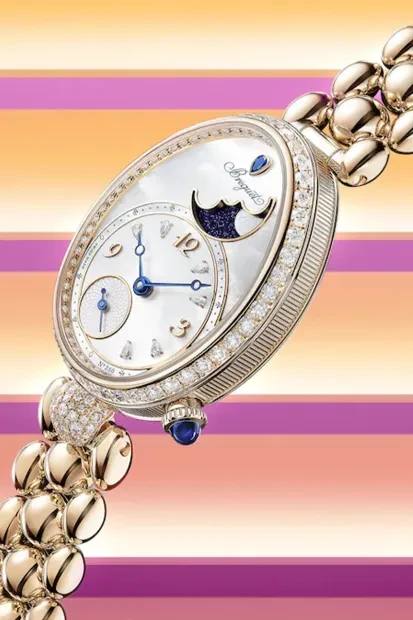
The 9935 is among the first Reine de Naples watches to feature Breguet gold, the Manufacture's proprietary gold alloy. The central lug at six o'clock is set with diamonds, while an integrated, invisible clasp preserves the fluidity of the design.
The Reine de Naples 8925
The beauty of simplicity
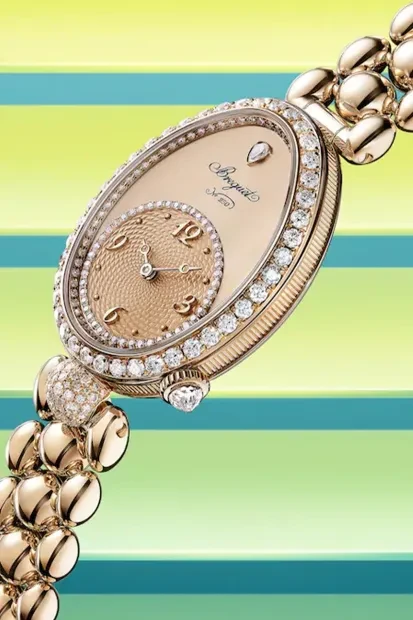
Where the 9935 explores the poetry of the moon phase, the 8925 focuses on the essentials: hours and minutes. Its pared-back display reflects Abraham-Louis Breguet's emphasis on clarity and legibility, while the collection's characteristic proportions lend it a recognisable identity. A pear-shaped diamond above the signature provides a discreet point of brilliance.
Three expressions of gold
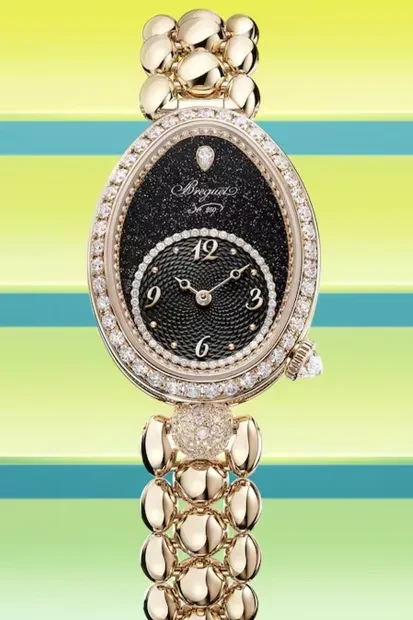
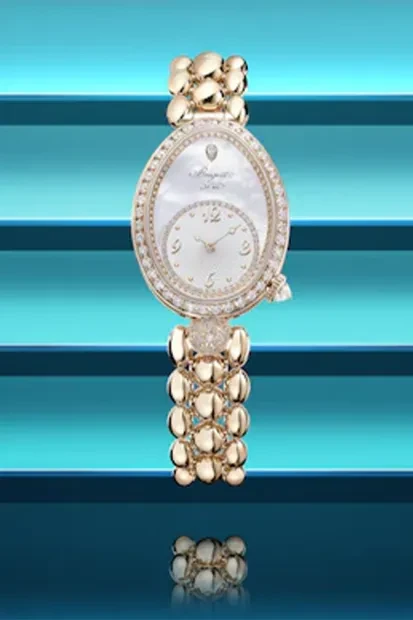
The 8925 is offered in three distinct dials. Extra-white mother-of-pearl provides a luminous backdrop for gold Arabic numerals, while another version pairs a sunburst-brushed background with a finely guillochéd hour and minute subdial. A third introduces black lacquer and shimmering black aventurine for a more dramatic effect.
A seamless silhouette
The 8925 is paired exclusively with a Breguet gold bracelet, whose articulated links follow the curves of the case. The bezel is set with 41 diamonds, while snow-setting on the central lug adds further sparkle. More than an ornamental detail, the bracelet forms an integral part of the watch's design, bringing together comfort, fluidity and the visual language of fine jewellery.
A legacy in motion – and emotion
The Reine de Naples began with a commission that challenged the conventions of early nineteenth-century watchmaking, while today, its distinctive form remains central to Breguet's identity, offering an evergreen canvas for both technical experimentation and decorative artistry. Its revival in 2002 transformed a historical milestone into a contemporary collection that continues to evolve through new materials, complications and interpretations of form.
With References 9935 and 8925, Breguet puts forward two anniversary creations that demonstrate how a pioneering idea can retain its relevance across centuries. After all, the most enduring designs are those that leave room for reinvention – and this regal collection seems to have many more tricks up her sleeve.

FAQ
What is the Breguet Reine de Naples collection, and where does its name come from?
Launched in 2002, the Reine de Naples collection reinterprets a pioneering wristwatch Breguet made in 1812 for Caroline Murat, Queen of Naples, through an elongated case and off-centred dial.
Who was Caroline Murat, and what was her connection to Breguet?
Caroline Murat, Queen of Naples and Napoleon Bonaparte’s younger sister, commissioned Breguet in 1810 to create one of history’s first wristwatches, delivered in 1812 and recorded in the archives as number 2639.
What is the Breguet Reine de Naples 9935?
The 9935 is a new Reine de Naples model marking Breguet’s 250th anniversary, featuring a larger moon-phase display, six pear-shaped diamonds, and a blue aventurine dial over Tahitian mother-of-pearl, crafted in Breguet gold.
What is the Breguet Reine de Naples 8925?
The 8925 is a pared-back, time-only Reine de Naples model offered in three dial finishes, paired exclusively with an integrated Breguet gold bracelet set with 41 diamonds on the bezel.


