L’Epée 1839 draws inspiration from worlds as diverse as contemporary design, and various art forms. Today our manufacture unveils a new series of unique creations, highlighting its craftsmanship and daring creativity. Iconic pieces from its Creative Art line are reimagined through an artistic lens, each transformed into a one-of-a-kind work of art. Every Unique piece showcases either the manufacture’s full in-house expertise or its collaborations with talented artists. The result is a collection of kinetic sculptures that transcend artistic boundaries, blending craft and creativity into singular masterpieces — each with its own distinct personality, and feel, celebrating artistry and individuality.
Behind every creation is a team of designers, engineers, mechanics, and master watchmakers whose passion drive the manufacture forward. From development to the final assembly, each clock passes through the hands of these artisans, who combine centuries-old know-how with bold innovation. Their expertise ensures that every detail — from the beating heart of the movement to the gleaming surface finish — reflects the soul of true craftsmanship.
The manufacture has been a place of creative partnerships, embracing collaborations and exploring new territories, where in-house expertise and external artistry come together to enrich each creative piece. Driven by this spirit of co-creation and innovation, L’Epée 1839 continues to push the boundaries of horology, offering collectors pieces that are timeless, daring, and fused with artistic expression.
Renowned for its technical mastery, extra-long power reserves, impeccable finishing, playfulness and unexpected touches of humor, L’Epée 1839 has earned a reputation for turning clocks into extraordinary kinetic mechanical sculptures.
For more than 185 years, L’Epée 1839 has cultivated the art of high-end mechanical clockmaking. Today, it remains the only Swiss manufacture fully dedicated to mechanical clocks, preserving traditional savoir-faire while embracing innovation under one roof.
Creative project One: Flying Tourbillon by L’Epée 1839 x Vincent Calabrese
In a bold celebration of horology’s most revered complication, The tourbillon, L’Epée 1839 unveils two special unique pieces—transcendent masterpieces born from the visionary collaboration with master watchmaker Vincent Calabrese and talented artists.
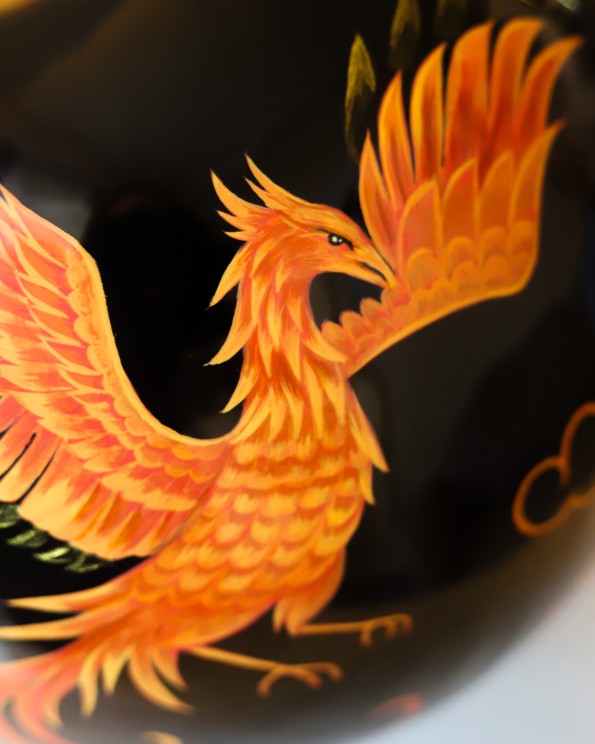
The Creative piece is presented in two hand-painted housings: Phoenix Eternis Ignis by artist Morena Fetoshi and The Icon – Beaux Arts by artist Séverine Bugna. These exceptional creations unite technical mastery with artistic expression, embodying the daring spirit of the manufacture.
Resident artists: Morena Fetoshi
Inspired by the mythical phoenix—an emblem of rebirth and eternal renewal—The Phoenix Eternis Ignis reflects the cyclical dance of time itself. Like the legendary bird rising anew from its ashes, this timepiece embodies eternal beauty, harmony and time's regenerative nature.
The phrase “eternal fire” captures the myth’s essence: a continuous cycle of death and rebirth, perfectly echoing the ongoing movement of the timepiece’s mechanism. More than a clock, The Phoenix Eternis Ignis is a poetic fusion of myth and mechanical—where legend and craftsmanship ignite in a celebration of eternal time.
On a deep black background, the Phoenix emerges in vibrant shades of orange, hand-painted in fine detail as it ascends in a blaze of light. A universal symbol of rebirth and resilience, the phoenix evokes the endless cycle of time—an allegory of renewal, energy, and transformation captured within the heart of the tourbillon.
About Artist Morena Fetoshi
From an early age, Morena Fetoshi found in drawing an escape from everyday life — a world where imagination and creativity could take flight. What began as a childhood passion became a lifelong pursuit, leading her to specialize in watercolor and acrylic painting. Her work often focuses on animated sketches and expressive portraits, capturing both the vitality of movement and the depth of human emotion. Through her art, Morena continues to transform personal expression into vivid, timeless creations.
Unique piece 2: The Icon – Beaux Arts
Resident artist : Séverine Bugna
A celebration of life with bold vibrant colors and voluptuous forms
Round shapes sing the joy of movement, Every curve is a smile, and every pattern a heartbeat. Lines dance, contours vibrate, art becomes a celebration, a joyful tribute to life in all its explosive softness.
The Icon - Beaux Arts celebrates form and color through fluid, hand-painted shapes that echo the roundness of the clock itself. Its harmonious composition transforms the housing into a living canvas, where curves and hues dance in perfect balance. A joyful expression of creativity, it reflects the fusion of fine art and horological mastery.
About Séverine Bugna
From an early age, Séverine Bugna has lived and breathed art. After earning numerous prizes and awards, like the Drouot cotation in 2012, she transformed her passion into a vocation, presenting her work at prestigious venues such as the Grand Palais for the Salon des Artistes Français in 2010. Guided by the belief that art is a wellspring of joy, she also lends her talent to charitable causes. Her creativity extends beyond canvas to objects themselves, where she reimagines everyday forms as works of art—an approach that made her the perfect partner to hand-paint this extraordinary creation.
About the movement
At the heart of the clock lies a flying double tourbillon, mounted directly on the minute hand. The entire movement rotates around a central axis, while the escapement itself makes a full 60-second revolution. By cancelling the effects of gravity, the tourbillon stands as a pure tribute to Abraham-Louis Breguet’s original invention. With a 40-day power reserve, the result is a mechanical sculpture where time literally takes flight.
The dial features a contemporary guilloché pattern, all-black plating, and turbine-inspired curves that reveal the architecture of the movement. Three layered main plates — shaped in waves — create a sense of infinite depth, while sun-satin numerals accentuate the vortex-like motion of the dial. The flying tourbillon, designed to turn counterclockwise against the natural clockwise motion of the dial, enhances both visibility and fascination. It is a technical feat and a visual spectacle — a poetic encounter between gravity, time, and mechanical mastery.
Creative project Two : L’Epée 1839 Time Fast Collection x The Dial Artist
Resident artist : Chris Alexander (Aka The Dial Artist)
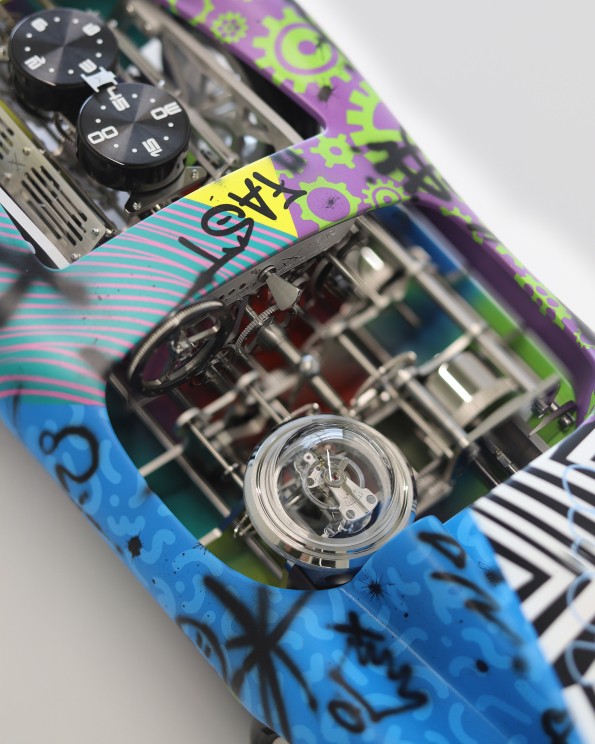
Following our very first collaboration on the Grenade timepiece, celebrating street Art, Art Bombing and Graffiti, L’Epée 1839 and Chris Alexander (aka The Dial Artist), join forces again on a collection of special hand-painted car-inspired Timepieces.
This collaboration consists of a series of one-of-a-kind creations, uniting the design and in-house movement of L’Epée 1839’s Time Fast collection with the expressive paintwork of The Dial Artist. Guided by his strokes and colors, each kinetic sculpture emerges with its own distinct character — a celebration of individuality and authenticity.
Time Fast D8 Raced, Time Fast II « Urban Racer » and Time Fast D8 by TDA take the opportunity to visualize the artistic meaning of the ‘Art-Bomb’ – a form of art that challenges the norm and public perception. Additionally, the graffiti culture refers to ‘bombing’ as a process of painting walls or objects with tags and throw-ups.
The Time Fast collection
Inspired by the golden age of racing, the Time Fast collection reimagines the legendary Formula 1 cars of the 1930s to 1960s as kinetic works of art, blending authentic design with horological mastery. Built on an aluminum H-chassis like the racing cars of the era, each model integrates an in-house movement designed to follow the aerodynamic curves of the bodywork. Authentic details abound: a three-spoke steering wheel to set the time, finely crafted spoked stainless-steel wheels, the escapement placed beneath the driver’s helmet, and soft rubber tires filled with foam to replicate the feel of real racers. The Time Fast cars come alive when the rear wheels are pushed back, echoing the nostalgic joy of childhood pull-back toy cars.
The Time Fast D8, the very first model of the collection, quickly became a best seller and an icon of the brand. Admired for its sleek, timeless lines and understated elegance, it embodies the spirit of vintage racing in a pure, sculptural form — with the time displayed like a racing number.
Building on this success, Time Fast II pushes the concept further with greater technical depth and playful mechanics. Equipped with two independent movements — one for timekeeping and another for a miniature V8 engine animation — it offers an even more immersive experience. A functional gear stick lets the owner switch between modes, while turning the dashboard key sets the pistons in motion in a captivating mechanical display.
Time Fast D8 Raced – “Race weathered”
The inspiration struck during a holiday—often the perfect moment to reflect and reimagine. In a casual yet creatively charged phone call with the L’Epée 1839 team, the idea took shape, rooted in shared memories of miniature modelling and painting. Chris, with his background in luxury miniature car modeling, had developed a unique set of techniques and processes over the years. As the conversation turned to the beauty of time’s impact on objects, the concept emerged naturally: to craft a 'raced' patina effect on one of our iconic racecar timepieces.
“Doing a Raced patina effect would look epic! - Imagine a Time Fast that looks like it’s lived a thousand laps—weathered by speed, marked by history,” Chris proposed. The vision was clear: to reinterpret the Time Fast D8 with the visual poetry of a machine shaped by performance and endurance, offering a bold, new perspective on a contemporary classic.
Time Fast D8 by The Dial Artist – “Graffiti Art Bombing”
Time Fast II by the Dial Artist – “Urban Racer”
Chris Alexander and L’Epée 1839 delve into the fusion of street art and automotive customization, transforming vehicles into moving canvases through the bold language of graffiti—once confined to walls, trains, and urban landscapes. This striking form of expression speaks to both artistry and rebellion, echoing themes of identity, freedom, and cultural narrative.
Here the Dial Artist used our two iconic racecar models, Time Fast D8 and Time Fast II into a new platform of expression.
Just like Ken Block's drift cars often having wild custom paint jobs influenced by graffiti, Art cars at Burning Man— Graffiti Art cars sit at the crossroads of cultures and art movements.
L’Epée 1839 and Chris Alexander sought to authentically engage with the essence of street culture—a powerful intersection of fashion, music, dance, language, and lifestyle, deeply embedded in creativity, self-expression, and cultural identity.
About artist Chris Alexander
Chris Alexander, known as The Dial Artist, is a British artist based in Scotland. Drawing inspiration from his childhood in South Africa, as well as Street Art, Pop Culture, Astrology, and Abstract Expressionism, he uses his platform to merge creativity with his love for horology.
A graduate of Gray’s School of Art with a Master’s in Design, Chris founded The Dial Artist in 2017 after more than 20 years in the creative industries. Through years of experimentation with paints, lacquers, and techniques, he developed his distinctive style — abstract dials bursting with color that blur the lines between contemporary art and horology.
Today, his works are celebrated worldwide, transforming each dial into a moving canvas. Chris sees every piece as a collaboration between client, artist, and watch, resulting in unique creations that reflect both personal passions and his unmistakable artistic identity.
Creative project Three: The Diamond Requiem by Kostas Metaxas
Resident designer : Kostas Metaxas
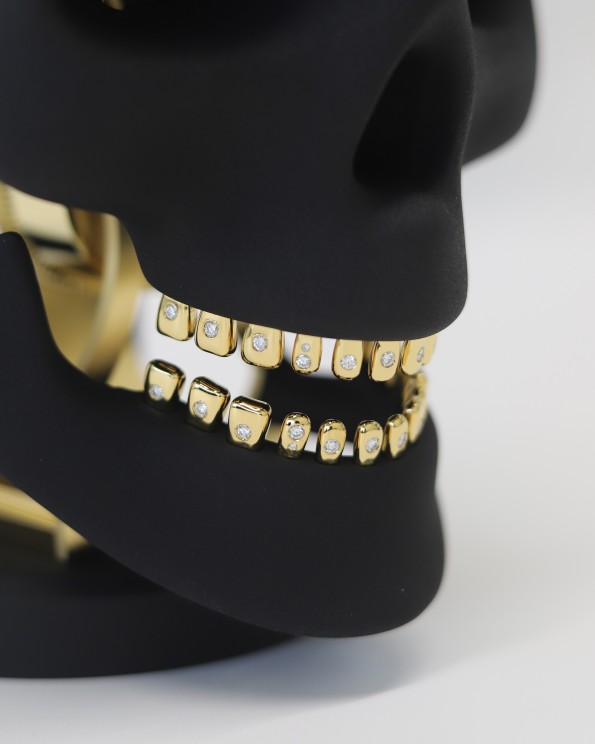
Requiem is no ordinary table clock — it is a bold horological sculpture designed in partnership with Kostas Metaxas. L’Epée 1839 unveils a dazzling new edition of Requiem, distinguished by its teeth set with brilliant-cut diamonds. This bold detail transforms the skull into an audacious jewel-clock. More than an ornament, the diamond-set teeth magnify the symbolism of Memento Mori — a reminder of life’s fragility and the fleeting nature of time, expressed here through eternal stones. With this extraordinary edition, L’Epée 1839 pushes the boundaries of mechanical art once again, blending technical mastery with a audacious artistic statement.
Shaped like a human skull, it transforms the age-old artistic theme of Memento Mori into a striking fusion of art and mechanics. Memento Mori, “Remember that you are going to die,” is both a reminder of humility and a confrontation with time itself.
At the heart of the skull lies the new in-house, an 8-day movement that serves as the “brain,” encapsulated yet master of its destiny. Time is revealed in the most haunting way: hours and minutes displayed on transparent discs embedded in the eye sockets. To read the time, one must face the skull directly — to stare into its eyes and confront mortality.
Every detail reinforces the symbolism. The protective skull allows only fleeting reflections of light to escape through its openings. Two crossed swords — emblem of L’Epée 1839 — pierce the temples, revealing glimpses of the oscillating escapement, like a portal into another temporal dimension.
Both graphic and technical, Requiem is a kinetic reminder of the intimate bond between life and time — a work of mechanical art that dares you to look death in the eye to discover… the hour.
About Kostas Metaxas :
“The clock is a fascinating object because you can play with what you hide and what you unveil.”
Kostas Metaxas is a magazine editor, film producer, and art-technology enthusiast whose eclectic path has shaped a bold, unconventional design vision. An Australian of Greek heritage, he draws inspiration from his travels and his passion for music, channeling them into creations that merge art, design, and innovation.
Self-taught and experimental, Metaxas explores new materials and collaborates with L’Epée 1839’s R&D team to push the limits of contemporary horology. For him, the sobriety of form mirrors the fascination of watch complications—an allegory of life’s fleeting and intricate nature.
With Requiem, his sculpted skull encapsulates the fragile balance between time and happiness, birth and death. Light striking the movement reveals fleeting glints of gold and silver within its shadows—a powerful reminder to carpe diem.
Creative project IV: L’Epée 1839 TF35 “Rust in Time” edition
Resident artist: Jeremy Brun
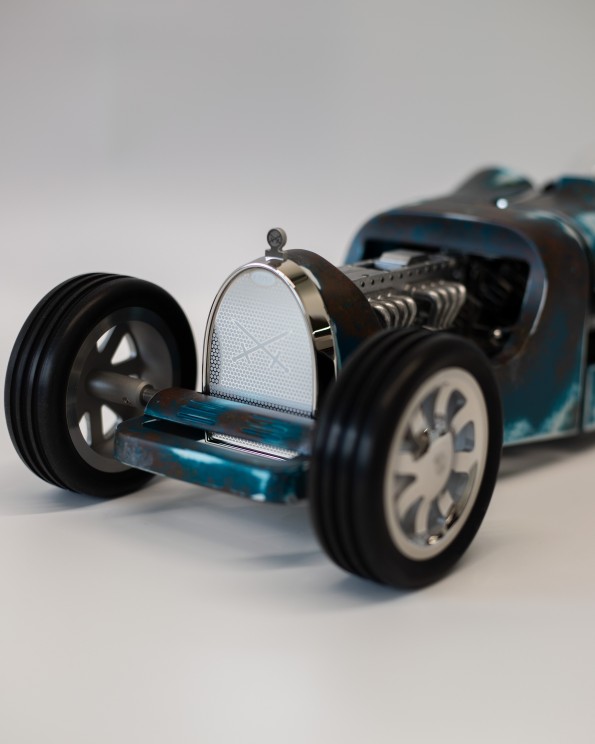
In a bold and visionary collaboration, artist and in-house artisan Jeremy Brun reimagined the bodywork of the TF35 racing car, infusing it with an exquisite aged patina through masterful airbrush artistry. This exceptional project extends L’Epée 1839’s celebrated savoir-faire beyond the field of horology, translating the brand’s meticulous craftsmanship into an extraordinary and unexpected canvas—celebrating innovation, artistry, and timeless beauty in captivating new dimensions.
About TF35
Inspired by the legendary race cars of the 1920s and 1930s, the TF35 pays tribute to an icon of speed and engineering excellence. More than a kinetic sculpture, it is the ultimate gentleman’s accessory: a clock that discreetly displays the hours and minutes on its chassis while concealing a cigar torch within its V8-inspired engine, revealed by activating the handbrake.
Every detail recalls the golden age of racing—from the three-spoke steering wheel with its 12 rivets, used to set the time, to the cockpit beneath a glass dome showcasing the escapement. Powered by an in-house 8-day movement, the TF35 merges horological precision with the curves of its aluminum bodywork. Like the toy cars of our childhood, it is wound by turning the rear wheels—a playful nod to nostalgia and innovation in equal measure.
About artist Jeremy Brun
Jeremy has always been driven by a passion for automobiles and art, which he transformed into a career. Trained in decoration and painting, he spent over a decade working independently in the automotive industry, specializing in bespoke car designs and racing helmets, where he mastered the art of airbrush and custom decoration. He later brought his talent to horology, applying his expertise to the intricate painting of watch dials. Today, as part of the painting and decoration department at L’Epée 1839, Jeremy’s precision and creativity enrich every project, making him a valued artistic partner within the manufacture.
Creative project V : The Fluorescent editions : Regatta and Time Fast II
Resident artist Floriano Castaldi
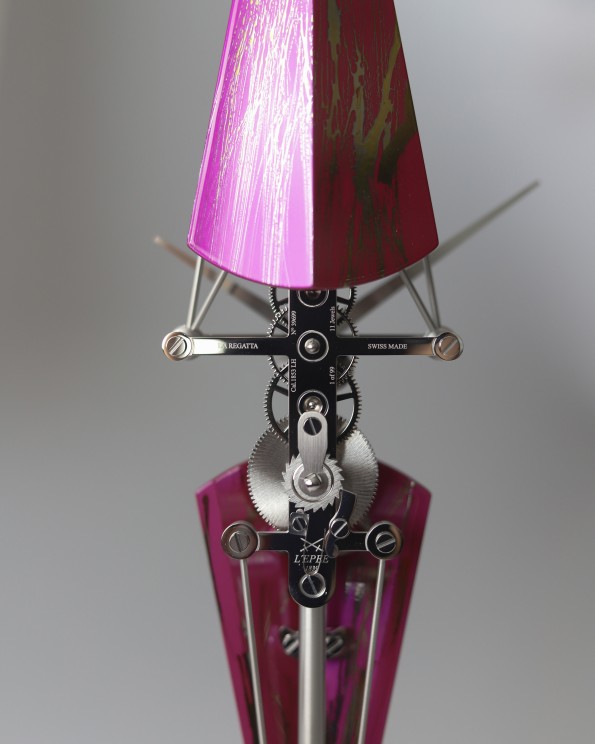
Using a unique painting technique, L’Epée 1839 partnered with skilled automotive painter Floriano Castaldi, to create a striking finish that blends the brilliance of chrome with vibrant colors. The result is a unique surface treatment that reflects both technical mastery and artistic daring, transforming the timepiece into a true work of kinetic art.
About artist Floriano Castaldi
Artist Floriano Castaldi unveils his chrome technique, a new pictorial approach exploring metallic reflections and the illusion of material. Working across various mediums, he plays with light, depth, and texture to create works with a striking chrome-like appearance. This series questions our relationship with image, surface, and perception, at the crossroads of contemporary art and technical experimentation.
Creative project VI : The Time Flies “Messenger”
Resident Artists : Jeremy Brun – painter Juliette Lefèvre – designer
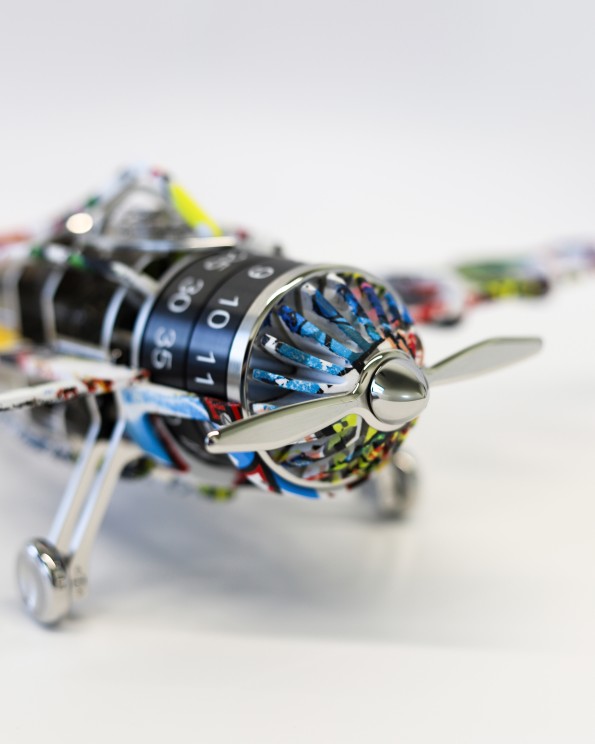
For this exceptional edition, Time Flies is reimagined through the refined artistry of Jeremy Brun, cloaked in a striking, patchwork-inspired palette. Inspired by the fragmented silhouettes of vintage postal cards, each hue is carefully composed—cut and reassembled with painterly precision—across the contours of this kinetic time sculpture. It is a vibrant homage to the golden era of correspondence and exploration, when handwritten letters crossed borders and oceans, forging connections and sparking imagination.
The warm, nostalgic tones evoke a sense of movement, travel, and timeless curiosity, echoing the pioneering spirit of aviation and adventure that defines Time Flies. More than a timepiece, this singular creation becomes a poetic emissary of time—where mechanical excellence meets artistic expression, and every glance invites reverie, recalling voyages past and awakening dreams of journeys yet to come.
About Time Flies :
Time Flies pays tribute to the conquest of the skies and one of the most brilliant inventions ever made: the airplane. Aviation made its mark on the last century, motivating adventurers to go ever higher and ever further, and it changed traveling forever. The plane captured the collective imagination, and there have been many stories of heroic aircraft journeys. Who never had a childhood dream of adventure as a pilot.
Some things fire up imagination and fantasy more than others. Some adventures only the elite, can enjoy, but the boundless expanse of the imaginary world is accessible to everyone. TIME FLIES is an 8-day clock in the form of a stylized 1930s plane, offering just enough structure to provide form, and just enough empty space to inspire our imaginations.
Hours and minutes are displayed on large diameter stainless steel disks with black PVD coating on a circular-brushed satin finish and stamped numerals. A quick glance is enough to read the time thanks to the excellent legibility of its display, but the spectacular, skeletonized movement is worthy of deeper contemplation. The movement, built specifically for this TIME FLIES, allows the escapement, which regulates precision, to be displayed in the cockpit. Accuracy is in the pilot’s seat!
The architecture of the 8-day movement, developed in-house by L’Epée 1839, follows the form of a real airplane. As in a plane, power comes from the front where the engine is located, and is generated by a fully openworked crown reminiscent of engine cooling radiators just behind the propeller. When fully wound Time Flies can soar for a full eight days before “refueling.”
An airplane’s control and instrumentation systems are located within the cockpit; and the same is true for Time Flies, which has a horizontal precision regulator in its cockpit, just above the wings. The constantly oscillating balance-wheel of the regulator draws the eye, and is protected from both cosmic radiation and curious fingers by a series of small panels forming the cockpit’s cage.
In another nod to childhood toys and fantasies, the propeller spins freely at a simple push of the finger. Despite of its airy skeleton, Time Flies weighs a substantial three kilograms, its three-wheel landing train providing excellent stability.
For a truly sensational display, L’Epée 1839 has developed a mounting stand on which TIME FLIES can be admired taking-off. An innovative latch beneath the movement clips it securely in place. On its stand Time Flies is as elegant placed on your desk as on its pedestal in a library.
About artist Jeremy Brun
Jeremy has always been driven by a passion for automobiles and art, which he transformed into a career. Trained in decoration and painting, he spent over a decade working independently in the automotive industry, specializing in bespoke car designs and racing helmets, where he mastered the art of airbrush and custom decoration. He later brought his talent to horology, applying his expertise to the intricate painting of watch dials. Today, as part of the painting and decoration department at L’Epée 1839, Jeremy’s precision and creativity enrich every project, making him a valued artistic partner within the manufacture.
About designer Juliette Lefèvre
Born in France, Juliette Lefèvre is a passionate and eclectic designer drawing inspiration for her creations from travel and discovery. After obtaining her science Baccalauréat, Juliette Lefèvre retained her love of the sciences and the magic of mathematics, revealing her Cartesian side in her artistic projects. Her artistic research led her to Penninghen and the Ecole Supérieure des Arts Graphiques in Paris (formerly the Académie Julian, where the Nabis movement emerged 1888, including such great names as Jean Dubuffet, Marcel Duchamp, Jacques Villon, Édouard Vuillardet, and Henri Matisse). She spent five years completing a Master’s degree in artistic direction. Juliette Lefèvre career encompassed the creative studio of Chanel, bringing color, travel, and artistic direction input to the pop-up stores in Tokyo, Singapore, and Madrid. She then resumed her studies, completing a Master of Advanced Studies in Design for Luxury and Craftsmanship at the ECAL (Ecole cantonale d’art de Lausanne). This proved to be a valuable year of new contacts, new subjects, and the discovery of a new artistic avenue. The collaboration with l’Epée 1839 was her first design project, which proved to be a project full of complexity and a highly stimulating challenge. Today, Juliette Lefèvre continues to apply her talent to the world of luxury and the artistic crafts to exalt expertise.
La Regatta Ébène edition
Resident Artists : Adeco– craftsmen workshop Juliette Lefèvre – designer
For this special edition, L’Epée 1839 dresses La Regatta in finely crafted wooden shells, created by the artisans of the Adeco workshop—a refined tribute to the noble art of boatbuilding. Like the sleek rowing shells designed to glide effortlessly across the water, these natural contours embody tradition, balance, and the timeless elegance of sculling.
About Regatta
L’Epée harnesses and pays homage to the grace of sculling with La Regatta, a sleek vertical clock invoking the shape of the long thin scull, with both the power (8-day power reserve) and precision of the most elegant of watch sports. Our modern lives are often busy and, at times, even chaotic, La Regatta invokes a sense of peace and calm.
The long blade-like hands of La Regatta echo the sleek shapes of the elongated triangle shells and make for effortless reading of the time. At 9:15, the hands are positioned like the blades of a scull, which do not pull through the water but anchor in the water to propel the craft. The visible isochronous oscillating balance wheel governs the beat, just like the coxswain of a quad scull.
Its gracefully elegant, tall and narrow 520 mm (20 inches) height, is supported by a substantial base, ensuring a low centre of gravity and maximum stability.
Sculling requires perfect balance, both in the symmetry of position and delivery of power. La Regatta mirrors that symmetry with its mainspring balance in line and in harmony with its escapement, ensuring power is delivered smoothly and precisely.
The full gear train of La Regatta’s movement is arranged in a single line, evoking both the backbone of the rowers that transmits power from their arms to the craft and the single line of multiple scullers in a quadruple boat. And La Regatta’s balanced aesthetics are not simply one-dimensional, the mainspring barrel is on the opposite side of the movement of the escapement, distributing weight and power evenly throughout its form just as sculling does.
The powerful 8-day movement of La Regatta is wound on the back of the movement by a key, which also sets the time.
About craftsmen workshop Adeco :
With over a century of know-how, Adeco has built a reputation for excellence in both the creation and restoration of fine woodwork, including projects for Historic Monuments. Its team of passionate craftsmen combines ancestral techniques with modern innovations, ensuring precision, respect for materials, and lasting quality. From design to production, Adeco passes down a culture of high standards and attention to detail, keeping alive the heritage of past masters while shaping contemporary carpentry. This expertise has been recognized with numerous awards, including the national qualification in advanced carpentry.
About Milagros Rodríguez:
La Regatta was designed in partnership with Milagros Rodríguez, a talented Peruvian artist based in Switzerland. Milagros first trained as an architect until a passion for Latin American arts and crafts led her to a career in design. It was while studying for her Master’s Degree and at the prestigious École Cantonale d'Art de Lausanne that she met L’Epée CEO Arnaud Nicolas who was considering developing a new clock based on a nautical theme. La Regatta is the fruit of their collaboration.