
How did the project to reissue the famous Rockwatch, a Tissot success from 1985 to 1994, come about?
We decided to recreate it three years ago. It took us two years to develop it. Tissot is fortunate to have preserved 8000 watches in its archives since 1853. With the Rockwatch, we indulged ourselves... and I'm sure we will delight all collectors!
How many pieces are you planning?
999. And all are numbered.
Why didn't you make as many watches as the launch year, 1985?
That's a very good question because, initially, that was our intention. However, since we are sourcing the maintenance stone from the tunnel, the quantity is limited. Moreover, during the production of the cases, many break. So we decided to limit ourselves to 999 to choose the most beautiful, the most aesthetically pleasing, and those that ensured the best water resistance. We kept only the best, and each one is unique.
So there won't be any more?
At the time, the Rockwatch was made from stone of various origins. For the first time, we used granite from the Jungfrau, making it truly special. We don't plan to make more with the Jungfrau stone—perhaps in 50 years, we'll see!
The stone comes from the refurbishment of a part of the tunnel in the north face of the Eiger, with openings on the cliff—a unique way to experience this mythical side. Is this project considered from a sustainability perspective, respecting the mountain and the environment?
Absolutely. This piece will last for a long time, for years. Most importantly, it is made from stone recovered during the maintenance of the tunnel leading to the Jungfrau. We didn't dig into the mountain; we took this "lost" material and transformed it into a jewel. Otherwise, we wouldn't have done it.
Do hard stone dials still appeal, and do stones like marble appear more and more among watchmakers? Is this a trend?
Certainly. At Tissot, we love working on our dials with different materials. In fact, in November, we are going to release a magnificent piece with a rather unique dial. We have also presented dials in forged carbon. The uniqueness of the Rockwatch is that the entire dial and case are made of stone.
At the time, the Rockwatch made such a strong impression that your predecessor said in the 2000s that Americans knew this model rather than Tissot. Is this talking piece designed to reach certain markets in terms of visibility?
For me, it's a watch that will appeal to all collectors who will want to acquire it. It's completely international.
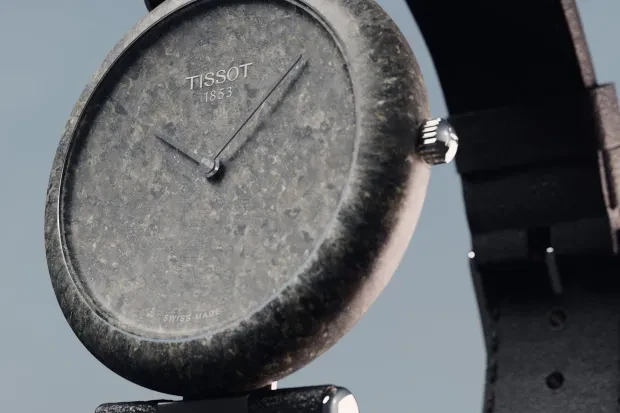
The reissue is very faithful, apart from the diameter and the color of the hands, previously red and yellow, like the Swiss hiking trail signs. Why?
We wanted to pay homage to the original watch with the same proportions, but with an enlarged diameter of 38 mm. The original indeed had colored hands, but in this version, it detracted from the beauty of this stone. We preferred steel-colored hands for a much more uniform appearance. The aesthetics are more beautiful this way.
What are the constraints related to using this stone?
This material is very difficult to work with. We also wanted a thin piece, which can therefore break easily during production.
What type of machine did you use?
We used CNC machines, but with special tools to be able to cut the stone.
I've heard that these are the same machines as back then.
Yes, it's the same supplier and the same machines as back then, at least regarding the base, as some parts obviously had to be changed.
What finishes are done on the stone?
It is polished, without treatment. It really is natural stone, for two reasons: first, for comfort, and second, for the authenticity of having a part of the Jungfrau on the wrist.
What about its performance, reliability, water resistance, shock resistance?
Granite is porous: moisture goes in and out. This is also why the stone is not treated. The construction of the watch respects this principle – the movement is protected in a small case, and we worked specifically on the adhesive between the sapphire crystal and the case with our supplier Asulab. The water resistance is at 1 bar. The shock resistance is also tested and equivalent to that of ceramic.
Is this a unique experience? Or does the Rockwatch pave the way for other reissues – such as the Woodwatch or the Pearlwatch created back then?
We have many projects in preparation. But for now, we are launching this anniversary edition and do not have short-term plans to revive this line.
Note that the new Rockwatch is now available at Tissot.