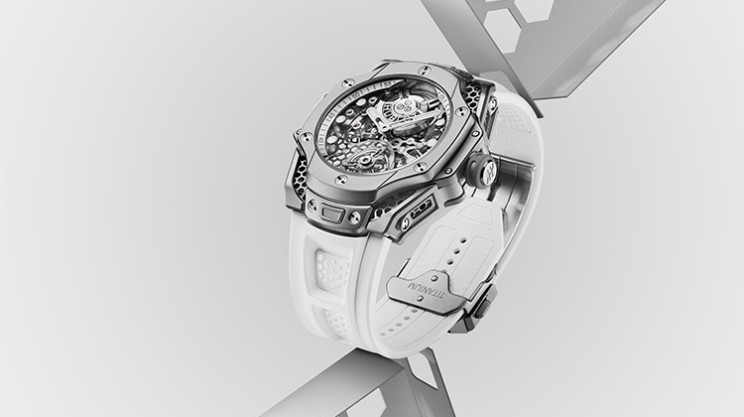
You’ve just launched the Big Bang Tourbillon SR_A by Samuel Ross. Do you envisage other types of collaboration with the artist?
Yes indeed and in two different ways, because he’s very talented and brings a fresh touch. We’d actually been working together for four years when he won the Hublot Design Prize. When Samuel Ross showed us his first designs for the new limited series with its honeycomb structure, I was immediately hooked. The only exchanges involving small adjustments took place with the technical department, such as on thickness issues. The idea now is to incorporate his DNA into a more commercial collection, as we want to make the next models he creates more accessible. He shares with us his eye for products, as well as for exhibition concepts and pop-up stores in which he integrates his universe with ours. His mentor was Virgil Abloh and he belongs to the same highly creative, multidisciplinary vein. His vision is used by Apple, Nike and Acqua Di Parma alike. He brings a lot to the table.
Hublot has around 15 ambassadors. How much of its sales do they generate?
By ambassadors we mean those with whom we conduct advertising campaigns for our watches, such as Kylian Mbappé, Usain Bolt, Novak Djokovic and Takashi Murakami. What I can say is that limited series linked to ambassadors account for between 10 and 15% of sales. Above and beyond the financial aspect, ambassadors like Samuel Ross enable us to create resolutely different watches and raise our Maison’s profile in their respective worlds. Hublot is a young brand compared to Breguet or Patek Philippe, who have been creating extraordinary watches for decades. It wouldn’t make sense to imitate them; we really need to differentiate ourselves and offer watches that can’t be found elsewhere. Bearing this in mind, the collab with Samuel Ross opens up new horizons that our designers alone could never imagine. We think outside the box and create distinctive products, even if it means being divisive. Our ambassadors bring us awareness and raise us to the level of the aforementioned big names. Hublot is also a true Manufacture-based brand, with its own movements, complications and materials. Hublot innovates and does so in its own way, by offering models with a difference.
How does your brand stand out from the crowd?
First and foremost, it’s materials that set us apart. Hublot was the first luxury brand to introduce rubber to its collections in 1980 – through straps as well as case inserts – and the whole industry followed suit. Hublot also generalized the use of ceramics because we were the first to succeed in offering so many vivid colors, notably red, which many considered impossible to obtain. This year, we presented a limited series in aluminum recycled from Nespresso capsules, designed to support circularity with a Swiss company. It was cited as an example in the Deloitte Swiss Watch Industry Study. We invest a great deal in R&D and explore many areas, from new materials in collaboration with EPFL, to subjects such as the Antikythera machine, mankind’s first mechanical calculating instrument, in collaboration with the University of Geneva. We have also developed underwater robots for excavations and are working on a very ambitious planetarium. In the R&D department, the team works on a multitude of projects, some of which come to fruition meaning our efforts are rewarded, others not.
Hublot also takes part in Dubai Watch Week. Is this a very important market?
Yes, but the situation there is different because we work here with our partner Seddiqi, the absolute benchmark for retailers in the region. The Middle East accounts for 10% of our sales and the Hublot boutique in Dubai Mall is by far the number one in the world. During Dubai Watch Week we present a limited series designed with a local artist. In all, Hublot has 138 boutiques worldwide, half of them in its own name, and it’s in Western Europe that sales remain the most significant.
“We think outside the box and create distinctive products, even if it means being divisive.”
What do you see as the main advantage of belonging to a group like LVMH? The LVMH group enables us to obtain the best locations in the cities where we want to establish a presence, such as with the Hublot tower in Tokyo’s Ginza district, or our New York boutique on Fifth Avenue next to Louis Vuitton as well as the Place Vendôme in Paris. A line-up of prestigious addresses that we would hardly have been able to negotiate without LVMH behind us.
As a WorldTempus reader, we are delighted to offer you the digital version of this GMT Magazine, that you can download here.