
When Cubitus arrived on the scene it was the first new collection from Patek in 25 years. “For a long time, really always, I have wanted to have a square watch in the collection,” said Thierry Stern, president of Patek Philippe upon the launch of the Cubitus collection in 2024. “And it had to be a watch that had all the DNA of Patek Philippe.”

With rounded corners, a dial inspired by the striped Nautilus ribbing, baton hands, and a mix of vertical satin and polished finishes, the Patek DNA is unmistakenly there. Especially if you connect Patek Phillippe with the legendary Nautilus designed by Gerald Genta.
Cubitus does reinforces its sporty-chic-stainless-steel-integrated-bracelet-1970s-heritage, with a model with an olive-green dial. But the four other models in the collection are dedicated to more exclusive materials; platinum, white gold, rose gold, and a bi-metal version in rose gold and steel.
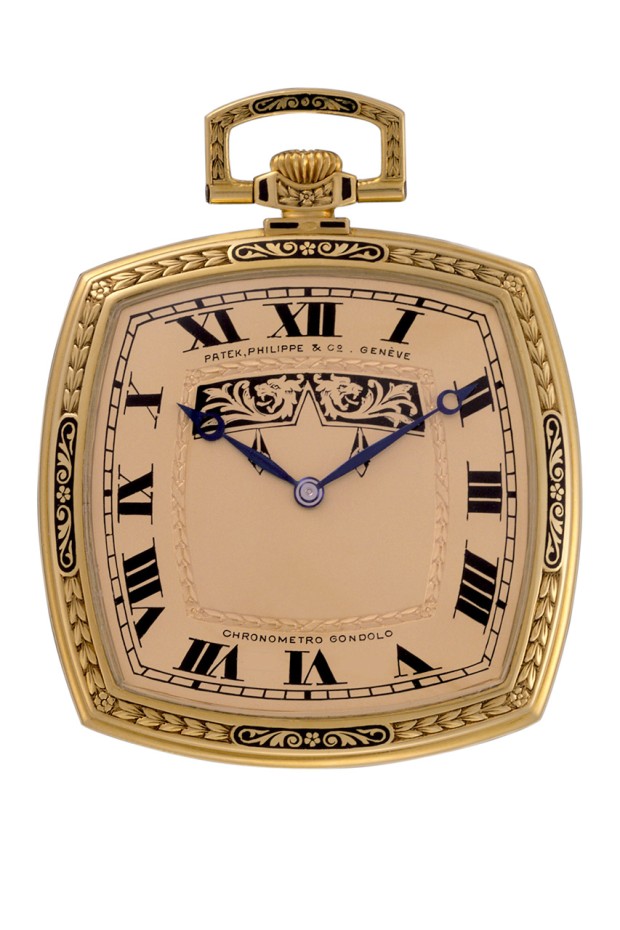
To create the collection Patek drew on its large heritage when it comes to square watches. Many models came during the Art Deco era in the 1920s and 1930s, but the Genevoise brand also released experimental square-ish watches in the 1960s and 1970s, including TV, and trapezoid shapes.
As too often when introducing something new into the watch world, the Cubitus collection was met with skepticism. It is often baffling what a conservative bunch watch afficionados are.
Now in its third year, the Cubitus collection is established, it has become popular, it is fresh – it is simply hip to be square. Or, come to think of it, I wouldn’t say it is hip. It is one of those models that arrived in an air of timelessness. It was born old and wise And if you ask me, I think Gerald Genta smiles from up above when he is peeking down at the Cubitus.
Exclusive Materials
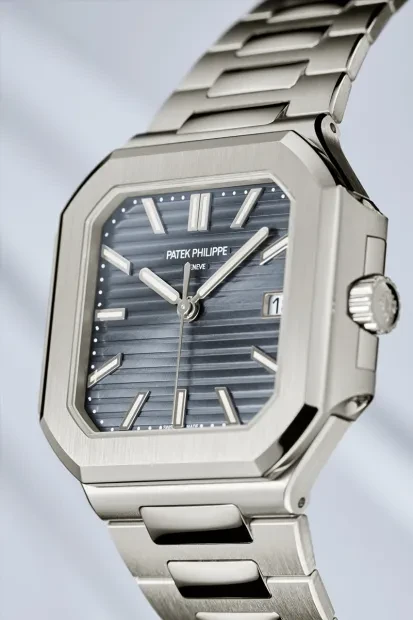
The 40-millimeter 7128/1G-001in white gold features all the marks of the Cubitus collection: A two-part square-shaped case with rounded edges and side attachments. Vividly contrasting polished and satin finishes reassures the contemporary design details of this watch. The embossed dial with a horizontal pattern shows that this is a descendant of the Nautilus.

With Instantaneous grand date, day and moon phases, the 45-millimeter 5822P-001 is the most complex Cubitus model to date. In fact, the platinum-encased creation has six patent applications. The ultra-thin automatic caliber is powered by a gold rotor, and everything is kept on your wrist with a navy-blue composite strap with cream-colored stitching.
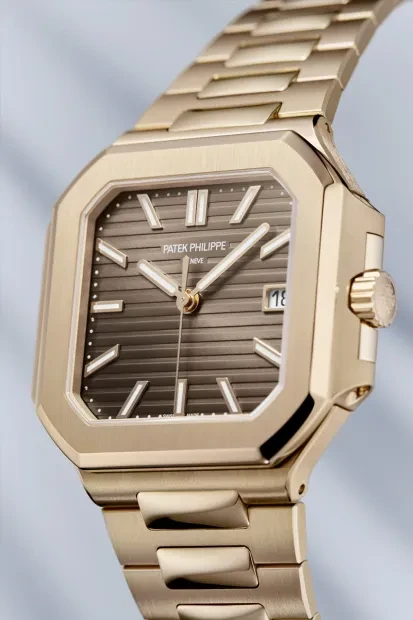
The rose gold 7128/1R-001 with a three o’clock date and sweep seconds is with its modest size of 40 millimeter suited for most wrists. The 21-karat rotor features the same subtle sunburst pattern as the ribbed dial – a hallmark feature for the Cubitus collection. The rose gold clasp at the end of the H-linked bracelet is patented.
Square Heritage
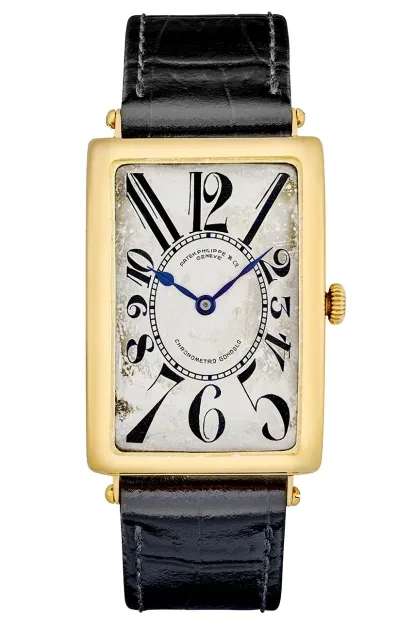
Patek Philippe’s Gondolo watches are known for its Art Deco style, but were in fact produced already from 1872, five decades before Art Deco was on the agenda. They were produced until 1927; all for the Brazilian retailer Gondolo & Labouriau. This one, with blued steel hands, rectangular yellow gold case, and a 12-line movement, was made from 1913-1922.
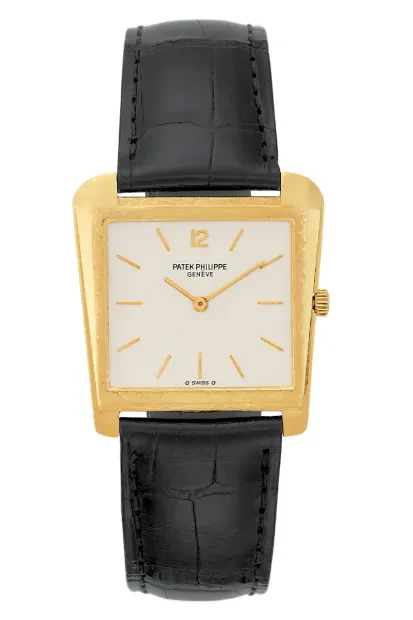
1960s was an extremely experimental decade in watchmaking, in art, and in architecture. For Patek this resulted in the exciting Reference 3489, a trapezoidal yellow gold watch with a silvered dial featuring applied Arabic numerals on gold and baton indexes. The also experimented with form by using a straight-line lever escapement.
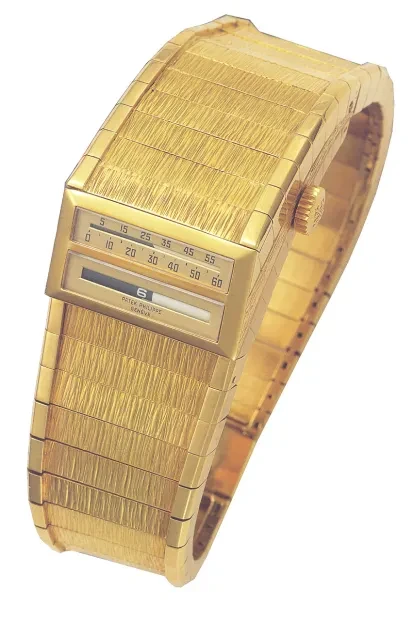
The yellow gold Reference 3414, with a liner display developed and produced by Louis Cottier, famous for his world timers, did not make it into serial production. Which is unfortunate for a digital watch whose time display is based on two superimposed cylinders, half white and half black, that are linked to the motion work.
It Takes Time
Square and other watches that are “shaped” can be a challenge in a market where around 85 percent of watches are round. Most collectors however tend – over time – to favor a varied collection when it comes to different shapes, sizes and materials.
Said Arthur Touchot, co-founder of auction house Marteau & Co. and WorldTempus vintage editor: “I think it is always fair to give time to a new collection to mature – most pieces that eventually become iconic where not immediately accepted by collectors. I don’t know the Cubitus very well, I have only handled it a couple of times – but I think it certainly has potential to become a very interesting collection spawning different sizes and complications.”