The Lange 1 in its finest details

Image
©A. Lange & Söhne
The A. Lange & Söhne icon was created over 30 years ago. The piece has never undergone a revolution, but rather slow and profound evolutions—always subtle—that keep it at the top. A true masterpiece of craftsmanship examined under the magnifying glass for the first time.

A work of aesthetes, for aesthetes. The philosophy of the A. Lange & Söhne manufacture could be summed up in this simple formula. The house produces only around 5,000 watches per year on average. Its CEO, Wilhelm Schmid, will enter his 15th year in the role next year — and one would be hard-pressed to find his equivalent in the industry. The man, like the brand, does not seek the spotlight. In fact, he even avoids it, cultivating discretion and rarity with the discipline of an ascetic.

Lange 1. Quite simply.

The product reflects the brand itself. You have to get up close to grasp its subtleties. And it all begins with the Lange 1. The name of the piece alone captures the positioning of the house: to christen its first contemporary creation after its rebirth in 1990, the brand named it after its founder, Ferdinand Adolph Lange, followed by the number 1. Lange 1. It doesn’t get more understated than that.

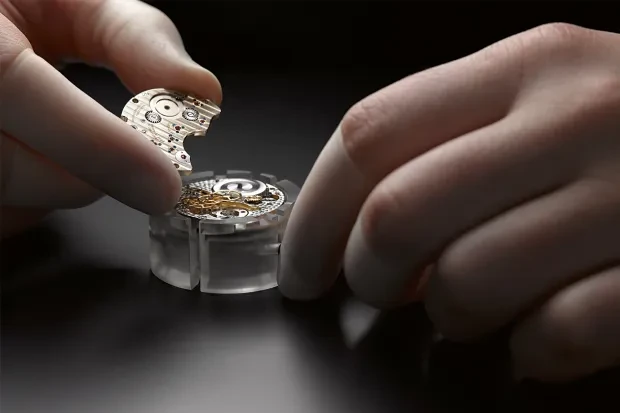
Yet the Lange 1 is teeming with details. Some are invisible once the piece is completed. Such is the case with the “montage à blanc.” This process involves fully assembling the watch, putting it into operation, then disassembling it, applying the final finishes, and assembling it again — all by hand. A process of absolute rigor that gives each watch complete reliability, since any potential defect (in adjustment or finishing) is detected during the initial assembly and then corrected. Almost no brand still performs this exercise, aside from a few rare manufactures — and even then, mostly only for grand complications or chiming watches.
©A. Lange & Söhne
©A. Lange & Söhne

The Big Date

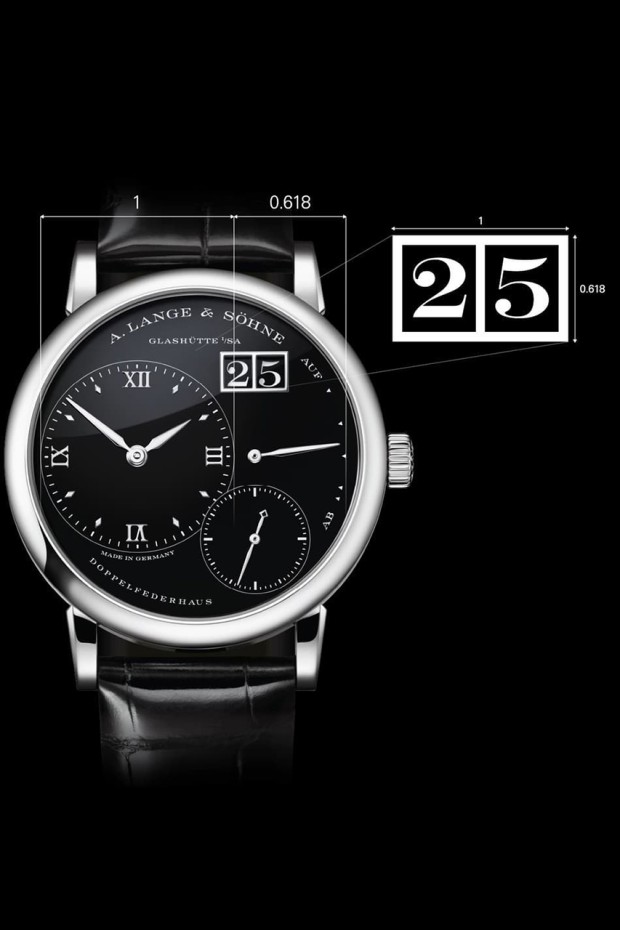
Maximum visibility, maximum secrets. The large date of the Lange 1 is the iconic hallmark of the collection for three reasons — but only the first is clearly visible: it is off-centered between 1 and 2 o’clock. The position feels natural, yet it is extremely rare in watchmaking, if not entirely unique. The other two reasons are imperceptible. The first lies in its proportions: 1 / 0.618. Some will recognize the golden ratio — particularly pleasing to the eye. The second secret concerns the date discs. There are two: one for the tens, and one for the units. They overlap ever so slightly to create the illusion of being on the same level — but they’re not. The difference is just 0.1 millimeter, completely invisible to the naked eye.

Secret Movement

Another barely visible element: the movement of the Lange 1. It may seem surprising for a manufacture of this caliber not to showcase the full extent of its expertise through the technical beauty of its caliber. But tradition dictates that it is always largely covered by a plate. The coverage rate is fixed at three quarters. The famous “three-quarter plate” of A. Lange & Söhne is a historical legacy from a time when the movement’s gears and wheels were better protected from shocks between two “sandwich” plates. Today, this is no longer a functional necessity. Modern movements are inherently more reliable and robust than those of the last century. Yet A. Lange & Söhne continues to honor this heritage of Glashütte watchmakers.

The Swan Neck
©A. Lange & Söhne
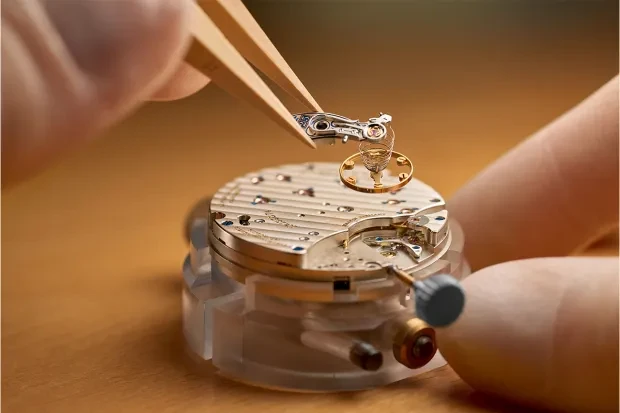
It’s called the swan neck. It’s the main visible element through the remaining quarter opening of the plate, which is closed on the other three quarters. The swan neck is the spring whose action allows the watch’s precision to be regulated by adjusting the component it holds, called the regulator.
©A. Lange & Söhne
It sits on a balance cock, richly engraved at A. Lange & Söhne, always with a floral motif. The swan neck is a somewhat old-fashioned regulating device, now mostly replaced by more modern methods, but still highly valued in traditional high-end watchmaking.

Engraved in Marble

©A. Lange & Söhne
©A. Lange & Söhne
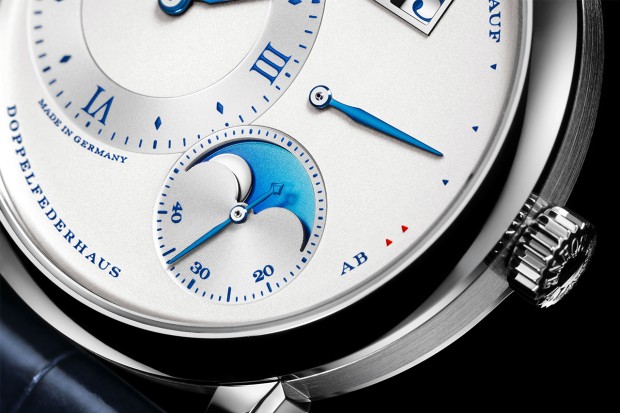
The final distinctive feature of the Lange 1: its design is nearly immutable. In practical terms, this means that any complications added must adapt to the dial’s layout—not the other way around. A. Lange & Söhne regularly deploys remarkable ingenuity to preserve the Lange 1’s design principles. A moon phase? Hidden within the small seconds. A world timer? The reference cities are moved to the periphery, and the local time takes the place of the small seconds. A perpetual calendar? The power reserve is replaced by the seven days of the week, and the 6 o’clock marker by the leap year indicator. Truly an art form!
Featured brand
Logo A. Lange & Söhne