


1969 was the year that rocketed Omega Speedmaster Professional into the mainstream culture of mankind. When the astronauts of Apollo 11 on July 21 were taking individual small steps that were giant leaps for mankind, one of the wrists were carrying an Omega Speedmaster, which were, after severe testings, the watch chosen for space by NASA.
Yes, on that first moon landing, there was only one Speedmaster worn on the surface of the moon, namely by Buzz Aldrin. Neil Armstrong had left his watch as a backup in the landing module, as the instrument panel watch had been playing up during the landing. The absolute trust and necessity of these tool watches could not be described in any better way. And to this day, the black-dialed, monochrome Speedmaster Professional, ever since 1969 dubbed as the Moonwatch, is one of the most iconic chronographs ever.

Fast Cars
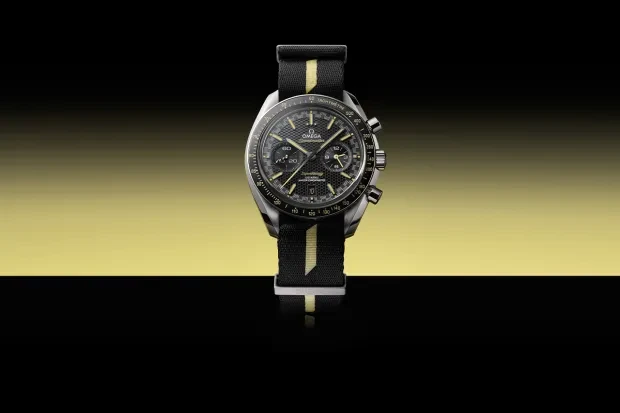
Omega’s journey in tool watch chronographs began in 1957, with the first Speedmaster made for the automobile racing community.
But first, let’s make sure we are on the same page when it comes to a definition of a tool watch. A tool watch is not a scientific term, nor is it a clear category among watch makers. But here at WorldTempus, we define a tool watch as a precision watch designed to withstand harsh environments, shocks, water pressure – in short, a watch designed for practical function rather than as a jewelry. When looking at vintage, you must also have in mind the evolution of watches in general: With new materials and better designs, a modern tool watch outperforms those of yesteryear.
As said, Omega’s first Speedmaster from 1957 was not only a robust timekeeper with broad arrow hour hands, it was also a racing tool. Thanks to its pioneering use of a tachymeter scale etched into the rim of the case. The first one had a black dial, luminous hands, and a what at the times was a chunky 39mm case. As Simon de Burton wrote this summer, it was “an instant hit with the automobilists at whom it was specifically targeted.”
The Second Generation
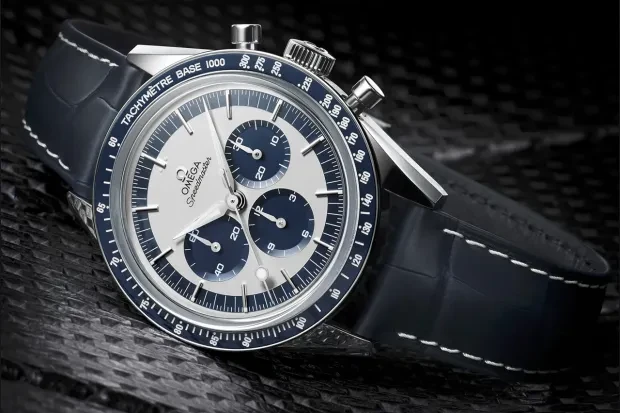
The second generation came already in 1959, and was produced until 1963. The CK2998 was, above all, an aesthetic evolution. As you would imagine for a tool watch, this was form follows function, as the upgrades made the watch easier to use. For instance, this watch had a new tachymeter bezel with a black aluminum insert, which made it easier to read. The case also grew from 39 to 40 millimeters. But from a functional point of view, one of the biggest improvements is invisible unless you dismantle the piece: O-ring gaskets around the pushers, which improved water resistance. Also, the hands got a makeover as the broad arrow was replaced by alpha hands (whose main difference from dauphine hands is having a thin attachment at the center).
The CK2998 was the start of Omega’s journey into space. Worn by Walter “Wally” Schirra on his first space mission, Sigma 7, Wally and his watch orbited the Earth six times – and just a few years later NASA would officially qualify the Speedmaster for all manned space missions.
Joint Space Mission
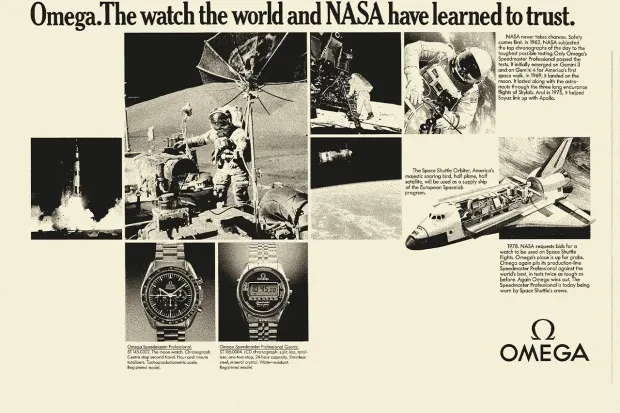
The same year the Speedmaster made a touchdown on the Moon, the Flightmaster arrived. The solid-block case made of Swedish stainless steel, is reminiscent of a shield. But the shape had, as always, a clear purpose: Ergonomical fit while providing a plethora of information operated by three crowns and two pushers: Timing starting from 1/5 of a second, rotable internal bezel, two time zones, and water resistance to 6 ATM.
The extreme space-like testing phase assured the mineral crystal was resistant to pressure, and that Flightmaster continued to function even in complete vacuum. You might wonder if a sapphire crystal would provide even stronger durability and scratch resistance? On Earth yes. But if a sapphire crystal was to break in zero gravity environments, you would have sharp pieces of glass floating around in the air which could destroy equipment such as space suits, cables, and tubes. Thus, a non-shattering material like a mineral or acrylic crystal is preferrable.
The Flightmaster became the watch of choice for some Russian Cosmonaut missions, including the training of Alexei Leonov, wearing the ST 145.036 Flightmaster. In 1975 Leonov would lead the docking of the Russian Soyuz spacecraft to the American Apollo capsule; the first ever spacecrafts from different countries collaborating for a joint docking in space.
Red Alert ALASKA
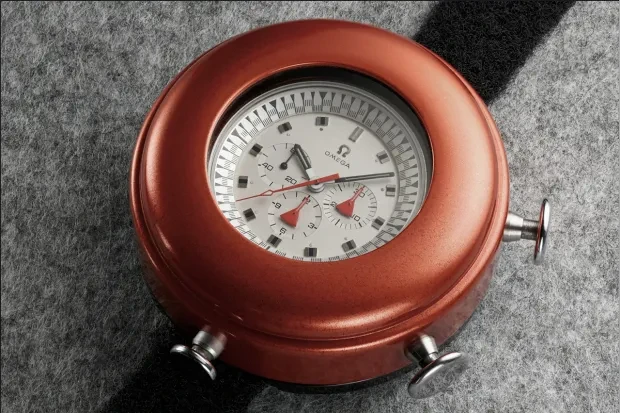
One of the most famous Speedmasters is the ALASKA project. The four models made between 1969 and 1978 were instrumental for the evolution, and Russian cosmonauts wore the watch during space missions in 1978 and 1980. In a nutshell, this was protection through layering. In total four new layers were developed by Omega in close collaboration with NASA engineer James Ragan in Houston. The goal of the collaboration was to create the ultimate space watch, and let’s take a look at the improvements made with four layers from the inside out. First, the caliber features new alloys and lubricants; second, this was one of the first ever polished titanium cases; third, the silver-white “space simulator” dial, which thanks to its enhanced reflectiveness minimized the effects of extreme temperature changes due to unfiltered UV rays in space; and last but not least, the most famous component of The ALASKA project: an optional bright red aluminum oversized case that could be worn on the spacesuits. The same red hue was also used for the chronograph hands, making them legible in any circumstance.
The Next Step
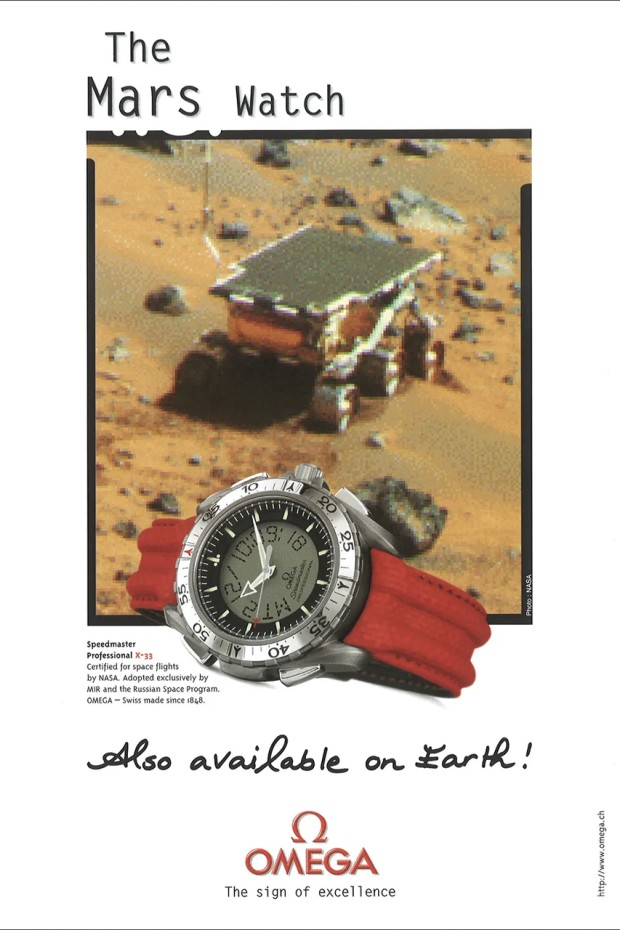
The ultimate space watch to actually be worn in Space eventually arrived in 1998: the Omega Speedmaster X-33. With a mix of analogue hands and a circular digital display with countdown and count-up functions and a light for dark conditions, the quartz caliber 1666 also provides a powerful alarm alongside the elapsed mission time that can run up to 1’000 days. Again, titanium was the metal of choice, and an interesting design detail is the openings on the caseback (which is of course water proof), which ups the volume of the alarm.
Since then, the X-33 has had two major upgrades: The Skywalker and the Marstimer.
The X-33 Skywalker came in 2014 with a redesigned display with a third time zone, the Phase Elapsed Time function, a ceramic bezel, and the thermo-compensated Caliber 5619.

The 45-millimeter X-33 Marstimer from 2022 was designed with scientists in mind. The titanium features many tools for space researchers, and the Caliber 5622 can track Mars’ sol date and time. A single Mars day – one sol – lasts 24 hours, 39 minutes, and 35 seconds and the scientific community has agreed on a continuous running count of sols starting from December 29, 1873. Thus, on the publishing day of this article, November 18, we are on Sol 54’347. Another reminder of the red planet on the Marstimer is the oxalic anodized aluminum bezel ring in red hematite color - reminiscent of Mars’ distinctive dust.
Over the years, the X-33 has become Omega’s most internationally used space collection. NASA, International Space Station, Russia MIR Space station, Japan Aerospace Exploration Agency, European Space Agency. Purpose-built space instruments – what more could you ask for from a master of tool watches?
FAQ
What is a tool watch, according to WorldTempus’s definition?
WorldTempus defines a tool watch as a precision watch built to withstand harsh environments, shocks, and water pressure, designed for practical function rather than as jewelry, unlike dressier timepieces.
What is the Omega Speedmaster Professional “Moonwatch,” and why is it called that?
The Speedmaster Professional earned the “Moonwatch” nickname after Buzz Aldrin wore one on the lunar surface during Apollo 11 in 1969, following NASA’s rigorous testing and official selection for spaceflight.
What was the Omega Speedmaster ALASKA project?
The ALASKA project comprised four Speedmaster models developed with NASA engineer James Ragan between 1969 and 1978, featuring a polished titanium case, a reflective dial, and an optional bright red aluminum outer case.
What is the Omega Speedmaster X-33, and what are its two major upgrades?
Launched in 1998, the X-33 combines analogue hands with a digital display and alarm for astronauts; its two major upgrades are the 2014 Skywalker and the Mars-focused 2022 Marstimer.


