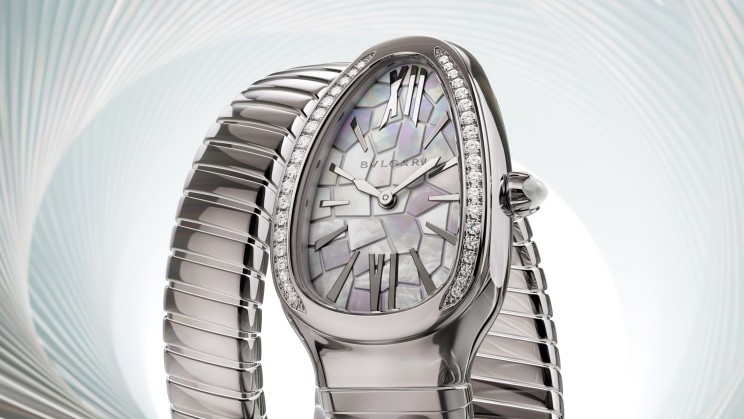
“I found a treasure!” A shimmering seashell catches the eye of young (and not-so-young) vacationers from the seabed. Its opalescent glow, also called iridescence, fascinates—whether in the luxury segment or among costume jewelry makers—and this has been the case since Antiquity. Buttons, dominoes, furniture, fans, pen holders, binoculars, belt buckles, or even paper knives, as showcased in the Museum of Mother-of-Pearl in Méru: mother-of-pearl finds its way into artisanal creations and watch dials alike.
Cascading Iridescence
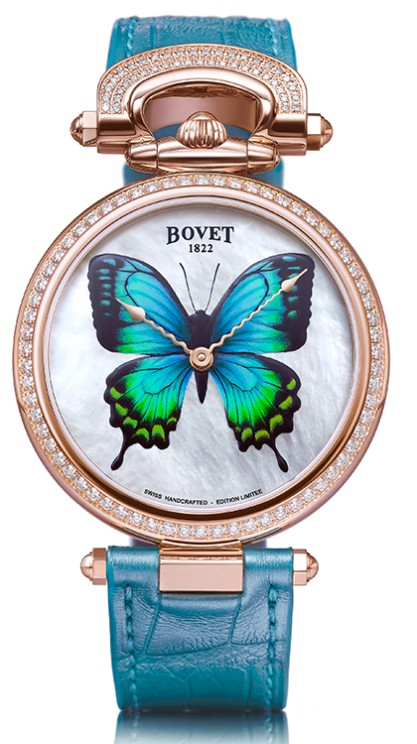
If the precious counterpart of mother-of-pearl is the opal, there is also an artificial version, made from horn or fish scales. The technique originated with Venetian glassmakers of the Middle Ages, later perfected at the beginning of the 17th century by a Frenchman (Dictionnaire encyclopédique Quillet, 1975). Today, pigments based on artificial mother-of-pearl are used in certain high-end car paints, in nail varnishes and gels, as well as in creamy, opaque lotions and shampoos! In nature, the same iridescent effect can be found in certain insects, such as butterflies.
Chance or “Gardening”
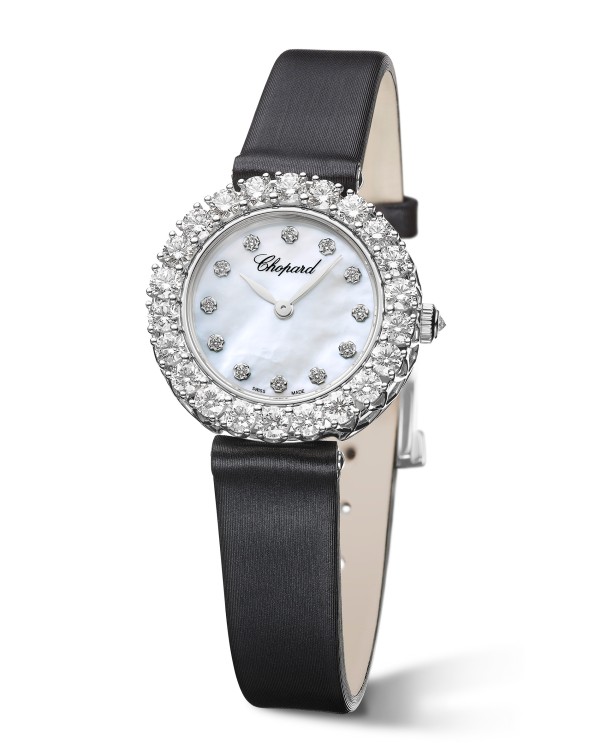
Whether natural or cultured, mother-of-pearl today comes mainly from Asia, Australia, and Polynesia. It is a substance secreted by certain mollusks. It is composed of organic conchiolin combined with microscopic crystals of aragonite or calcite, deposited in thin layers in what is known as a conchoidal structure—one that even inspired a type of particularly resistant ceramic (CRNS, 2014). The material builds up on the inside of the shell, but also around any foreign body, such as a grain of sand, introduced deliberately or accidentally. This is what produces a pearl! Watchmakers often use mother-of-pearl sourced from cultured pearl industries. More or less rare, with varying hues and qualities, mother-of-pearl is classified accordingly. Luxury watchmaking generally uses the highest grade—“perfect” surface and “brilliant” luster.
A Rainbow Beneath the Sea
There is a wide spectrum of hues, from white to… black, like the very distinctive Tahitian mother-of-pearl. However, naturally colored mother-of-pearl is rarely used in watchmaking, due to its lack of uniform color. Watchmakers prefer transparent or white mother-of-pearl, tinted from below and polished on top for greater brilliance.
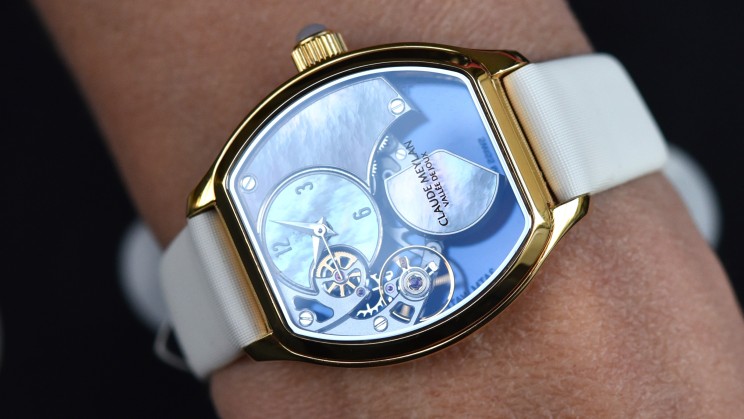
Working with mother-of-pearl is delicate, due to a very high risk of breakage. To insert it onto a dial requires thinning it down as much as possible—well under a millimeter in thickness (barely a few tenths of a millimeter). Philippe Belais, CEO and owner of Claude Meylan, explains: “Concerning mother-of-pearl for dials, we favor a thickness of 0.8 mm, so that we have sufficient depth for maximum effect. Indeed, if the mother-of-pearl is thinner, the material’s transparency would require a coloring or tint that would alter its natural color and depth. We also use mother-of-pearl for our Ondine Bracelet, with cuts of cloudy white mother-of-pearl averaging 1.6 mm.”
The Pearl of the Métiers d’Art
“The surface of mother-of-pearl can of course be engraved to create reliefs or textural effects, but also painted to further shape patterns,” explains Olivier Vaucher, engraver and founder of the Geneva-based atelier bearing his name. “Mother-of-pearl and shells offer a wide variety of colors. For example, a shell that looks brown on the surface may reveal a violet hue deeper down. It is possible to influence the nuances through plays of transparency. Each piece obtained is unique, due to the organic nature of the material.” This engraving work on shells—with or without iridescent mother-of-pearl—is best known to the public through the technique of the cameo. Engravers then play with the natural shades of the different layers of the shell—or of stones such as onyx—to create relief images, such as ivory profiles on an orange background.