


Touch Me

If one word were to capture the design of the new Tradition collection, it would be tactility. The coined case edge, the mirror- polished, softly rounded lugs, the smooth enamel dial, the finely grained bridges, the box-shaped sapphire, the knurled crown. Not forgetting the finer aesthetic touches such as the secret 6 o’clock signature. The latter has always doubled up as a useful functional element – since given the difficulty involved in both producing a smooth enamel dial and engraving it with a signature, it also serves to authenticate a genuine Breguet timepiece.
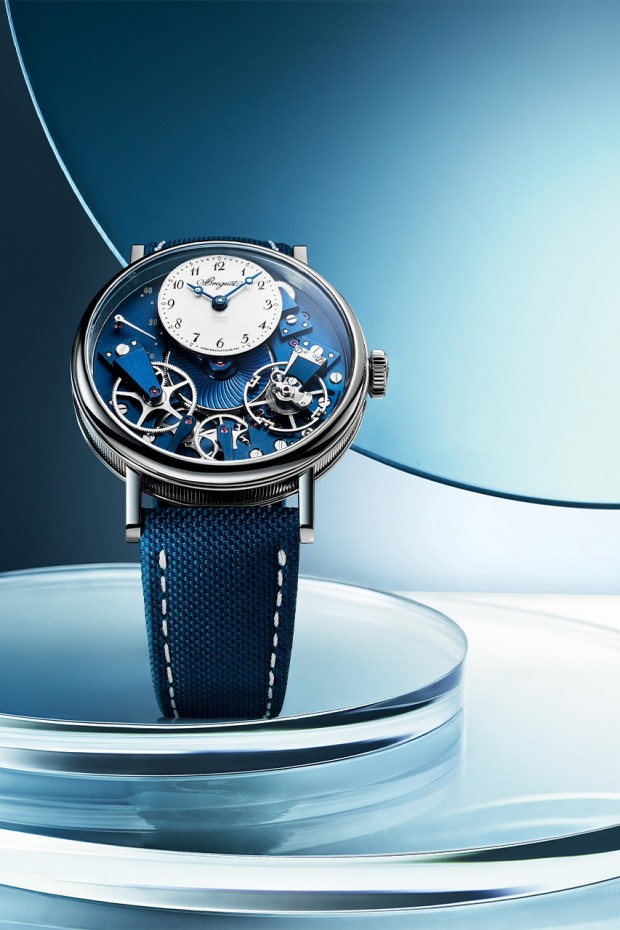
Such design choices perhaps explain why the Tradition collection feels so contemporary. In a modern digital age, tactility has once again become a sought-after quality in design. While a focus on the tactile dimension of design is often said to have emerged in the late 19th century, the work of ingenious creators like Abraham-Louis Breguet supports the argument for it having appeared around a century earlier, at least in watchmaking.
TIME Machines
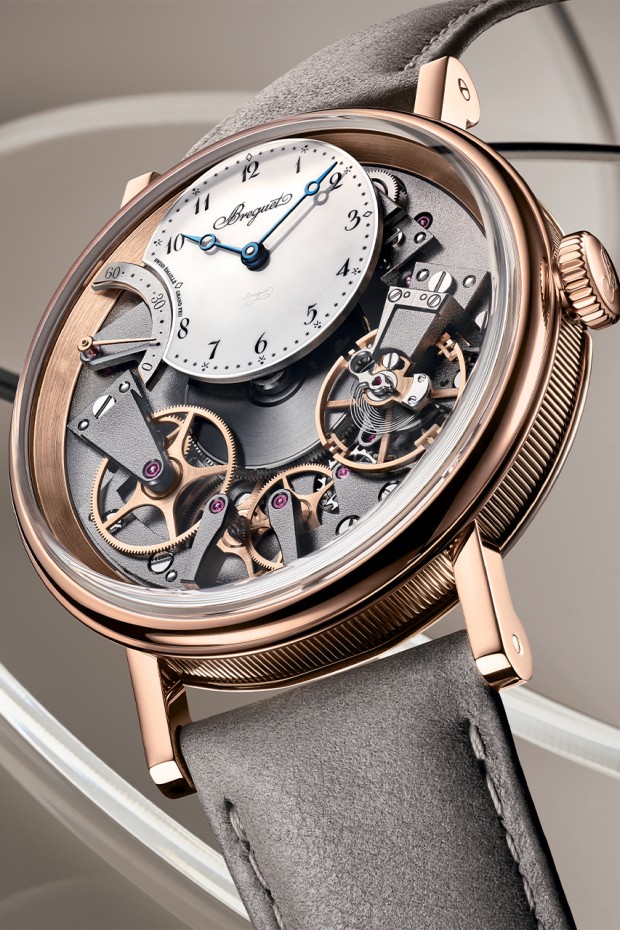
Both the retrograde seconds and the GMT movements are robust yet elegant open-worked creations offering a 50-hour power reserve. Part of their mechanical appeal lies in a certain historical playfulness in the execution of fundamental components. One example is the blue-toned movement of the white gold retrograde model. Blue is traditionally applied to small screws through an age-old heating process – yet here, entire bridges are blued to a similar hue using the latest Atomic Layer Deposition technique.
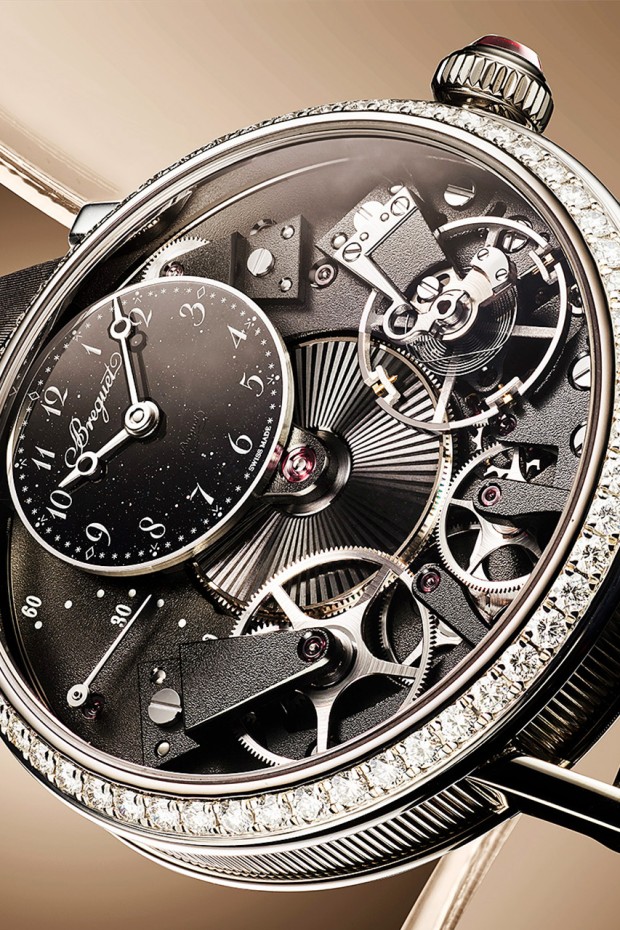
As for the technical features, most remain largely unchanged, though materially updated, drawing directly from Breguet’s inventions of 250 years ago, such as the pare-chute shock-absorbing device and the balance spring, now crafted in silicon. Through these evolutions, the Tradition collection emerges as a contemporary gateway into a new era.
ARTISTRY MEETS ARTISANSHIP

Abraham-Louis Breguet was an innovator, both technically and in the realm of watch decoration. It was he who – as early as 1786 – became the first to raise guilloché to art form status in watchmaking. This technique has been cultivated over the centuries by the Manufacture Breguet which has made it a true style signature, particularly on the Tradition watches, of which some models have thus far featured a finely guilloché dial. The new creations take a different approach in which the art of guilloché is deployed more discreetly, revealing a spiral or sunburst pattern applied to the barrel cover.
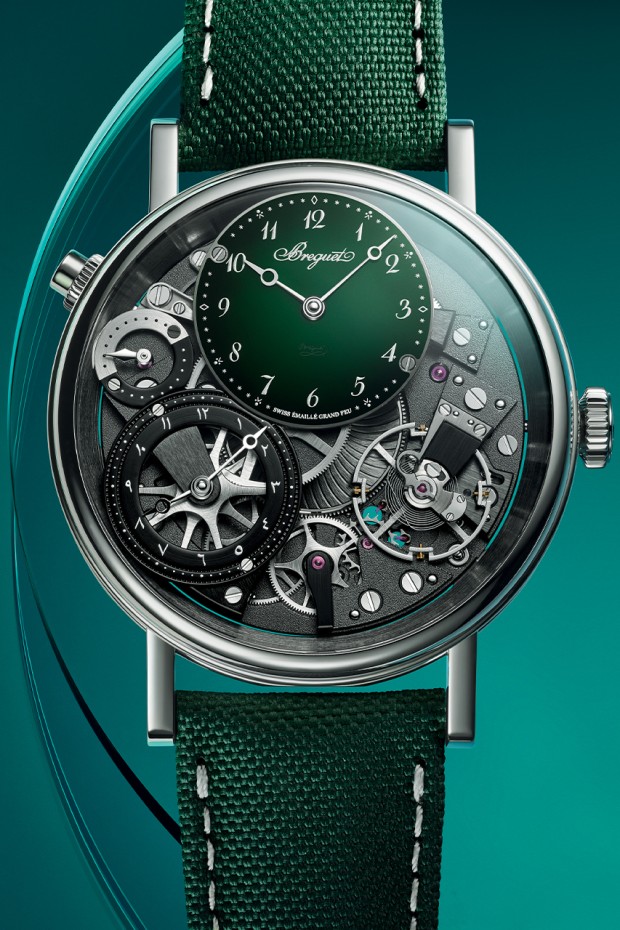
Meanwhile, the dial of the new Tradition models is now adorned with Grand Feu enamel on white gold, in white or black interpretations as well as a first-ever delicate green and black gradient on the Tradition GMT 7067. Within this incredibly difficult process, the selection of powders, their gradual blending, the subtle balance of hues and above all the meticulous control of the firing process after each application of enamel make each dial one-of-a-kind, secretly signed – as tradition dictates – with the Breguet name.


