WORLDTEMPUS - 23 December 2010
Elizabeth Lilly Doerr
In 1892, Danish watchmaker Bahne Bonniksen patented an invention in England: he called his invention the karussel thanks to the motions it made. The biggest and perhaps most significant difference between the tourbillon and the karussel is that Bonniksen's device—registered for a patent 91 years later than Breguet's—is driven by the third wheel (the transmission wheel between the wheels driving the minutes and seconds) instead of the fourth wheel (which also drives the second hand, and the reason one often finds small seconds on a tourbillon cage). This fact makes the karussel much sturdier and less prone to shock than the traditional tourbillon. Bonniksen worked with three different rotational speeds as described in his original patent: 52 ½ minutes, 34 minutes, and 39 minutes.
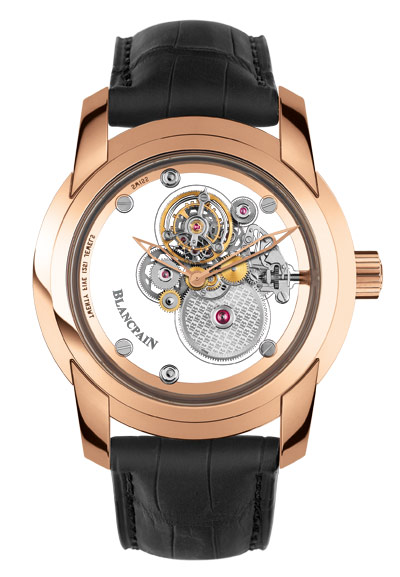
In 2008, Blancpain introduced Vincent Calabrese's innovative version of Bonniksen's karussel: the Carrousel Volant Une Minute. When Calabrese began developing this particular masterpiece, however, he found that anything slower than a one-minute rotational speed would be “boring,” so he added two extra wheels to the karussel train to allow it to make a full revolution within a sixty-second period. The wristwatch that emerged could well be considered the world's first wristwatch karussel – and certainly the world's fastest.
The 2010 version of this masterpiece takes the aesthetic to a new degree by removing the base plate – a Calabrese specialty – and encasing the minimalist gear train, escapement, and balance between three panes of sapphire crystal.