WORLDTEMPUS - 23 December 2010
Elizabeth Lilly Doerr
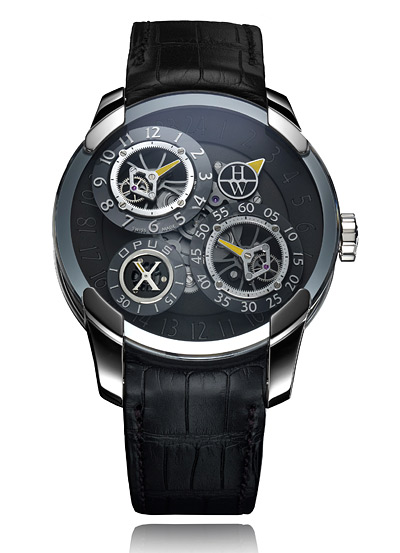
Watchmakers are seldom allowed to create what their hearts desire. After all, the resulting object is expensive and needs to turn some sort of profit –particularly if it is backed by a larger company with a reputation at stake. Harry Winston, headed up by the inimitable Maximilian Büsser at the time, took a chance in allowing chosen independent watchmakers to create limited editions for the Opus series beginning in 2000 – with great success. Not only for Harry Winston, but for independent watchmaking and artisanal horology as a whole. During the September 2010 celebration of ten years of the Opus series, I took an impromptu poll of some of the high-powered guests attending the event as to which of the ten Opus models was the favorite. The answers astounded me, as the obvious frontrunner ended up being the Opus 3, a model that needed seven years and millions of francs to get into working shape. What should have been a small humiliation for the company has actually turned into its greatest triumph: tenacity, imagination, risk, daring to dream –this is what the Opus series stands for.
The Opus X was something of a small sensation itself. Not even industry insiders had necessarily previously heard of Jean-François Mojon and his little company Chronode previous to its Baselworld introduction. Mojon's company works behind the scenes as a complication developer. In pictures, the watch is in no way done justice – it is a timepiece that one really needs to see in action to understand the fascination.
Synchronized rotational motion of disks replaces traditional fixed hands. Mounted on a revolving frame that completes one full rotation in a 24-hour period, each of the slightly inclined subdials (hours, minutes, seconds, second time zone/24-hour display) turns within its own sphere to ensure that orientation remains constant in any position. Seeming almost like a microcosmical solar system, the hand-wound movement is outfitted with a planetary gear train: the displays are located on individual satellite gear wheels that “orbit” around a central wheel. Limited to 100 pieces, the Opus X comes in a white gold 46 mm case.