WORLDTEMPUS - 23 December 2010
Elizabeth Lilly Doerr
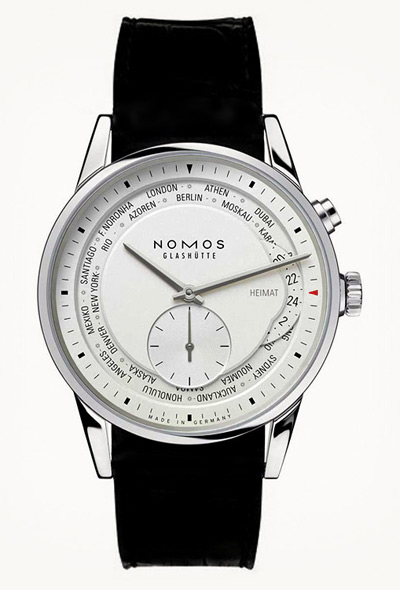
I have already written a lot about Nomos this year, and the reason is simple: Nomos delivers the biggest bang for the buck anywhere in the watch industry, bar none. Many readers outside of Germany will ask the obvious question: why is it then that we have never heard of the brand? The answer is simple: until now, Nomos's products have rarely been distributed with any regularity outside its home country and in the few rare cases it has, such distribution was not accompanied by much advertising. Quite unfortunately in the modern age, name recognition is everything; without it such great brands as this will easily get lost in the shuffle.
This year, Glashütte-based Nomos introduced its first larger complications: two watches, one outfitted with a GMT display and one with a world time display. While both are practical and reliable, it is the world time watch that is perhaps just a touch more aesthetic. This world timer puts an emphasis on practicality with its easy-to-use reference city ring controlled by a button and unobtrusive home time display, the settings of which can only be changed by a corrector in the case. This avoids any accidental setting.
The world timer's movement is called Xi and is the latest in the line of Nomos's in-house calibers christened with Greek letters. (The word Nomos itself is Greek in origin and means “law” or “order.”) Caliber Xi is based on the automatic movement that Nomos introduced in 2005 and boasts a solid 42 hours of power reserve. After five months of testing this watch, I found the movement to be incredibly reliable. A look through the sapphire crystal case back also shows that the movement is very aesthetic, well thought-out, and a true Glashütte product exhibiting many of the elements that created the mystique that surrounds the name of the city. This movement is easily identified as having originated in the Saxon burg.
As always, one of the biggest reasons any watch enthusiast should look at Nomos is the company's exceedingly fair price policy (which explains the lack of large-scale advertising). Prices for these Bauhaus-style manufacture products begin at 820 euros; the complicated simplicity of the Zürich Weltzeit can be had for 3,400 euros.