The highly reactive ingredients comprising zirconium, 328 watch components and epitrochoids began stirring in 2008 when Büsser and Baumgartner spent an afternoon dreaming of another joint project. They had previously joined forces on Harry Winston's Opus 5 (released in 2005) while Büsser was still the managing director of Harry Winston Rare Timepieces. The two share not only a respectful friendship, but also a number of common horological views and a penchant for exciting new projects.
As is Büsser's custom, the duo invited a number of friends to join in the fun – so that the small boutique brand (if you can really call it that) encompasses a number of well-known figures in the world of high-end horology. The Urwerk team is in charge of making the watch a reality; movement designer Cyrano Devanthey developed the ZR012's movement according to a design Baumgartner and co-founding partner Martin Frei had conceived inspired by a Wankel engine; the displays do not move in the usual circle. Büsser and MB&F co-partner Serge Kriknoff teamed up with the industry's premier freelance designer Eric Giroud to design and produce the ZR012's zirconium case, a material derived from the mineral zircon, whose appearance is much like that of titanium, but harder. Last, but hardly least, Ian Skellern was tapped to act as managing director of the boutique brand, which will never actively market or sell the timepieces produced by the conglomeration of exceptional talents that is now known as C3H5N3O9
“Since we decided there will be no marketing, we also said we should call it something ‘difficult',” Skellern explains. “The number and letter combination of the molecular formula is difficult enough, so we call it ‘Nitro' internally – for nitroglycerin.”
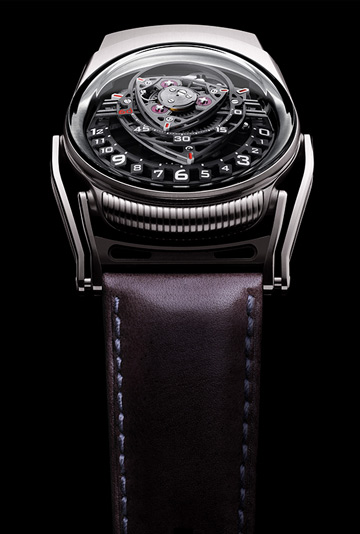
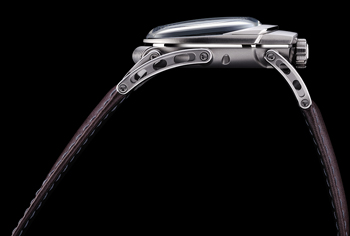
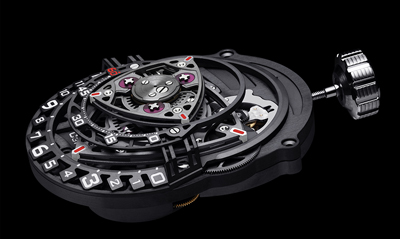
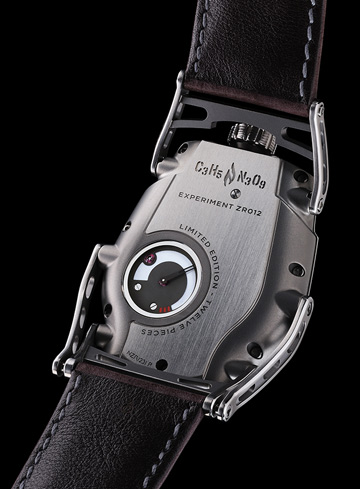
TNT is more like it: the unusual looks of what Skellern calls the “experiment” is accentuated by the Wankel engine-inspired display using eccentric, rotating triangular elements. The top polygon shows the minutes by “pointing” to a small scale, while the lower polygon points to a larger retrograde-style scale. In true Urwerk manner, the power reserve indicator of the 55 x 44 mm hand-wound timepiece is located on the zirconium back. Interestingly in light of its explosive looks, Skellern reports that – like in an Urwerk – none of the movement's components are made of silicon or LIGA-grown nickel-phosphorus. The zirconium lugs hug the wrist much like those found on watches by MB&F and De Bethune.
So, if it is not being marketed or actively sold, how will the consumer find out about C3H5N3O9? “Since we aren't doing any publicity beyond our own website and Facebook page and not exhibiting at fairs or placing advertisements, if anyone wants to see it, they'll have to look at my wrist,” Skellern laughs. “The aim is not to make a coherent brand, and we have no concrete ideas for the next models after the ZR012 – which also means no constraints.”
What does the mystic name of this first model mean? “ZR” stands for zirconium, the material of choice for the first 12 pieces, some of which will already be available from the first week of July. The next 12 pieces, which will be housed in red gold, are scheduled to appear in 2013. “012” stands for the year – all quite simple, actually.
Skellern reports that those who would like to own one example of this first model will have to part with 110,000 Swiss francs total after depositing 33,000 of them as a confirmation of order. However, once these 24 pieces of the ZR012 are gone, that will be it. And the explosive team of C3H5N3O9 will move on to the next detonative design.