Today, Jewish communities around the world are celebrating the Jewish new year (Rosh Hashana, “head of the year” in Hebrew), first day of the year 5769. A festive date that can be calculated with a watch conceived by Alain Silberstein.
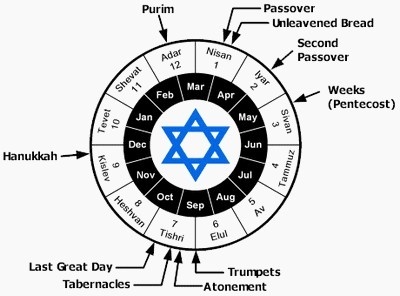
The subtlety of the Jewish calendar knows no bounds. 5769 is a “normal” year, with the second month containing 29 days and the third month containing thirty days: it is made up of twelve lunar months and 354 days.
This subtlety did not discourage Alain Silberstein, one of the most creative watchmakers from the Franco-Swiss region, who in 1994 in association with the complex and talented Svend Andersen, a master watchmaker from Geneva, devised the only watch with a perpetual Jewish calendar: it automatically jumps from the 29th to the 1st of the month, where applicable, and it automatically takes into account the 13th month of the embolismic years (Adar 1).
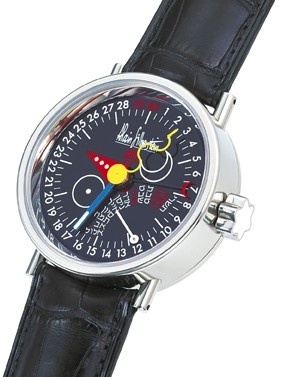
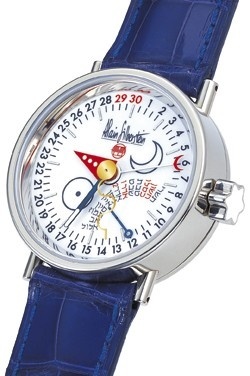
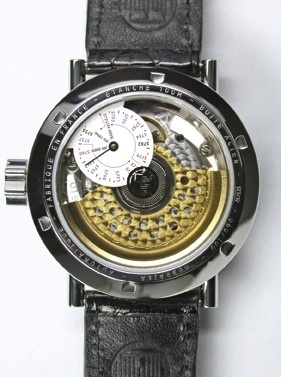
The second and third months of the year may contain 29 or 30 days, depending on the year. This number of days does not correspond with a regular cycle, one only has to refer to the colour code for the year located on a disc on the back of the watch, to find out if these months have 29 or 30 days and then make the appropriate adjustment manually, if required.
This disc of the years, located on the back of the watch will need to be changed after 40 years and replaced by a second disc supplied with the watch.
As the day begins and ends at sunset, the date changes at 6 p.m., the time reserved in the Jewish tradition as the basis for astronomical calculations.
An instruction booklet is provided to explain the functions (see below).
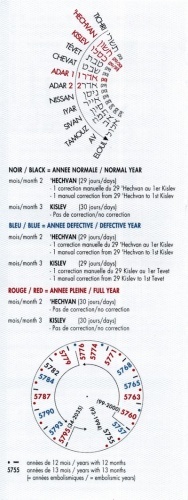
Calendars are one of Alain Silberstein's passions: the way passing time is measured characterises every culture and civilisation. In a globalised world, where the Gregorian calendar is used as the universal calendar, religious or cultural calendars still express today the identity of many peoples in something that is most precious to them: the measurement of “their” time.
Alain Silberstein is currently working on the development of a “calendar trilogy”: three watches, in which the Gregorian calendar cohabits with the Islamic, Hebraic and Chinese calendars. Their commercialisation is planned to start in 2010 (the complication is under development in one of the most famous specialist workshops in the watchmaking valleys).