Press release
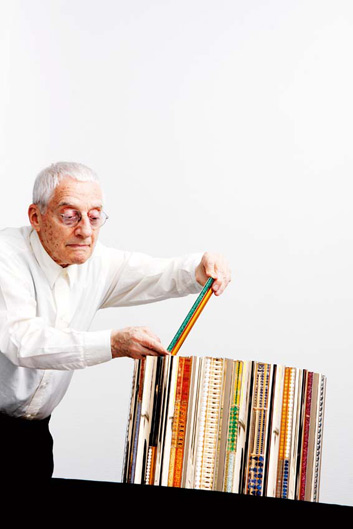
For the third consecutive year, Cartier is supporting Art Basel, the international most renowned artistic fair. This exhibition is taking place from June 10th to 14th. This year, Cartier is present at the Art Collectors Lounge, where we show a mesterpiece created by the famous Italian architect-designer Alessandro Mendini for Cartier.
This piece of art, scintillating column made of gold and precious stones, unique treasure composed of recycled stones that can no longer be used in jewellery, is ecological and stable, and can be dismantled, repared, recycled. Measuring almost 2,50 meters, this stele of gold gives a second life to thousand of pearls, engraved emeralds, sapphires, mandarin garnets, moonstones, chalcedonies and rubies. It was created in Cartier Joaillerie workshops and required over 18 month of work.
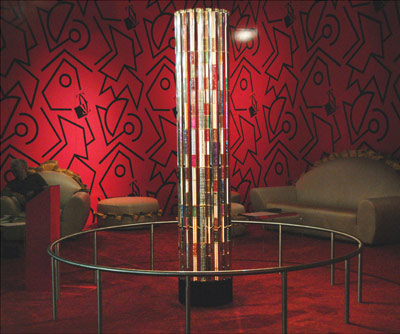
Creating a work of art using fine and precious stones, a collection made with gems that can no longer be used in classical jewellery as they have been pierced, dismounted and engraved; giving a second life to pearls, engraved emeralds, sapphires, mandarin garnets, moonstones, diamond paving, chalcedonies and rubies… Cartier entrusted this creative mission to the renowned Italian architect-designer Alessandro Mendini, who presented his work at the Fondation Cartier pour l'art contemporain in 2002 as part of the “Fragilisme” exhibition.
The development and production of the “precious column” conceived by Mendini have been entrusted to Cartier Joaillerie.
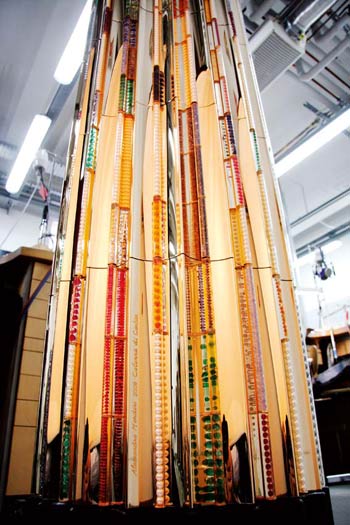
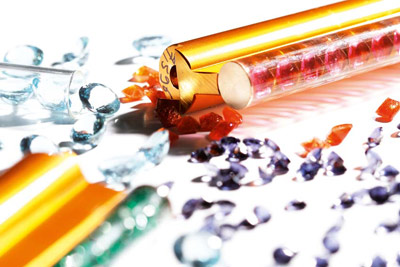
These incredible gems, a true lapidary's handbook, were classified by category before being encapsulated into crystal cylinders subsequently incorporated vertically within pink-gold flutes. This column, 2.30 m high, required over 18 months of work, from the initial sketches to the final project. In accordance with the principles of Greco-Roman architecture, this ingenuous challenge involved layering more than 7 blocks around a central axis. Topaz, citrine, peridot, emeralds: all the stones were set into epoxy resin after 80 hours of polymerisation.
Exhibited for the first time at the Art Basel exhibition, this “big jewel”, as it has been baptised by Mendini, will be displayed in an original salon designed specially for the occasion by the Mendini Ateliers.
The Cartier Column
The Cartier Column project is so exceptional that it has no modern-day equivalent. I believe this may be the first time that an artist has been commissioned to freely conceive an object x using literally thousands of stunning and perfectly-cut gems. Such a profusion of large jewels only existed in the treasures of medieval churches and of kings and sultans as pieces of extreme rarity, relics or symbols of devotion and ostentation.
But those days have since passed. Thus, when Cartier approached me and said, “Do you see this multitude of stones? We would like you to transform them into an object x, one sublime jewel that reveals the essence of each of its individual gems, a symbol of the history and craftsmanship of Cartier," I was immediately overcome by a rush of mixed emotions - joy, fear, and apprehension. I felt joy and pride at the prospect of creating and presenting a vast collection of the purest materials known to nature (semi-precious and precious stones). Yet I feared proceeding with arrogance and presumption (the ultimate form of excess) and was filled with the doubt that can seize even the most conscientious of designers when faced with such an unusual and daunting task. In today's cruel world, I felt I wanted to create an idealized symbol of utopian purity, one that would replace religious devotion and the ostentation of royal power with a non-religious, abstract, and spiritual treasure.
I wanted the viewer to forget for one moment the folly and drama of the contemporary world and be struck by the purity of gems, pearls, and precious stones, materials of nature that stand the test of time. These are miracles of God, small constellations of perfection and beauty normally admired alone or grouped together in small ornate compositions. In my object x, they are present by the thousands, brought together in new sequences. The surprising amount of gemstones at my disposal and the powerful combinations they inspire led me to base my design on a “neutral” form so that I could focus all of my attention and energy on experimenting with the play of light, reflections and colour on the precious stones. From here I designed a 233 cm-high gold-plated cylinder - a column with a diameter of 45 cm with 20 vertical flutes, each containing an alignment of crystal tubes filled with stones and carefully placed one on top of the other in a logical sequence.
And thus object x was born, the "Cartier Column", a column without limits, a representation of secular passion, a classification tool for the world's most beautiful minerals, a museum presenting every type of precious stone found in nature. Each stone rises up in a glass tube, like mercur y in a thermometer recording a patient's temperature. In the case of the “Cartier Column”, the mineralogical fever is virtual and obsessive. An analytical object, its alignment of precious stones succeeds in conveying the force and spiritual magic of its own aesthetic representation. It is a cylinder, a column that recalls a blurry and detached neo-classical memory, alien to the modern age, but nevertheless a new artistic presence. This column is the result of the expertise of Cartier 's workshop and jeweller y design school, a powerful example of extraordinary craftsmanship. It is a vision, a mirage of unchanging yet evanescent dots of light multiplied by their own reflections in the golden flutes, an orderly constellation of sparkling facets and edges. This piece has been created as the sign and the symbol of unattainable purity.
Alessandro Mendini
The “Cartier Column” by Alessandro Mendini
Total height: 2.33 m - diameter: 45 cm - weight: 720 kg
Materials used
Exterior surface:
23.6 kg of 18 carat gold - colour: 4N pink gold
140 flutes
Thickness: 5 tenths
Height: 30 cm
Width: 7 cm
Average weight per flute: 165 grammes
Base: black granite
Cover (upper part): bronze covered with 5 microns of gold
329 tubes:
(255 measuring 10 cm - 57 measuring 20 cm - 17 measuring 30 cm)
Total weight of stones and pearls: 17,763.079 carats
Diamonds: 61 carats
Emeralds: 920 carats
Sapphires: 3,067 carats
Rubies: 1,293 carats
Pearls: 9,865 carats
Tourmaline: 695 carats
Aquamarine: 75 carats
Chalcedony: 831 carats
Amethysts: 336 carats
Garnets: 295 carats
Moonstone: 307 carats
Cordierite: 17 carats
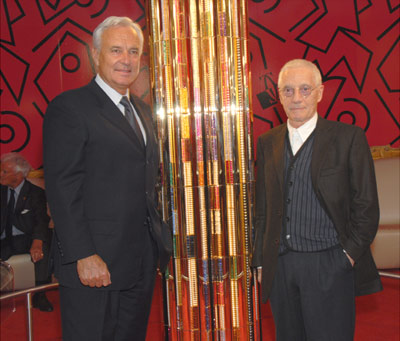
Alessandro Mendini - Biography
Architect Alessandro Mendini was born in Milan in 1931. He
has directed the magazines Casabella, Modo and Domus.
Monographs on his individual work and projects with the Alchimia group have been published in different languages. He designs objects, furniture, concept interiors, paintings, installations and architecture. International collaborations include Alessi, Philips, Cartier, Swatch, Hermès and Venini. Alessandro Mendini is a design and image consultant to different types of companies, from Italy to the Far East. He is an honorary member of the Bezalel Academy of Arts and Design in Jerusalem. In 1979 and 1981, he was awarded the Compasso d'Oro of design, while in France he carries the title of Chevalier des Arts et des Lettres. He is the recipient of an honorary title from the Architectural League of New York and was awarded an honorary doctorate degree from the Milan Polytechnic. At the Universität für angewandte Kunst in Vienna, Mendini has worked as a professor of design. He is an honorary professor at the Academic Council of the Gangzhou Academy of Fine Arts in China.
His work is featured in many museums and private collections. With his brother Francesco Mendini, he opened the Atelier Mendini in Milan in 1989. Projects include the Alessi factory in Omegna, the new Olympic pool in Trieste, a series of subway stops in Naples, the refurbishment of the Naples City Hall, the Byblos Art Hotel Villa Amistà in Verona, Italy, the new offices of the Trend Group in Vicenza, the renewal of three industrial areas with buildings for commerce, offices, apartment hotels and homes in Milan Bovisa, a tower in Hiroshima, Japan, the Groninger Museum in Holland, a district of Lugano, Switzerland, the Madsack office building in Hanover, a commercial building in Lörrach, Germany and other buildings in Europe and the USA.
Mendini and the Atelier are currently coordinating a public project in Korea that entails a number of buildings: “Milan Design City”, which includes the new Incheon trade-show center and a branch of the Triennale di Milano.
All of Mendini's different types of work - theoretic, written and design-oriented - are rooted in the crossroads between art, design and architecture.