There is a curious tension in the world of diving watches. This tenuous thread that watchmakers are careful not to break must nonetheless connect two incompatible necessities: on the one hand, the irrepressible desire to wear an authentic diving watch, the original, the one that every collector wants to own; on the other, the realization that a model like this is now outdated and would struggle to withstand even a simple shower. It's quite a tricky balancing act that involves on the one hand safeguarding aesthetic appeal, on the other introducing innovations - such as new materials, helium valves, additional complications, style elements (interchangeable straps) - and all while ensuring compatibility with an ISO 6425 norm that has been modified twice since its creation in 1982 !
FIRST MILITARY STEPS
Through gradual successive improvements, watchmakers have nevertheless managed to maintain both desirability and technical sophistication. Today, the world of diving watches can be divided into three categories. First, there is the military type, dating back to the 1930s and 40s. Panerai was a leading player in this field. The brand equipped the Italian Royal Navy with compasses, depth gauges and then watches for combat swimmers. As these divers mainly operated at night, Panerai used a radium-based luminescent material developed in 1916 and called Radiomir. This was followed by a second patent in 1949, which gave rise to Luminor. The rest is history, as Luminor and Radiomir became Panerai's two flagship ranges.
THE DAWN OF CIVILIAN DIVING WATCHES
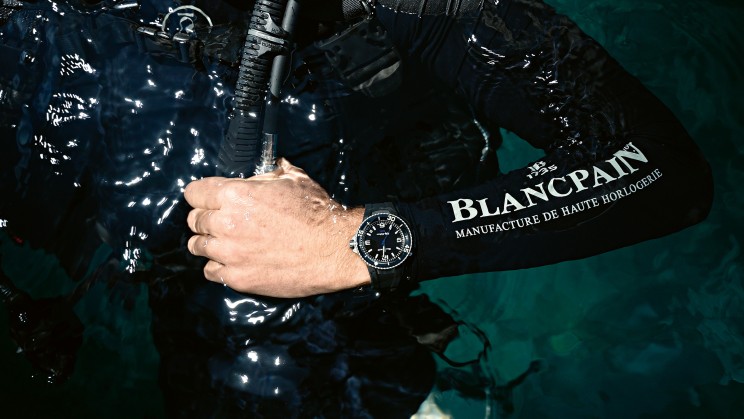
The civilian market opened up in the 1950s, headlined by the iconic Rolex Oyster Submarine created in 1953. Its operational character is best represented by the limited-edition COMEX series, named after the Compagnie Maritime d'Expertise, a Marseille based company founded in 1962 that specialized in deepsea operations. It was around the same time - between 1955 and 1965 - that recreational scuba diving developed. The link between the military and civilian worlds had already been established by Omega. While the latter had been working on waterproof watches for the Royal Air Force since 1939-1945, the Seamaster released in 1948 was a civilian model developed to mark Omega's 100th anniversary. The operational watch thus gradually became available to the general public. Winner of the 1956 Palme d'or at the Cannes Film Festival, Louis Malle's The Silent World movie about the Cousteau saga played no small part in this. The illustrious figure with the red beret also wore a Blancpain Fifty Fathoms. Designed by Blancpain's then CEO Jean-Jacques Fiechter, it was the diving watch that won over the general public. It remains one of the spearheads of the Blancpain collections, constantly updated and perfected.
THE SIXTIES SPELL FREEDOM
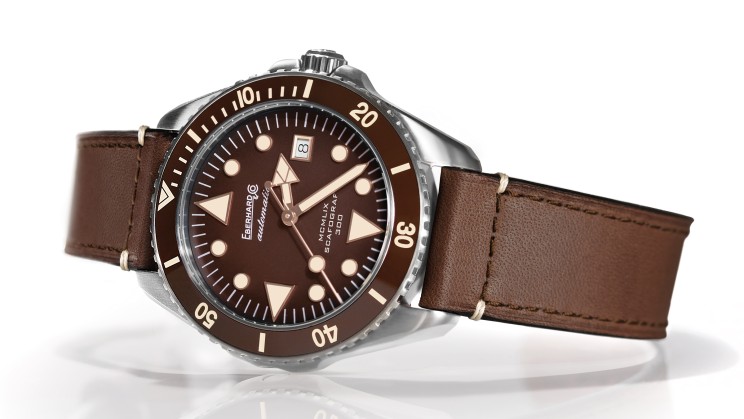
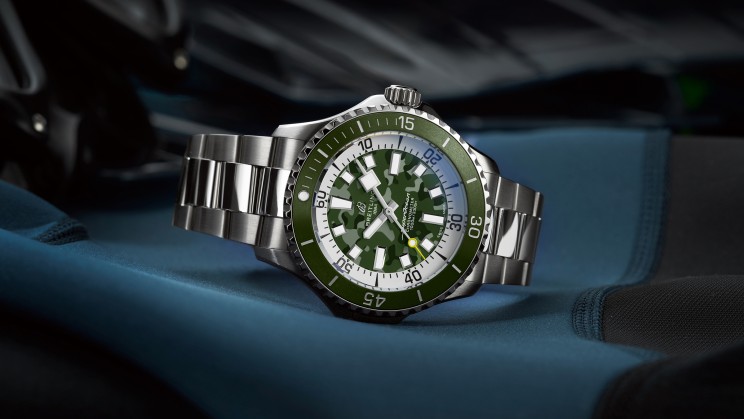
From then on, designs became more free-spirited, reflecting the age of the first transatlantic crossings that allowed Europeans to explore new horizons. Enter Breitling with the Superocean. The watch made its mark in the 1960s with revamped designs attuned to the zeitgeist. Milanese mesh appeared and diameters diversified from 39 to 48mm. The current collection is a direct descendant: youthful, cool and trendy, yet highly technical and accurate. The Italian-Swiss route pioneered by Panerai in the 1930s and 1940s has also survived in the civilian world. It is currently represented by Eberhard & Co., notably through its iconic Scafograf diver's watch designed in 1959 that found its way through subsequent decades, culminating in an impressive 1,000 meter water resistant model unveiled in 1983. The Scafograf is still part of the collection at Eberhard & Co, based in La Chaux-de-Fonds and independently run by the Italian Monti family. The quest for new records continues with contemporary watchmakers such as Richard Mille, whose RM 032 Automatic Flyback Chronograph has just been released in an 'Ultimate' edition, combining titanium, carbon as well as the complication after which it is named. Might this be a window onto the future of diving watches ?
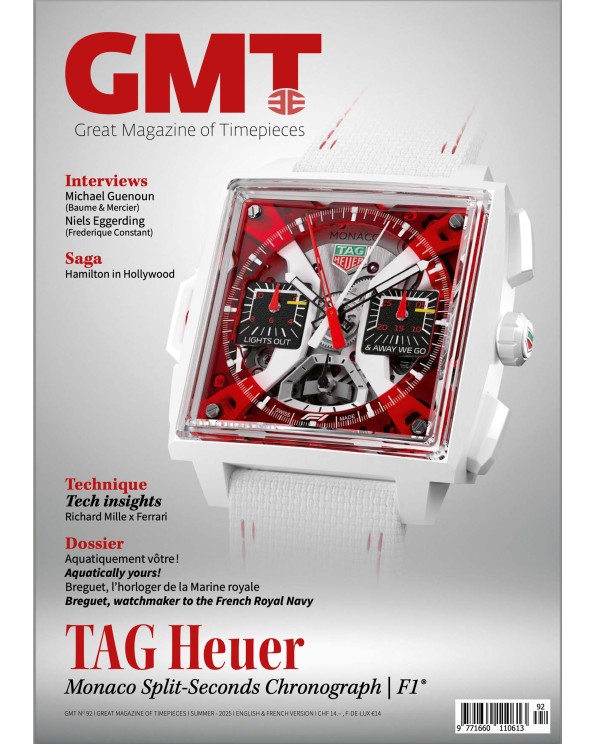
Because you are a WorldTempus reader, we are delighted to offer you the digital version of the "GMT 92", which you can download here.