My excitement rose as I headed over to the Palace hall on Baselworld's press day to pick up my test watch for the week: not often have I had the chance to put such a rare and unique watch on my wrist.
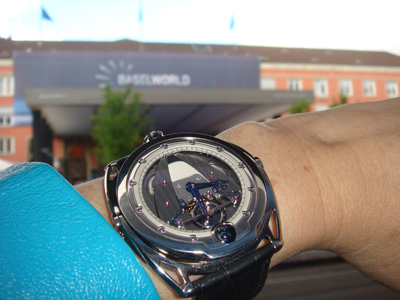
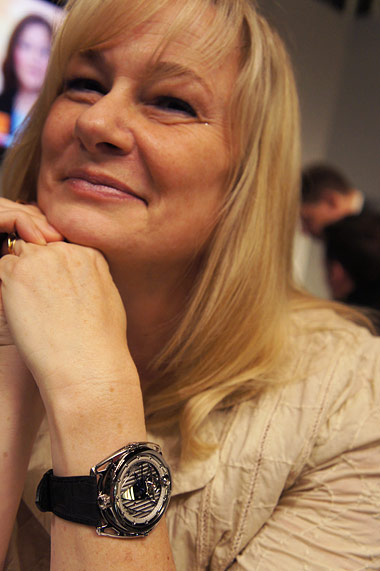
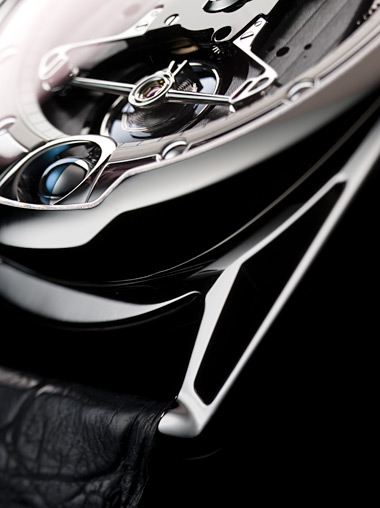
At 43 mm in diameter and a very svelte and wearable 11.3 mm in height, in polished titanium De Bethune's DB28 really flies under the radar in terms of being noticed on the wrist by those outside the industry. This indeed was a comforting side effect, for large watches in rose or yellow gold can be a scary proposition for a little wrist. This timepiece is, however, eminently recognizable to those involved in the watch industry, and once an aficionado got a look at my wrist, the conversation remained on this timepiece for a long while – envious comments, broad enthusiasm, and downright wonder in the eyes were the most common reactions. This watch's comfort is enhanced by what the company calls its floating lugs. These patented, spring-loaded elements are attached at mid-case and entirely movable to ensure a snug fit regardless of the wearer's position. In fact, the combination of the floating lugs and the titanium case made for one of the most comfortable watches I've ever had the pleasure to wear.
Since there is no name brand emblazoned on the front of this watch, it would be hard for a non-enthusiast to know which brand makes this beauty. I find this to be a very endearing element, since wearing such a watch is not about subscribing to a marketing concept. De Bethune models with more conventional dials do include the logo, but very discreetly. The DB28's dial, serving as a “window” into the mechanics, is in reality the movement's base plate, which consists of an interplay of high-polished and matte-polished stainless steel. The côtes de Genève of Caliber DB2115 is applied at a different angle than usually found in Swiss watches, which enhances its post-modern feel. I never tired of looking at the mechanics – in fact, personally, I very much appreciate having the mechanics on the front. I am one of those people who immediately turn the watch over to inspect it from the movement side before going back to look at the dial when I look at a new watch. For an enthusiast such as myself, having interesting parts of the movement visible where the time is also displayed is like being in heaven.
The main attraction for the eye is not necessarily the time – though I found the blued steel hands very legible under every lighting circumstance – but rather the two elements found at the bottom of the “dial” near the 6 o'clock position. The De Bethune escapement with its silicon-palladium balance wheel is the main draw and was often mistaken for a tourbillon thanks to the very visible bridge holding it in place and the triple pare-chute shock-absorbing system that keeps impacts to the balance staff to a minimum. The three-dimensional moon phase located directly underneath it that will only deviate by one full day in 122 years – an extremely unique and easy-to-read display – was one of my favorite elements (though at times it was not recognizable by observers for what it was).
Some very luxurious watches have slightly disadvantageous elements to them that only become visible when the watch is worn for a period of time. I am happy to report that this particular timepiece had none of that, except maybe one small detail: placed at 12 o'clock, the crown's location adds to the extreme comfort and aesthetics of the piece. It is, however, a screw-in crown, which I personally found slightly unnecessary – though I may be alone with this opinion. With an extreme power reserve of six days provided by the twin spring barrels, it was not necessary for me to use it much, though. The power reserve display on the solid titanium case back was a nice touch and allowed me to check the status of the mainspring at my convenience. Additionally, I was very pleased at the extreme accuracy of the timepiece. Without a second hand it is harder to measure, but I kept track of the minute hand every morning, and I am certain it did not budge off the correct position even once. Technical director Denis Flageollet's perpetual quest for perfection has been practically fulfilled, at least in my book.
On my last day at Baselworld, I walked back to De Bethune's booth in the Palace thinking, “This timepiece is going to make some collector really, really happy.” Parting can indeed be such a sweet sorrow.
For comments in French by Louis Nardin, who also tested this watch, please click
here.