HH Magazine - December 2009
Christophe Roulet
Finishing gives a perfect appearance to the smallest detail of the part itself, while decoration is used to embellish a timepiece with various, often elaborate motifs. Both call on the artistic professions or métiers d'art so often referred to in Fine Watchmaking. A non-exhaustive review of some of these techniques follows.
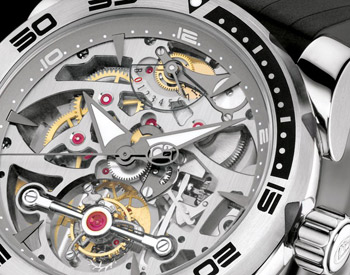
Engraving is the technique of inscribing patterns, ornamentation, numerals or letters into the movement's parts or the watch case using various methods. Engraving can have a decorative function (motifs) or be used as a form of identification (manufacturer's name, calibre reference number, hallmarks, etc.).
Modern engraving
• Mechanical engraving: most of the letters and numerals on movements are engraved by CNC machine.
• Chemical etching: the surface to be engraved is covered with a UV-sensitive protective varnish. A negative of the chosen design is positioned on top of the varnish to mask those parts to be preserved. The surface is then exposed to UV rays before being dipped in an acid reagent which only erodes the exposed metal. Chemical engraving is used for extremely precise forms with lines that are several tenths of a millimetre deep.
• Pantograph engraving: the letters, numerals or forms to be engraved are inscribed on metal templates. These guide an articulated arm equipped with a cutting tool (diamond, graver or miller) which reproduces the design to the required scale.
• Laser engraving: a digitally-controlled laser beam sweeps the surface.
Modern engraving is more productive but nothing can replace the authentic touch of the engraver's hand. Some recutting or whorls, for example, can only be done by hand. A further difference is that the artisan-engraver polishes the surface as he etches it. Machine engraving can always be finished by hand, using a sharp burin, to eliminate the unattractive mechanical aspect. Read more