For more than 165 years, Glashütte has been a centre of fine German watchmaking. Today the town is renowned as the home of Glashütte Original and its watchmaking school. The German Watch Museum Glashütte, too, co-founded by Glashütte Original and the town of Glashütte, attracts thousands of visitors every year. After touring the modern and interactive exhibition, visitors pass a further highlight of the museum: the restoration workshop of Glashütte Original. Here, guests are offered an unobstructed view of watchmakers' workbenches, tools, and watchmakers at work, all of whom are highly qualified employees of Glashütte Original.
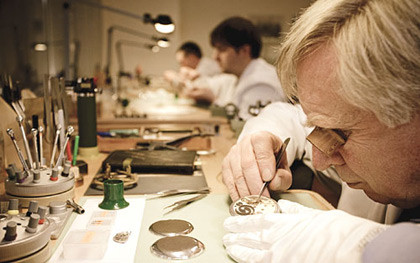
These master craftsmen have a special task. They repair and restore historic timepieces - old clocks and watches manufactured in the town of Glashütte since the middle of the 19th century. Their precious expertise serves the German Watch Museum, of course, but is also available as a service to private owners of wrist- and pocket watches, precision pendulum clocks or marine chronometers made by various famous Glashütte watch manufacturers such as Julius Assmann, Adolf Schneider, Strasser & Rohde or Paul Stübner, to name just a few.
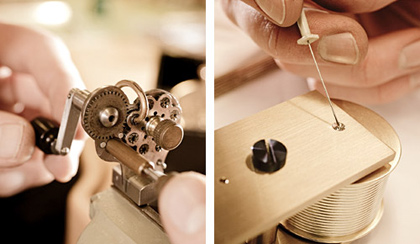
The unique expertise and value of the Glashütte Original Restoration Workshop is evident in the fascinating story of a rare precision pendulum clock discovered in the astronomical observatory in Qingdao, China, where it had served for more than fifty years and was in dire need of repair. As the rightful heir to Glashütte's long history in watchmaking, Glashütte Original agreed to inspect, restore and repair the clock and had it shipped to Glashütte for that purpose. There, Glashütte Original's expert restoration team undertook repairs and a complete overhaul of the historic timepiece, manufactured in Glashütte by the noted firm of Strasser & Rohde in the 1950s. It took the specialists ten months to restore the Qingdao gem to its former beauty; all of the components and individual parts, including the wheels, hands, dial, pendulum and wooden case were lovingly repaired or carefully reproduced.
On completion of the work, the clock was carefully packed and shipped to China, first to Shanghai and subsequently to Qingdao. It was accompanied by the expert watchmaker who was responsible for its repair and would ensure proper regulation of the heavy pendulum on arrival. The rare timepiece was ceremoniously returned in 2010 to the Qingdao Observatory, where today it serves as a witness to history and the fine art of mechanical timekeeping.