Piaget launched watches in the early 1960s featuring hard stone dials vying with the radiance of the shimmering gold bracelets. Over 30 different stones spelled the triumph of colour, while the chains and bracelets expressed the Brand's creativity and technical mastery. This two-fold virtuosity stems from a demanding approach based on unwavering standards of excellence combining time-honoured expertise, a tireless quest for the avantgarde, along with the traditional art of watchmaking. The unmistakable Piaget signature.
This major upheaval stemmed from a specific characteristic of the brand, that of ultra-thin movements.
First presented at the Basel Fair in 1957, the slim 2 mm Calibre 9P with its generous diameter afforded new opportunities for
visual expression – and spelled a genuine revolution in the field.
Technical and aesthetic innovation was conveyed firstly through watches with colourful gemstone dials and secondly through
ever more sophisticated gold workmanship. More than ever, quality and craftsmanship formed the very core of these
creations radiating an inimitable sense of exclusivity. The Piaget expertise was thus eloquently confirmed and its vocation as a watchmaker and
jeweller truly determined.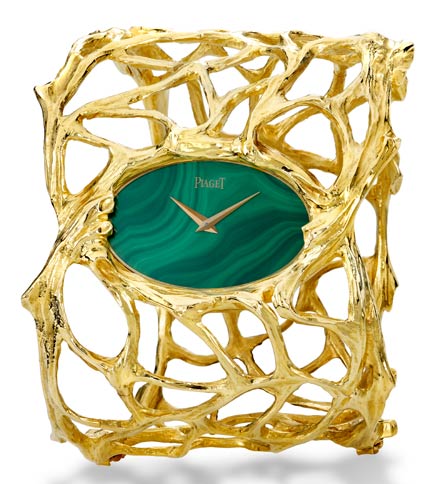
A colourful artist’s palette
Propelled by the incredible creative momentum of the 1960s, the House raised hard stones to the rank of precious stones.
The brand soon grasped the value of using these materials and immediately mastered the requisite gem-cutting skills. Colour
became the hallmark of the brand: jade, coral, lapis lazuli, tiger’s eye or turquoise… Over 30 different stones were to adorn a
stunning array of exceptional models. Thanks to their interaction with light, to their inclusions and their subtle nuances, they
gave unique character to each creation. Surfing the Op Art wave, Piaget created graphic effects by combining various hard stones. The latter indeed soon also invaded bracelets, transforming watches into full-fledge jewellery creations.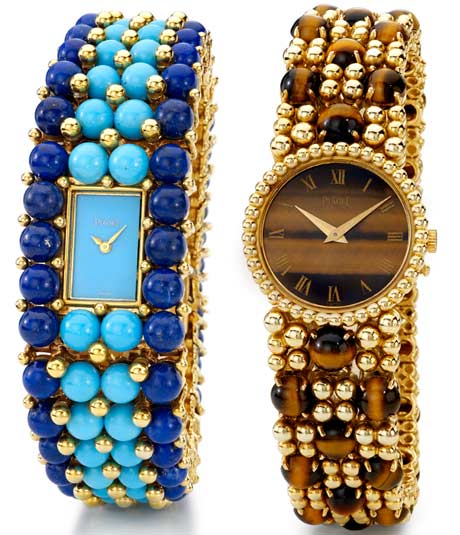
Piaget the goldsmith
Piaget took the decision in 1957 to craft its watches exclusively from precious metal. This
essential choice was to lead to the in-house integration of gold and platinum workmanship and to engender exceptional
expertise. In 1961, Piaget began acquiring various workshops specialising in goldsmithing as it sought to achieve complete
vertical integration of its production. The brand now has the means to fulfil its ambitions.
The chain bracelets represented the firm’s first steps in the pursuit of new ways of working with precious metals in order to
enhance its timepieces.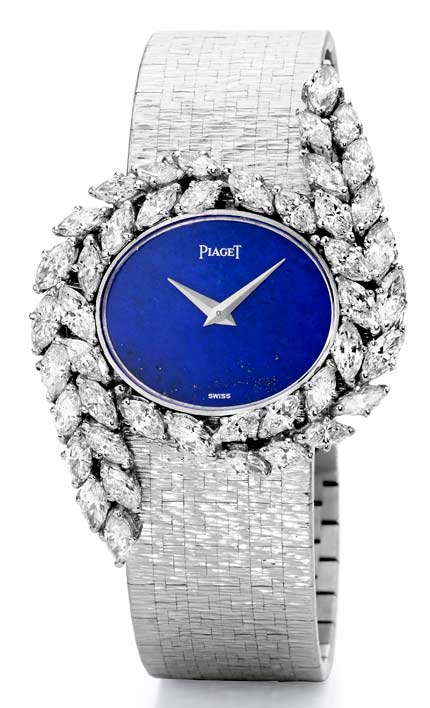
Today, the Manufacture Piaget is one of the rare companies still perpetuating the jeweller-chainmaker profession. This skill is
cultivated within a workshop entirely dedicated to this art and where numerous bracelet prototypes are stored – representing
an invaluable memory bank of expertise passed on from generation to generation.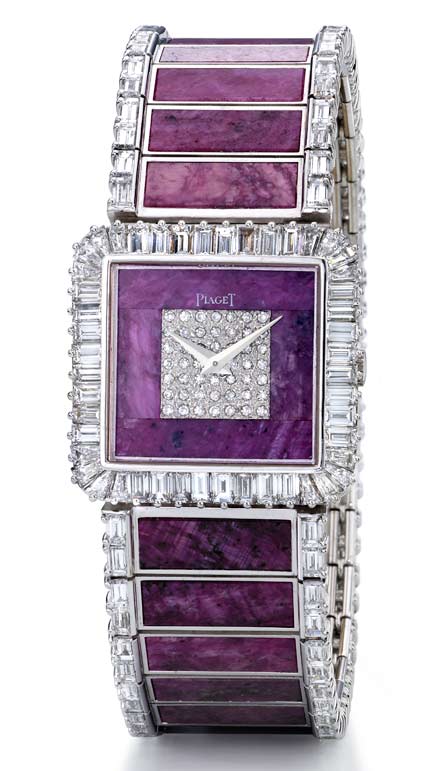
Gold and colour

The exhibition “Gold and colour” is to be seen in the Piaget Time Gallery, Geneva, from August 12th 2013 to March 31st 2014.
Featured brand