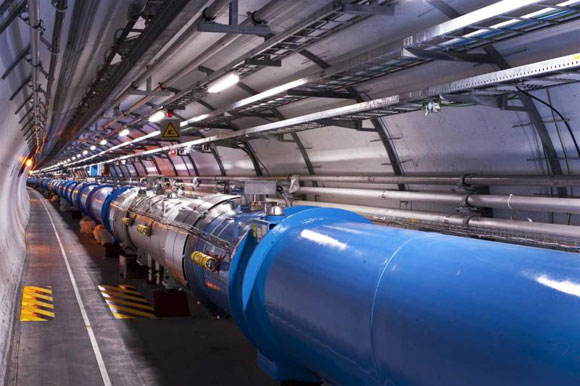
Dr Harry Cliff is a particle physicist at the University of Cambridge who works at LHCb, one of the four big experiments at CERN’s Large Hadron Collider in Switzerland. As such he is essentially looking for signs of new physics that might be detected in a huge ring-shaped tunnel that runs around the border between France and Switzerland.
Cooled to -271 degrees Celsius (just above absolute zero), the LHC can contract by up to 30 metres in diameter at its operating temperature yet still needs to remain aligned at the micron level. Furthermore, it measures time accurate to within one trillionth of a second – a level that the watchmakers working above ground just a stone’s throw from the LHC’s radius can only dream of.
"The universe is essentially a holographic projection and as a result our concept of time is just an illusion"
But what if the space-time continuum posited in Einstein’s General Theory of Relativity, which celebrated its 100th anniversary last year and is the foundation on which our current timekeeping systems are built, was just an illusion? This is exactly what the relatively recent “holographic principle” suggests. According to this theory, the universe is essentially a holographic projection and as a result our concept of time is just an illusion. Bad news for watchmakers!
Such theories remain just that, though. Although the research conducted at CERN is at the cutting-edge of physics and has already changed our understanding of the universe, the implications are unlikely to be felt overnight and time is unlikely to stand still. But as Dr Cliff explains of his work at the quantum level, where time itself becomes difficult to measure, “if physics is telling us that something cannot be measured in principle at such infinitesimal scale, then it probably doesn’t exist.”
We should understand the word “exist” here, as meaning “exist under our current understanding of the universe”. If something ceases to exist then we will need some other order of the universe to explain its absence. We can rest assured that time will march on relentlessly. Or can we? None of the equations in Einstein’s theory suggest that time moves in one single direction. This has been the basis for many a time-travelling novel or film, where it is, in theory at least, possible to travel in time (in practice, travellers on a 40-year space trip from Earth, accelerating steadily at 1g for the first half, then slowing down at the same rate before turning back and repeating the procedure for the return journey, would find that 58,000 years had passed when they arrived back on Earth). Journeys into the past, which have become the stuff of fantasy thanks to the wormholes posited in Einstein’s equations, pose more ethical and philosophical questions.
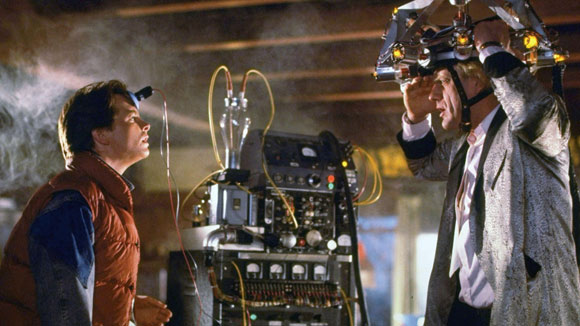
If space voyagers on the same 40-year return journey were somehow able to take one of these wormholes with them, and someone or something managed to pass through it, they would find themselves in the past. They could not travel back further than the time the machine was created, but if it was a person and they bumped into their grandfather and were tempted to kill him, they would never have existed in the first place. And just imagine what could happen if they took a smart watch with them!