Press release
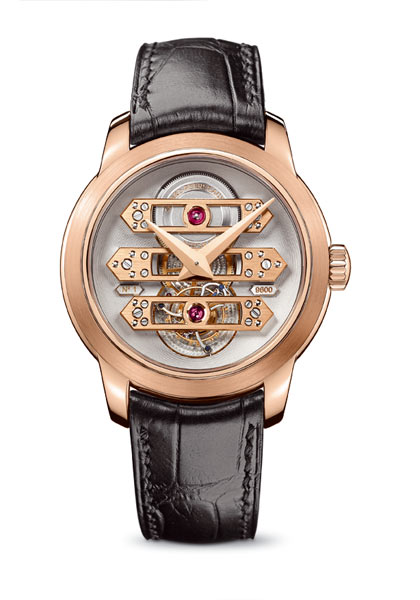
The Girard-Perregaux icon is enclosed in a round case, increased to a diameter of 41 millimetres, and exudes an elegance which is at once timeless and highly contemporary.
This new showpiece in Girard-Perregaux's Haute Horlogerie collection is the embodiment of a unique heritage whose origins date back to the middle of the 19th century. At this time, the La Chaux-de-Fonds watchmaker Constant Girard-Perregaux was conducting research in the field of the Tourbillon escapement. In 1860, he created a timepiece which was awarded a first-class prize by the Neuchatel Observatory: its Tourbillon movement featured three parallel bridges, under which the barrel, centre wheel and Tourbillon were aligned.
The watchmaker continued his quest, applying for a patent from the United States Patent Office in 1884 to protect the design of the movement with three parallel arrow-shaped bridges. In so doing, he established a completely new concept: the movement was no longer simply a technical and functional component; it was also a design element in its own right. In 1889, it received the ultimate accolade: the Tourbillon with three Gold Bridges was awarded a gold medal at the Paris Universal Exhibition.
A century later, in the late 1970s, Girard-Perregaux decided to resume production of this icon of Swiss Haute Horlogerie. It was a brave endeavour, which preceded the renewed success of mechanical complication watches. The first in a series of twenty pocket watches was created in 1981, the result of some 1500 hours of work. Since then, the Manufacture's workshops have produced a few rare wristwatches each year offering a modern take on the design.
The new 2010 version of the Tourbillon with three gold Bridges adopts a rare shape for the bridges themselves: the same as those on the watch awarded the prize by the Neuchatel Observatory in 1860. They have been reinterpreted in an openworked version which imbues the watch with a highly contemporary purity. Their stunning perfection is the result of painstaking preparation: the bridges are first of all hollowed out and carefully polished by hand. It takes seven whole days of work to obtain an impeccable finish.
The delicate Tourbillon also demands extreme attention to detail: an incredible dexterity is required to assemble its 72 components, all of which fit into a diameter of just one centimetre. It weighs 0.3 grammes - about the same as a swan's feather. Accompanying it is a self-winding system patented by the Manufacture: a small-diameter platinum oscillating weight is fitted in the space below and around the barrel. This leaves the movement's dimensions and architecture intact.
The gold case, whose proportions and curves are designed for a perfect fit on the wrist, adds a new dimension to the prestigious collection of Tourbillons with three gold Bridges, further developing the model's enduring history.
Technical specifications
Pink gold case
Diameter:
41 mm
Antireflective sapphire crystal
Case-back fastened with 6 screws
Water resistance:
30 metres
Girard-Perregaux movement GP9600C
Mechanical with automatic winding
Calibre:
32 mm
Frequency:
21,600 vibrations/hour (3 Hz)
Jewels:
30
Power reserve:
minimum 48 hours
Functions: Tourbillon, hour, minute, small second on the Tourbillon
Alligator strap with folding buckle
Limited and numbered edition of 50 pieces
Movement
Movement dimensions Diameter: 32 mm
Height: 6.25 mm
Number of components
Complete movement: 262 components
Tourbillon cage: 72 components, 0.3 g
Jewelling
30 jewels
Power reserve
Minimum 48 hours
Barrel
Guilloché and hand-engraved cover, two-tone electroplating treatment
Automatic winding
Micro-rotor mounted on barrel staff crafted in platinum, patented by Girard-Perregaux
Balance wheel
Free-sprung with gold adjustment screws (diameter 8.35 mm), lift angle 52°
Frequency
21,600 vibrations/hour (3 Hz)
Balance spring
Philips terminal curve
Main plate
Rhodium-plated, hand-applied azure finish with stippled look, polished corners, circular-grained and bevelled recesses
Bridges
Three gold Bridges, arrow shaped, bevelled and hand-polished (inspection under 10x magnifier)
Two gold marking plates, polished corners, satin-finished rim, two-tone electroplating treatment
Gear Trains
Involute of a circle profile
Tourbillon
One rotation per minute
Upper and lower cages bevelled and polished
Cage balanced with gold adjustment screws
Escapement bridges and pallet bridge bevelled and polished
Screws
Bevelled and black-polished
Steel parts
Drawn and bevelled
Display
Hour and minute
Smalls seconds on the Tourbillon
Exterior
Case materials and finishes
Pink gold with domed sapphire crystal
Case-back fastened with 6 screws
Hand-engraved individual number
Case dimensions
Diameter: 41 mm
Height:
11 mm
Water resistance
30 metres
Crown
Gold, with engraved Girard-Perregaux logo
Hands
Hour and minute, in gold
Small seconds in blued steel on the Tourbillon cage
Strap
Black hand-stitched alligator strap, with gold deployant buckle with Girard-Perregaux engraving