The workshops of the Hermes watch company in Bienne have now welcomed a major new arrival. Since October 9th 2006, they are home to the Hermès watch-strap workshop. High-precision mechanical engineering and fine leather craftsmanship, now performing together in perfect harmony.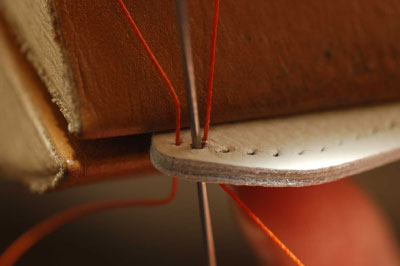
It was always meant to be. In the 1920s, Hermès made its entry into watchmaking through its watch straps. Today its leathers are coming to Switzerland. The two faces of the Hermès watch, saddlery know-how and watchmaking creativity, are uniting at last. The company is thus providing the answer to the growing demand of its international clients and to special orders, which may be summed up in a single word: adaptability. A Hermès watch strap is a choreography performed by an array of human hands, pirouetting and passionate, working with living leathers that are always very distinctive. The curtain rises on a little-known activity within watchmaking circles, a masterful twelve-act ballet. 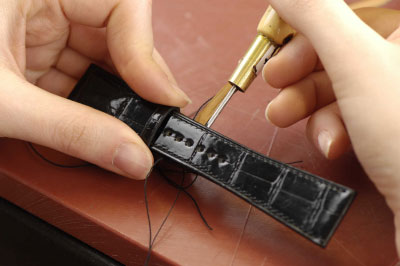
As a prelude, the hides are stored in a sealed warehouse, at constant temperature and humidity levels. These are the same as those used in manufacturing bags and saddles. The stock includes all types: goatskin, calfskin, buffalo skin, ostrich skin and alligator leather. One recognizes such Company names and qualities as robust Barenia or Epsom grain, and fine colourings like the red H. Act I involves pre-cutting and pairing for texture and aesthetic appearance of two compatible parts that will serve to make up the strap: the longer part, attached to the watch at 6 o'clock, which will be tapered, in which the holes will be pierced; and the shorter part, attached to the watch at 12 o'clock, to which the buckle will be fixed. The selection process is rigorous, avoiding wrinkles, veins or scratches, and ensuring that the two pieces have the same shade and that their crocodile scales, for example, are of the same shape and size. During Act II, the dressing and the tapering takes place, gradually and evenly thinning down the hides from their central full proportions to a paper-thickness at their outer edges, eliminating any hides that are too thick. Act III gluing, first the “viledon” fabric that holds the piece together and then the lining material. The meticulous manipulations and the working tools are as precise as those of the machines from which they derive their inspiration and which have earned the Jura mountain region its formidable reputation. Act IV consists of precision cutting and represents the point at which the leather begins its transformation. At this stage, the leather workers enter the scene to stage the twirling ballet of the finishing processes. They are multi-instrumentalists and all their tools – such as the various needles, edge beveller, bodkin or skiver – have been adapted and refined specifically for working leather. 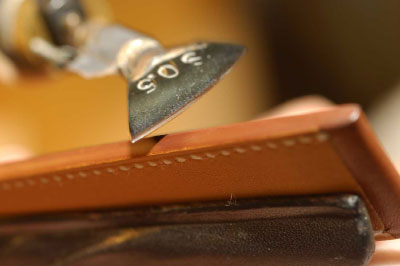
After Act V of this choreographic performance, which consists of marking with a compass or tracing the sewing line and the stitching points, the stitching itself represents Act VI. Using a single flaxen thread and two hand-operated needles crossing in each hole and finishing in three end stitches at the extremities, the artisans create the famous “saddle stitch”. Act VII takes the strap section and softens it at the edges, by rubbing and sandpapering. Act VIII involves dyeing this part, Act IX smoothing it out and Act X polishing, with each of these steps being repeated several times. In Act XI, creasing or marking a furrow between the sewing line and the edge of the leather makes the strap more supple, while at the same time enhancing its thickness.
During the final act, in a series of even more delicate operations, the two loops of the strap, one fixed and one mobile, are in turn cut out, thinned down towards their edges, glued, marked in preparation, and then once again sanded, dyed, smoothed out, further smoothed, polished and repolished. The most intricate manoeuvre of all is carried out on the fixed loop, which is sewn by hand, always in the same saddle stitch, with the needle flitting around the mobile loop without moving it at all.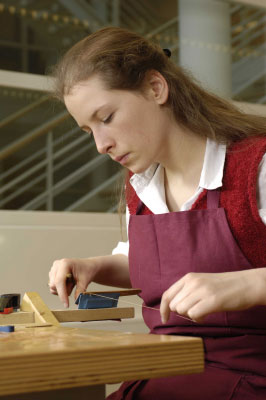
In the grand finale, the marker authenticates each strap with a letter signifying the year of manufacture of the leather, and with a geometric shape designating the most precious hides.
At last, the House logo or maker's mark is stamped on the strap, summing up the Brand in a single gesture: Hermès. Glossary Pairing
Matching two pieces of leather on the basis of their colour and appearance, for example the structure of their scales. Plain strap end
The longer of the two strap parts, at six o'clock (or attached to the bottom of the watch case), which is the tapered part where the holes are pierced. Buckle strap end
The shorter of the two strap parts, at 12 o'clock, where the buckle and the two loops are adjusted. Layer cutting
Cutting length-wise through the thickness of the leather, also called “cutting in layers”. Paring
Thinning down the edges of the leather, gently and progressively, starting from the full thickness at the centre and finishing with paper thickness at the edges. Tracing
Marking a line with a compass, indicating where the stitching will be. Indenting
Making a crease in the leather to indicate the position of each stitch and the distance between them. Edge-softening
To soften the border or the edge of the leather. Saddle stitching
Hand-stitching, using a single thread and two needles, which cross each other in each hole, ensuring greater overall resistance.