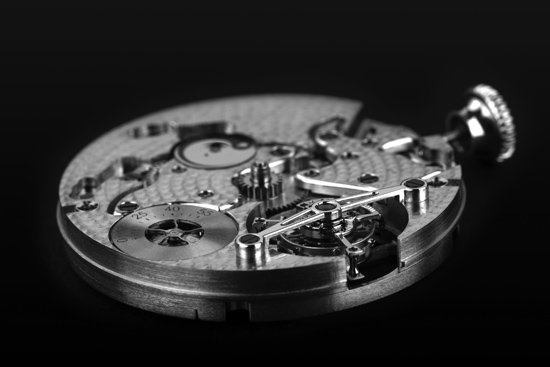
Starting from 2007, and over the best part of the next 5 years, Fabien Lamarche would put together an expert, autonomous team: the forty watchmakers, genuine master craftsmen of time, now make every Julien Coudray 1518 watch, from design to assembly, as well as decoration. True to the philosophy of the firm, they also question the limits of their trades by setting themselves ever more ambitious goals, and take the time to achieve them, without ever giving up. This decision to rely on "teamwork" and this passion for a challenge are not driven simply by the quest for quality, but also by the Manufacture's desire to perpetuate its know-how, by encouraging internal transfer of this know-how from the outset. Keeping to this fundamental principle is made easier by the Manufacture's location in Le Locle, at the heart of the historic region of Swiss watchmaking, which undoubtedly packs in more micro-mechanics expertise than anywhere else in the world.
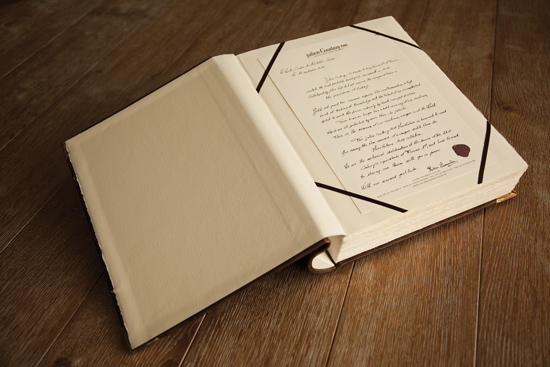
See also video presentation of the manufacture
Combining science and art, technology and aesthetics
this is the principle on which the Manufacture designs and makes every single watch. Here everything starts with the movement. Since it opted to manufacture each of the main components from a solid precious metal, the Manufacture designed and manufactured new tools and taken on the entire watchmaking process, starting with the design of the movement components worked to a microscopic level of precision. So in a Julien Coudray 1518 calibre, the arm wheel arches are no longer square: Fabien Lamarche redesigned them as a curve, an exclusive shape better suited to the qualities of endurance that they must exhibit. Similarly, the winding stem fastening system – the subject of one of the ten patents filed by the Julien Coudray 1518 Manufacture – was completely redesigned to prevent the risk of damaging the movement in the final steps of its production.
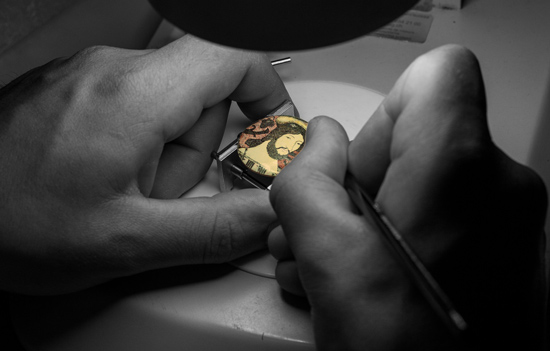
In the field of decoration, the patterns are inspired by the Renaissance style and the elaborate works of architecture and the decorative arts, with in-depth research a vital part of the manufacturing process. The enamel indexes of the Manufactura 1528 watch underwent a battery of tests – including the development of specific techniques – so that the eye beholds an immaculate surface, slightly domed and perfectly polished. Along the same lines, the plique-à-jour enamelled dial of the Competentia 1515 watch was the subject of a host of investigations, to produce a genuine stained-glass window offering a glimpse of the decorations on the movement components.
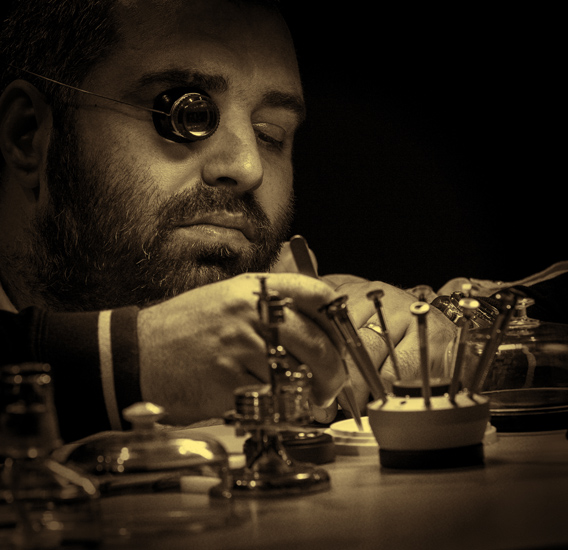 See our video on the art of enamelling in the manufacture
See our video on the art of engraving in the manufacture
See our video on the art of bevelling int the manufacture
See our video on the art of assembling in the manufacture
There is nothing to rival precious metals for standing the test of time
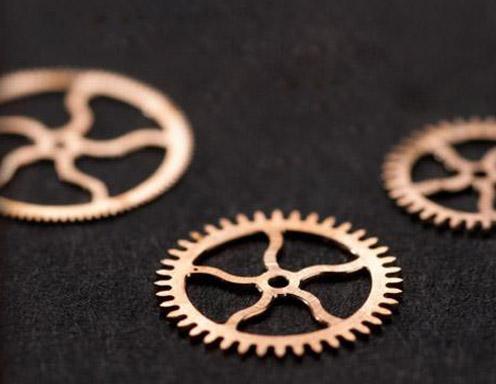
Doubtless because watchmakers, more than anyone else, have a firm grasp of the passage of time and a love of precision, the Manufacture has chosen to work only with materials that will survive the centuries, and whose durability will maintain the precision of the watch. Whether for visible or invisible parts, solid gold and platinum, plus traditional “grand feu” enamelling, are the only materials adopted for making the movement, case and dial of watches, which therefore become inalterable. Similarly, there is no chemical coating or plating involved at any stage in the manufacturing process. True to this desire to leave an enduring mark, the Julien Coudray 1518 Manufacture makes and sets aside for every watch produced the spare parts that might prove necessary, even in the distant future.