Before creating his company, Fabien Lamarche spent around 20 years serving a variety of prestigious watch brands, including as Process Manager at Breguet, Product Manager at Roger Dubuis, module and automaton developer at L.Leroy, and a spell as head of methods and industrialisation in the mechanical and prototype department at Zenith. It was in 2007 that he decided to turn independent in order to fulfil his dream of creating the ‘Manufacture de grande horlogerie’. Within five years, he built up a ‘collective’ composed of around 40 carefully selected individuals able to handle the production of all parts of a watch, and all driven by a determination to pass on their respective skills. As well as working as a supplier to other firms, he was steadily preparing to launch the brand that was introduced in 2012, Julien Coudray 1518 – of which he agreed to give us a broad overview.

Marie Le Berre : Why the name Julien Coudray 1518 ?
Fabien Lamarche : “In tribute to the ‘horologist’ who in 1518 invented the portable watch. Invited by King Francis I of France to the sovereign’s castle at Blois, he managed to insert sprung movements into the pommels of two royal daggers. Generally speaking, I am very fond of the Renaissance era. The ways of thinking, acting and creating were a state of flux, as science and the arts experienced a period of unprecedented effervescence. My goal is to transpose the spirit of the Renaissance into this 21st century brimming with new discoveries, by creating watches that are highly exclusive, in a way, inherently ‘regal’”.
What does your “Manufacture de grande horlogerie” actually encompass?
“It’s our way of emphasising our personality. ‘Grande’ evokes fine craftsmanship, a rare mind-set, a different way of envisaging watchmaking, and this approach takes on its full meaning with the choice of exclusively noble materials, including for movement production. The parts are in solid yellow, pink or white gold, or in platinum. Alongside their prestige, these are durable materials that will stand the test of time while safeguarding the precision of the watch. For the same reason, they do not undergo any chemical treatment or plating. This led us to develop new tools and to review the entire production process. For example in a Julien Coudray 1518 calibre, the spoked wheels are not cut out at right angles but instead curved, a shape more conducive to the desired durability. In the same way, the winding-stem fastening system – duly protected by one of the ten patents filed by the Manufacture – has been redesigned to avoid any risk of it damaging the movement during the final stages in its crafting. In terms of decoration, we naturally draw inspiration from the Renaissance style, from its architecture and its decorative arts, as well as undertaking in-depth research aimed at achieving perfection. We have thus developed specific techniques for creating slightly domed enamelled hour-markers with a pristine surface; as well as a stained-glass window type dial in plique-à-jour enamel that subtly reveals the movement decoration.
Could you introduce us to the Julien Coudray 1518 collection?
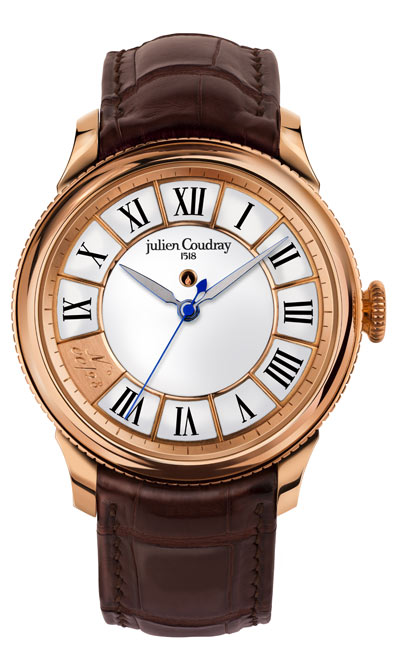
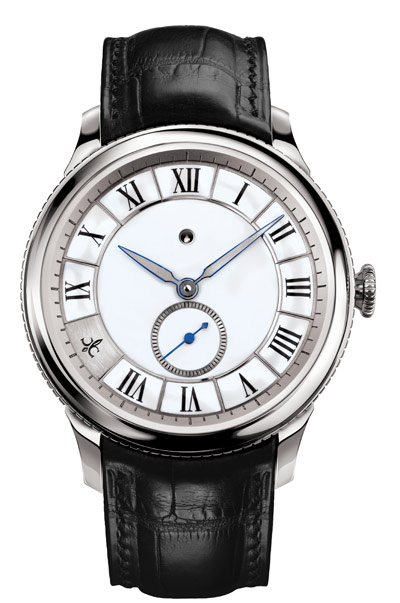
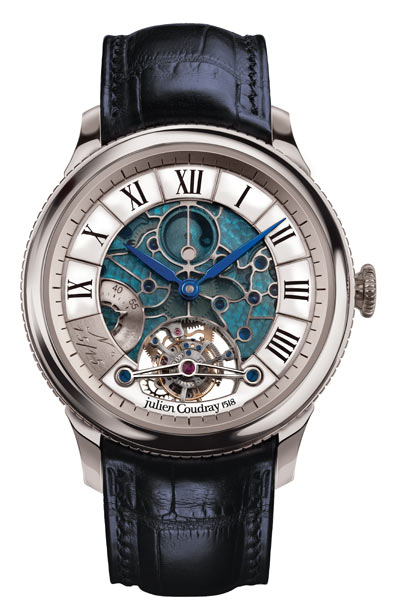
Last year, we launched our two first lines offered in four strictly limited series (yellow gold, red gold, white gold and platinum versions), alongside the option of personalised one-of-a-kind models. The Manufactura 1528 watch is driven by a three-hand manually-wound calibre equipped with a service indicator – a rare function that signals the need to have a maintenance service performed every four years. The bridges, which are visible through a sapphire case-back, are engraved with a Renaissance motif and the grand feu champlevé enamelled dial is a modern interpretation of historical steeple clocks. The Competentia 1515 model is a hand-wound tourbillon watch with service, day/night and power-reserve indicators. While the rim of the dial reflects the layout of 16th century clocks, it is distinguished by a sophisticated translucent plique-à-jour enamelled centre. At Baselworld (atten Baselword ici en FR) 2013, we are presenting our third creation, the Classica 1548, an evolved version of the Manufactura 1528 distinguished by a larger case, a small seconds display and a 100-hour power reserve instead of the previous 55 hours.