Worldtempus -13 August 2012
Carlos Torres
In 1551, eight years after the first Portuguese had arrived at Japan's shores, Jesuit priest João Rodrigues presented Yoshitaka Ohuchi, the daimio of Suo (the ancient name of today's prefecture of Yamagushi), with a mechanical clock. It was to be the first example of its kind to enter the island nation, then ruled by the Ashikaga shogunate. The same João Rodrigues was later responsible for holding the first clock making course near Nagasaki around 1600.

Masahiro Kikuno is certainly one of the spiritual descendants of those students who first made contact with the western art of clock making more than four centuries ago. Kikuno is also the first Japanese candidate to enter the prestigious circle of the A.H.C.I., the Académie des Horlogers Créateurs Indépendants, an important step in the career of the young watchmaker and one that also certifies his high level of workmanship.

In 2005, at 22 years of age, Kikuno graduated from the most important watchmaking school in Japan, the Hiko-Mizuno in Tokyo, where he presently works as an assistant. During these last years his genius has produced some complicated pieces with retrograde indications and single and multi-axis tourbillons. His latest creations include the first perpetual calendar with tourbillon made in Japan and two remarkable wristwatches inspired by the old traditional temporal hour system of the Edo era.
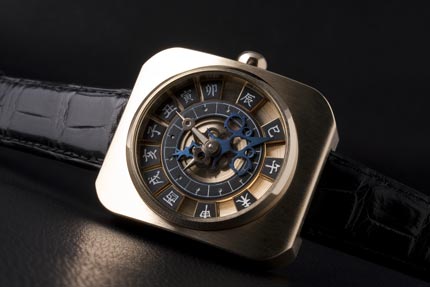
Japanese temporal hours of a Wadokei wari-koma
The temporal hour watch Kikuno has made is the first automatic winding Wadokei incorporating a dial that displays the hours according to the “wari-koma” technique. “Wadokei” is the name given to all the Japanese clocks that show the hours according to a system in use during the Muromachi era of the fourteenth century. Its use spanned the entire Edo era (1603 – 1868), only to disappear with the local implementation of the western calendar by the Meiji government in 1873.
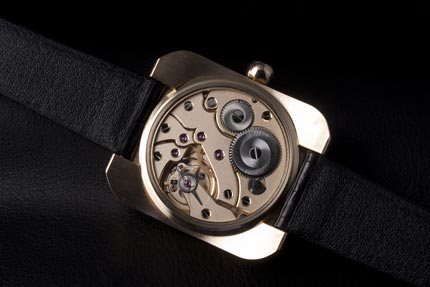
The time measuring system used during this period of Japanese history was variable and followed the seasons. In full contrast with the conventional daily 24-hour division of equal length we all are familiar with, the Japanese seasonal time measuring system separates nighttime from daytime through the use of hourly periods of variable duration. These are divided into two sets of six units called “koku” ( ? ). Each koku bears the name of one of the 12 noble animals of Japanese culture, from the rat (?) to the boar (?), and were numbered in an unusual way. Midnight, the hour of the rat, was associated with number 9, while 6 represented dawn. The numbering continued, with the number 4 was the last koku before noon. As with midnight, number 9 also represented noon, and the sequence repeated itself along the afternoon and beginning of the night. Numbers 1, 2 and 3 were not used in Japan for religious reasons as they corresponded to the number of bell strokes used by Buddhist monks as a call for prayer. The crucial times in this seasonal system were the boundaries between daytime and nighttime. These points in time, at dawn and dusk, were defined as the times when three lines on a human hand became visible or invisible. This was a moment that necessarily changed through the seasons of the year and for which it was paramount to come up with a specific measuring system; this led to the creation of the so-called “nichõ-tempu” and “wari-koma” clocks.
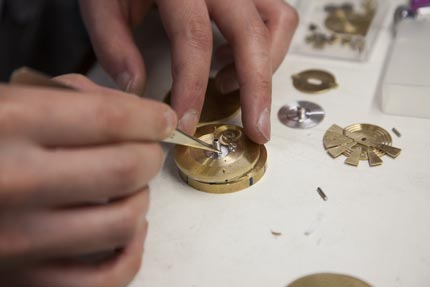
The nichõ-tempu and wari-koma clocks
The nichõ-tempu system utilized the oscillation of two foliots (a forerunner of today's Swiss lever escapement) operating serially and alternating between the beginning of the night and the beginning of the day. Weights were positioned along the foliot bars so that its oscillating time could adapt itself to the variable hours of the seasonal time measuring system. These positions were modified twice a month and at each sekki ( ?? ) (the name given to the 24 points of the Japanese calendar that define the change of each season) or at the beginning of each lunation. With this system in place, the hands of the clock turned at a variable speed during the six daytime and the six nighttime hours.
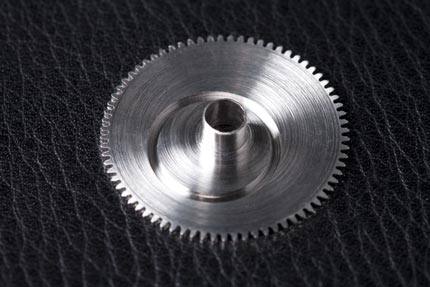
The second system – simultaneously the one Kikuno uses in his Japanese Temporal Hours Wadokei watch – is called wari-koma. It utilizes movable elements that are repositioned twice a month in order for them to correctly indicate the seasonal time. Almost all these wari-koma clocks were adjusted by hand, although some rare exceptions are known to exist in which the mechanism automatically adjusts the movable elements to indicate seasonal time. Built in 1851 by Hisashige Tanaka (the man that is at the origin of what is today the Toshiba company), the annual astronomical clock known as Myriad is one of those rare examples and largely exceeds the usual complexity of the Japanese clocks of the mid-nineteenth century. The highlight of this clock is unquestionably the indication of the Japanese temporal hours that doubles as the most complex part of the clock's mechanism, which is responsible for the motion of the plates necessary for the representation of the hours of variable length.
Masahiro Kikuno's Wadokei
The Wadokei built by Masahiro Kikuno was precisely inspired by Tanaka's creation; it utilizes an eccentric wheel connected to a cam that is responsible for the progressive approach and separation of the hour plates decorated with corresponding ideograms (called Kanji). The evolution of the duration of each six-hour period representing day- or nighttime is displayed on the dial by the variable positioning of each koku. As such, the space between each daytime hour marker will be at its maximum during the day period of the summer solstice and at its minimum during the winter solstice. The opposite is obviously also true for the nocturnal hours. However, the timepiece made by Kikuno includes an additional complication: hidden in the Japanese temporal hour indication itself is an accurate equation of time, which the system needs in order to indicate the variations in length between day and night over the course of the year.
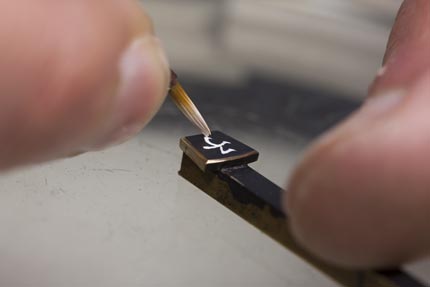
For the second watch, Kikuno decided to adapt the system to Western culture. With this purpose in mind, the young watchmaker substituted the six hours of daytime and the six hours of nighttime for two twelve-hour periods distinguished by their white and black colors. The temporal hour hand, identified by the representation of a sun in its extremity, will therefore complete an entire rotation every 24 hours and will share its axial position with three other hands needed for the indication of the months, and Western hours and minutes, which make use of a scale comprising 12 dots marked upon a concentric disc.
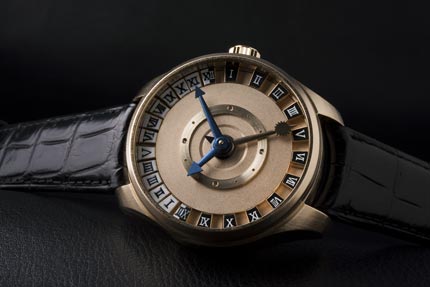
Masahiro Kikuno presented these watches at the 2011 edition of Baselworld, where he exhibited at the A.H.C.I. booth. I dare say that it is certainly not the last time that we will be hearing from this talented young Japanese watchmaker, and I hope that we have not witnessed the birth of the last Wadokei.