
Slyde sparks the most extreme comments, from being described as a stroke of genius or an elaborate bluff. Its founder Jorg Hysek has heard it all and such reactions are doubtless a source of mild amusement for this born anti-conformist who enjoys making light of hasty judgements.
Many brands claim to be the sole occupants of their niche. While few truly are, one of them can say so with no risk of contradiction: Slyde. Which are the other Swiss digital watch manufacturers? There aren’t any.
The man behind this crazy project is Jorg Hysek, better known to the general public for his eponymous Hysek brand launched in 1997. Backstage, he is also the designer of such models as Vacheron Constantin’s “222”, Kirium by TAG Heuer and the Marine collection from Breguet. Jorg Hysek remains true to his emphatic belief that “ A good designer must always be ahead of his time”. That is indeed probably what led him to create Slyde. The first watch was sold in December 2011, and the brand now based in the village of Luins (Canton of Vaud) has a 20-strong staff and is distributed in over 150 points of sale worldwide.
The elusive Jorg Hysek

All designers’ first drawings end up being amended for various technical reasons. Even the boldest designs cannot escape the fact that a watch comprises a mainplate, jewels, gear trains, an oscillating weight, a crown and so on – all of which means that initial sketches must be adjusted to take account of these technical realities.
Slyde does the exact opposite: by digitalising its movement and thus breaking free of any technical constraints, the brand could develop any case shape it wished. Yet Jorg Hysek opted for a traditional tonneau or barrel-shaped version. A way of thumbing his nose at the watch industry?
«One should never be confined within a given style or conventions»
With Slyde, he has in fact returned to more traditional designs – while purely and simply eliminating the mechanical movement. Nonetheless, Hysek admits to being “almost behind in the game again”. The brand is progressively asserting itself, despite the early doubts expressed by many observers: “everyone told me it wouldn’t work, but by dint of energy and sheer willpower, it does work”, he now points out.
Anything but a smartwatch !
Just as the man himself can prove elusive, so too the brand is hard to grasp due to a lack of reference points. The “digital watch manufacturer” segment simply does not exist apart from Slyde. What about its clientele? “Definitely people with a knowledge of mechanical watchmaking”, explains Jorg Hysek. That often implies collectors, and such individuals looking for “watchmaking of the third kind” may well choose a model that breaks with conventional codes while also bridging the generation gap. There are indeed cases of parents wishing to gift their children an atypical watch – and what better way than Slyde to introduce young people to watchmaking?
«Technically, there is no limit to digital simulation»
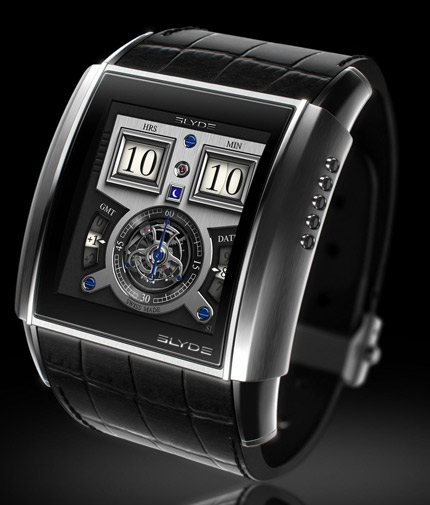
Making light of hasty judgements
Although the easiest criticism is its inevitable direct antagonism with mechanical horology, this argument is not tenable in that the two products occupy entirely different niches. They are thus in fact not on opposing sides, but are instead complementary.
At the end of the day, Jorg Hysek’s use of the aesthetic codes of traditional watchmaking, particularly in terms of finishes (gold, PVD, titanium, etc.), is merely a means of outwitting the opposition. Jorg Hysek can in fact dare to make all kinds of watchmaking analogies: he knows that those who have grasped the Slyde concept will not actually draw such parallels. Critics actually offer him the best possible exposure, in accordance with the well-known adage that “bad publicity boosts sales”.
Looking ahead, above and beyond the design itself, Jorg Hysek is examining potential upcoming functions for his Slyde: “one might imagine interaction with a phone, or a vibrate mode, for example”. And thereby increase the resemblance with a smartwatch? “Not at all! It would be a question of working with something very visual and useful. Technology moves ahead so quickly that you have to give people time to get used to it. Luxury is something very vulnerable and one can easily fall into the trap of gadgetry”. While studiously avoiding any revelations, the designer is clearly already thinking about his next move…ment.