Examining a sense of time with Martin Frei, co-founder, artist and chief designer of the Geneva-based boutique brand
“If we don't have the ability to witness change, if somehow we existed in space, in a vacuum, with no deterioration or erosion, does time actually exist?”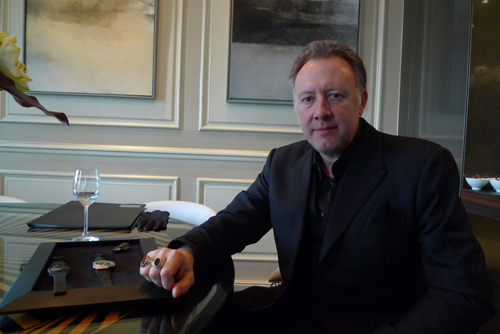
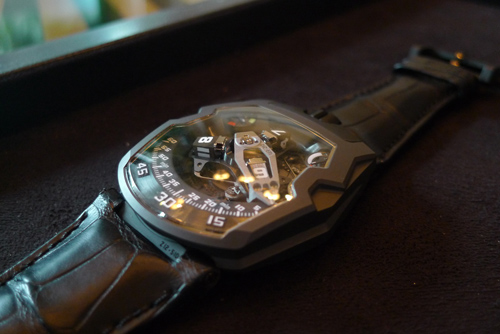 Open to inspiration For Frei, everything around him is his inspiration, including the work of the architect friend with whom he shares a space in Zurich. He feels it would be only limiting himself artistically to say, “I am now thinking about watches.” When he and Felix Baumgartner design their pieces, it is more a case of “I am thinking about time” that makes up the URWERK philosophy.In talking about the UR-210 and the revolving satellite complication with flyback minute hand, Frei mentioned the Swiss train station clocks - the second hand stops shortly before it reaches 12 o'clock. It stands still and then it the final step comes suddenly. It is as if time stands still for a moment. This bears a relationship to the UR-210, whose revolving satellite suddenly snaps over. The interplay between speed and the indication of time is something that he is clearly very conscious of and interested in developing in innovative ways.Relishing creative challengesOne of the most marked changes to Urwerk since its early days is the pace of the brand's work. Nowadays, the duo's company has about four projects concurrently in progress, as opposed to just one in the past. Some projects are even five years long, like the Zeit Device. As a designer, he says, the Zeit Device was a lot more work, since a different (much larger) size meant more challenges, especially in terms of working out proportionality and paying attention to the small details.
What began with Martin Frei as a discussion about the UR-210 and Urwerk's focus on the relationship between man and machine (“it tells you about your own behaviour”) ended up as something else entirely – a philosophical conversation about the nature of time and how we, as humans, perceive it.Interactivity between wearer and watch Urwerk has long had a quirky interactive component to its watches, of which the UR-210's efficiency indicator is the most recent manifestation. Frei, the design part of the dynamic Urwerk duo, is an artist working in a studio shared with an architect in a building filled with other creative people. As an artist, when he started working with watches he was fascinated to discover that people saw watches in many different ways – as mechanical objects or as status symbols, for example. He has an interest in watches, but not from a watchmaker's perspective. As he puts it, he is interested in a “philosophical machine.” By this he means not just a machine that tells the time, but a machine that makes you think about time, about the concept of time. He believes that by indicating time in a different way, you make people think about time in a different way, and as watches are a representation of the passage of time, people can experience this passage in different ways according to how it is represented by Urwerk.
Open to inspiration For Frei, everything around him is his inspiration, including the work of the architect friend with whom he shares a space in Zurich. He feels it would be only limiting himself artistically to say, “I am now thinking about watches.” When he and Felix Baumgartner design their pieces, it is more a case of “I am thinking about time” that makes up the URWERK philosophy.In talking about the UR-210 and the revolving satellite complication with flyback minute hand, Frei mentioned the Swiss train station clocks - the second hand stops shortly before it reaches 12 o'clock. It stands still and then it the final step comes suddenly. It is as if time stands still for a moment. This bears a relationship to the UR-210, whose revolving satellite suddenly snaps over. The interplay between speed and the indication of time is something that he is clearly very conscious of and interested in developing in innovative ways.Relishing creative challengesOne of the most marked changes to Urwerk since its early days is the pace of the brand's work. Nowadays, the duo's company has about four projects concurrently in progress, as opposed to just one in the past. Some projects are even five years long, like the Zeit Device. As a designer, he says, the Zeit Device was a lot more work, since a different (much larger) size meant more challenges, especially in terms of working out proportionality and paying attention to the small details. The creative challenges brought on by competition is relished by Frei – he sees it as inspirational – but nonetheless Urwerk is determined to develop at its own pace; each new piece is seen as an evolutionary process in which the previous watch can be seen in the new watch, but there is something new as well. In discussing whether Urwerk feels under any pressure to come up with new models and new innovations regularly, Frei answered that he and Baumgartner do not feel as though they need to come up with something totally different each time. As a small brand, they have a degree of flexibility: “Big brands have a DNA and we are more like a virus,” he quips.“If we don't have the ability to witness change, if somehow we existed in space, in a vacuum, with no deterioration or erosion, does time actually exist? If there is nothing that shows the passage of time?”
Featured brand