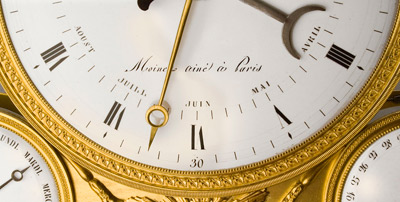
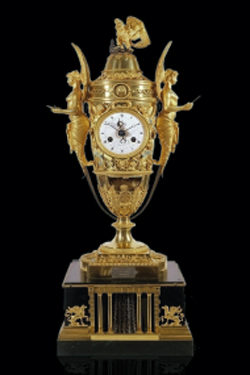
The « Napoleon Clock » was made in 1806 by Louis Moinet in Paris, and is equipped with an eight-day movement. It displays the hours, minutes and date.
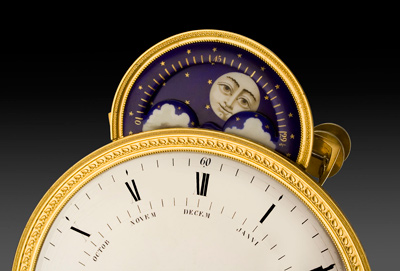
The great originality of the « Napoleon Clock » lies in an outstanding mechanism displaying the moon phases inside the day hand, by means of a tiny ivory ball.
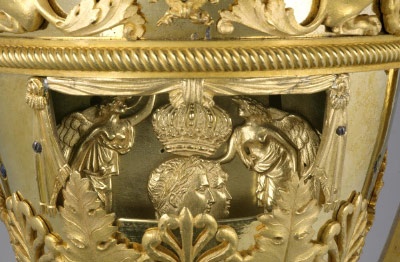
Napoleon and Josephine are crowned Emperor and Empress as soon as the music box is activated. To achieve this, an ingenious mechanism physically places the imperial crown on their heads.
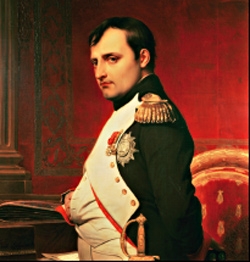 Maréchal Murat clock
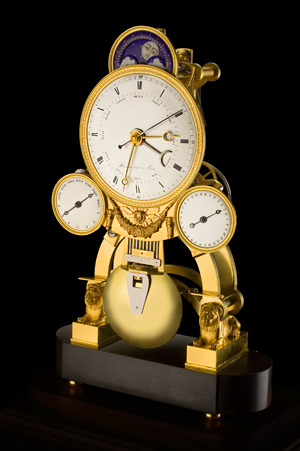
This exceptional clock of astonishing intricacy was manufactured for Marshal Joachim Murat, King of Naples.
The four different dials combine a full calendar indicating the hours, minutes, seconds, day, date, month and moon-phase.
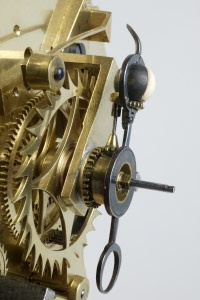
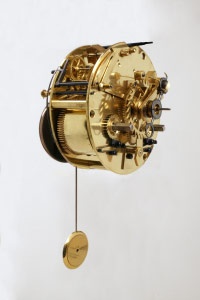
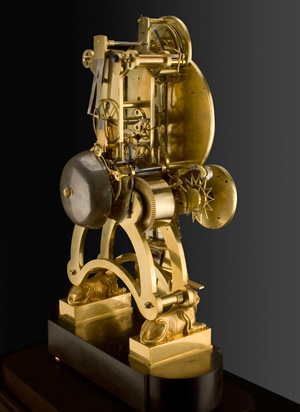
The movement is entirely visible from the back. The key-winding mechanism is ingeniously concealed in the design of the clock.
 Prince of Hanover clock
 This bronze clock dates from ca. 1810 and was manufactured for Ernst August, Prince of Hanover. Its “rotating circles” technology is used to spectacular effect. It enables to read the hours and minutes through two different cylinders located inside the urn.
Dimensions : 72.0 x 34.5 x 25.5 cm
 Empire clock
  Creators : Louis Moinet (watchmaking) and Philippe Thomire (bronze)
 Description : Empire clock in bronze
Dimensions : Height : 31 cm ; Length : 21 cm ; Depth : 13 cm
Courtesy : SothebysNeron clock
This clock was made in ca. 1825 and represents Emperor Nero. It strikes the hours, halves and quarters.