


“The UR-100V is like a blank canvas providing scope for infinite exploration,” said Martin Frei, URWERK’s artistic director and co-founder. “We're having fun with this collection, constantly rediscovering it through new expressions. Hunter Green was an obvious choice. It's a living, breathing colour that interacts with light and time,” he said of the grey-green colour which has an undeniable British touch to it.
Featuring URWERK’s signature satellite hours, this iteration of the 100 collection is one of the most legible ones, and as per usual the satellite hours are mounted on beryllium-bronze Geneva crosses carried forward by an aluminium carousel.
For the third time, Mr. Frei and URWERK’s master watchmaker and co-founder Felix Baumgartner opted for a full metal jacket in titanium. “The tapering titanium bracelet has been sandblasted and shotblasted, and has, in our view, the perfect metal look – magic titanium finish as we call it,” Mr. Frei continued about the surprisingly ergonomic timepiece which is only 14 millimetres thick.
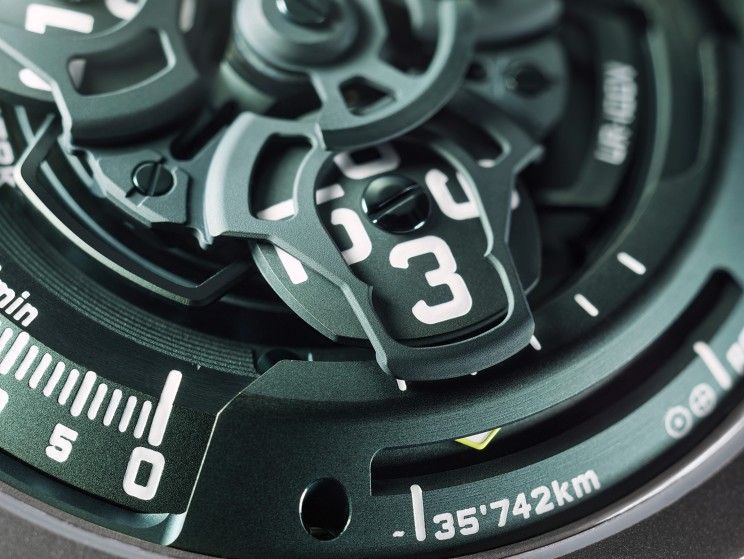
In its 28-year-long history, most URWERK models have had a monochromatic approach and look, but not so with the UR-100. “Our other watches tend to be predominantly black and metal. That is why I really enjoy being able to explore colours on the cases, and to have more colourful renditions of our watches. This UR-100V Magic T – Hunter Green edition
explores this direction, and it is also our entry-level piece,” Mr. Frei said of the 58,000-Swiss franc watch that has 48 hours of power reserve.
A Celestial Journey
But there is more to this automatic sci-fi-inspired watch, whose widest measure is 41mm and has a length of 49.7mm. This fine example of nouveau horlogerie also bears witness to the mindboggling journey of the Earth. On the left side, what you would normally refer to as 09 o’clock, the peripheral indicator gives you the rotational distance at the Equator in 20 minutes – which is 555 kilometres. And the other aperture on the right at 03 o’clock shows the orbital distance in 20 minutes on our perpetual journey around the Sun, which is a mind-blowing 35,740 kilometres.
“Every time I show and explain the watch, people are astonished about these measurements. They hadn’t heard about this before, or I should say they hadn’t thought about it in this way. I was inspired by a concept clock in the Sandoz collection, which also shows this,” Mr. Frei said before the floodgates opened to a larger philosophical meandering. “Space and time are interlinked, they are two different aspects of the same thing. And the hand shows how we are travelling through space. The mechanics of the sky are doing this, but what is time? We indicate time by understanding a change in the movement of celestial bodies – this is time for us,” he continued.
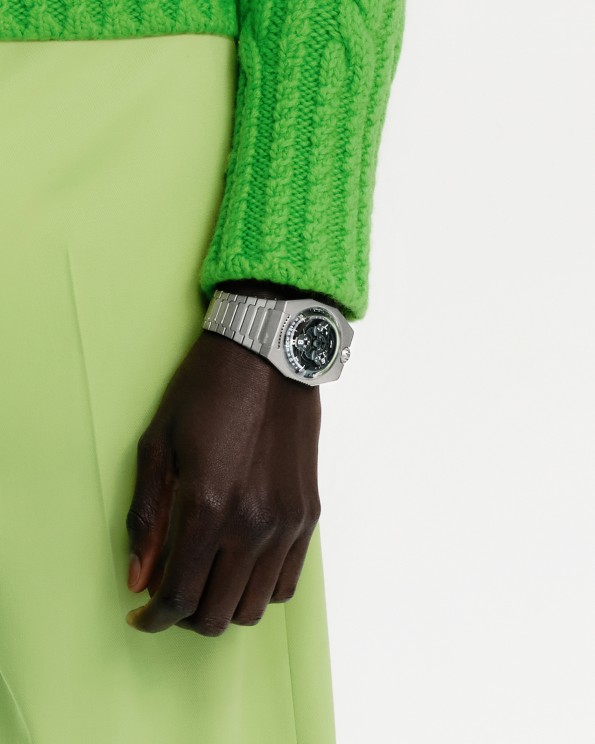
Mr. Frei refuses to be limited by the traditional constraints of watchmaking. Perhaps his creative and novel approach has got to do with his background in art and documentary filmmaking. “To indicate the movement of our planet around itself, and our journey around the sun, are not anything that you necessarily need to think about. But it makes you understand that this is actually what any watch is all about. We tend to forget this, and it is okay to forget this. But it is also great to be reminded of it every now and then.”


