
Omega's Railmaster is a well-kept secret. It has its fans and collectors, those who like to steer clear of the inescapable Speedmaster to explore lesser-known territory. Yet Speedmaster, Railmaster and Seamaster are close relatives. And with good reason. They all came out in 1957. They belonged to the same collection, known as the "Professional Line". They shared many technical and aesthetic attributes. And they even had three consecutive model numbers: CK2913 (Seamaster), CK2914 (Railmaster) and CK2915 (Speedmaster).
History clearly helped the first and third models. The Seamaster benefited from the recreational diving boom of the 50s and 60s, as did Blancpain's Fifty Fathoms, Rolex's Submariner, Doxa's SUB collection, Breitling's Superocean and Eberhard & Co's Scafograf. As for the Speedmaster, originally designed for car racing, it was to find itself at the pinnacle of glory when it went directly...to the Moon.
A large family
Against this backdrop, the Railmaster had a hard time asserting its qualities. While it benefited from the glory of its two star sisters, it also suffered from their shadow. Yet the Railmaster was unveiled at the right time. It belonged to the specialized technical watch segment. So did IWC's Ingenieur (1955), Rolex's Milgauss (1956), Jaeger-LeCoultre's Geophysic (1958) and Polaris (1968).
The Railmaster was designed for railway workers. Exposed to the magnetic fields of electrical substations, they needed a timepiece that would guard against them and keep accurate time, vital for railway regulation. Their caliber was therefore protected by a soft iron Faraday cage resistant to 1000 Gauss, a dial twice as thick as the average, and a movement favoring copper, by nature non-magnetic.
Unfortunately, working on rails doesn't have the same charm as diving with sharks or going to the Moon. The Railmaster has paid the price. As a result, the model has been discontinued time and time again, which, paradoxically, has led to an explosion in the price of vintage models, which are now impossible to find (especially those which, in the meantime, had attracted a few rare air fighter squadrons, in Peru or Pakistan).
Four affordable 2025 editions
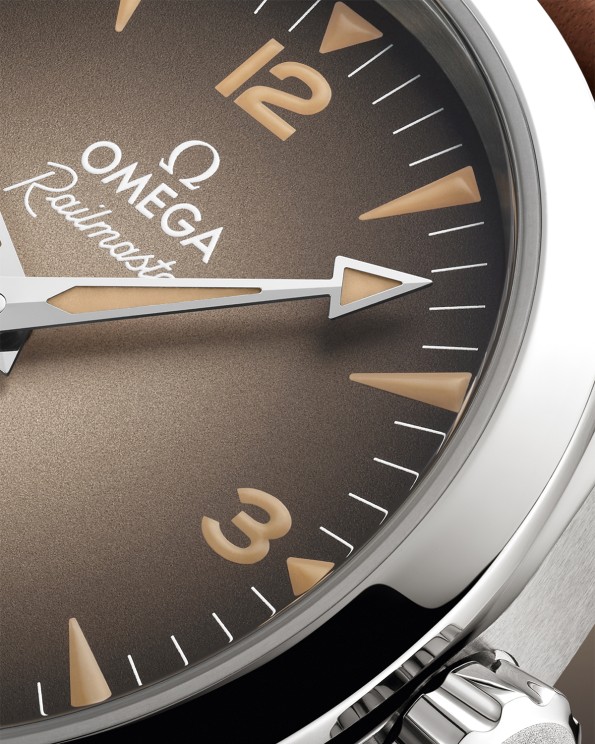
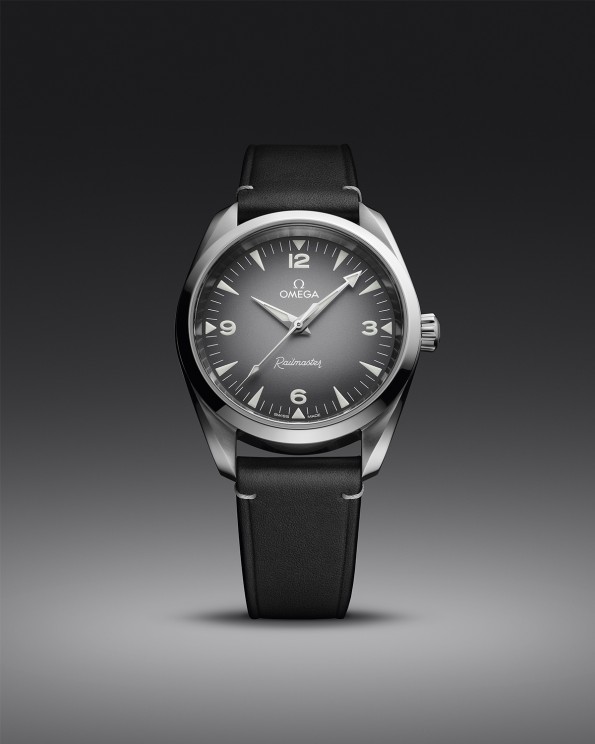
The Railmaster is now back in four variations: grey gradient dial with three central hands (leather strap or steel bracelet), and brown gradient dial with small seconds (leather strap or steel bracelet). Their common diameter is 38 mm, very close to that of the original Railmaster (37.5 mm). We find the "Arrow" hour hand, more stretched and incisive, with no curve, and a minute hand with the opposite treatment (shorter, wider). The balance is thus preserved but, in a way, "reversed". The seconds hand, which at the time was not luminescent, now has a Super-LumiNova tip.
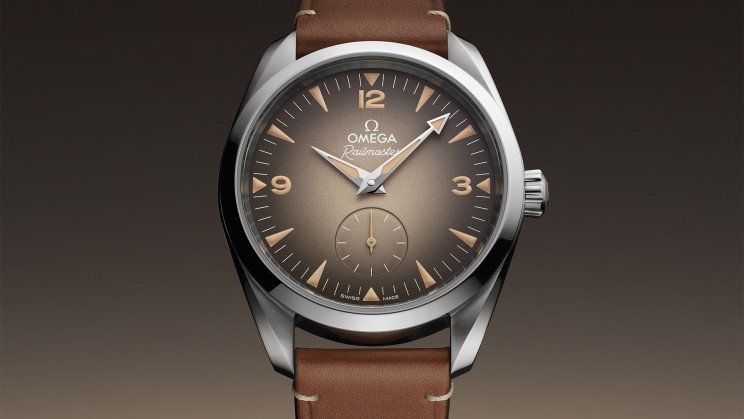
We appreciate that this timepiece remains "utilitarian" and retains its steel case for this purpose. The Faraday cage has been removed, as the new Railmasters, equipped with a silicon balance-spring, have their Co-Axial escapement by nature anti-magnetic. The escapement is Cal. 8806, common to many Seamasters. The icing on the cake: at CHF 5,200, the new Railmaster remains the most affordable of the trilogy it forms with the Speedmaster and Seamaster. For the time being...