
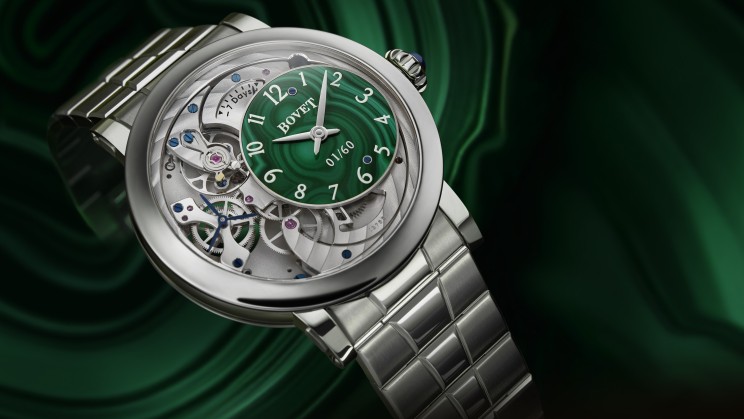
Stones possess real or subjective virtues - who cares! Their colors and patterns are largely perceptible and appreciable to the naked eye. While hard stones had their heyday in the pop designs of the sixties, watchmakers do not hesitate to regularly feature them on their dials. Their shades particularly appeal to collectors seeking uniqueness, bringing an organic dimension and a touch of character to watches. In the Récital 12, malachite and tiger's eye engage in dialogue with the mechanics and the shine of the carefully decorated components.
Malachite: Circles of Time
Malachite stands out with its concentric blue-green, deep green, light, dark, or even black-crossed waves. These rings, often described as hypnotic, originate from the alteration of copper. A stone from the carbonate family, malachite is found in many copper deposits: from the Congo to Zambia, from Namibia to Russia, but also in Australia, the United States, Italy, or France.
Beyond its beauty, malachite feeds an ancient imagery: stone of travelers, it is said to protect and reassure, while promoting concentration. A symbol of metamorphosis and protection since Antiquity, its intense green is reminiscent of the Jura forests – where the Bovet castle and manufacture are located.
Fragile because relatively soft (hardness of 3.5 to 4 on the Mohs scale and density of 3.60 to 4.05), it must be cut into thin slices, then fixed on a metal support and polished mirror.
Tiger's Eye: Inner Fire
With tiger's eye, Bovet explores another dimension: that of light in motion. Belonging to the quartz family, this mineral features a golden sheen with a “cat's eye” effect. Its fibrous structure comes alive with brown and golden, honey, or copper reflections depending on the angle of the light. This microcrystalline quartz forms from oxidized crocidolite, and is primarily found in South Africa, Australia, India, Burma, or Brazil.
Since Antiquity, tiger's eye has been regarded as a protective talisman, a symbol of courage and insight. It is attributed with qualities of mental clarity and emotional resilience.
Again, transforming it into a dial requires precise cutting and meticulous polishing – even though it is harder than malachite (7 on the Mohs scale).

Showcasing Mechanics
Beyond its unique mineral casing, the Récital 12 reveals the house's expertise. The movement is reversed and open-worked on the dial side, exposing the balance and the regulating organ designed internally. The seconds wheel is topped with a crown of three blued hands, a distinctive signature.
Under this apparent lightness, the caliber delivers a power reserve of seven days (168 hours) with a single barrel – a feat that far exceeds current standards. True to its integrated manufacture model (including spiral production), Bovet manufactures more than 95% of components in-house.
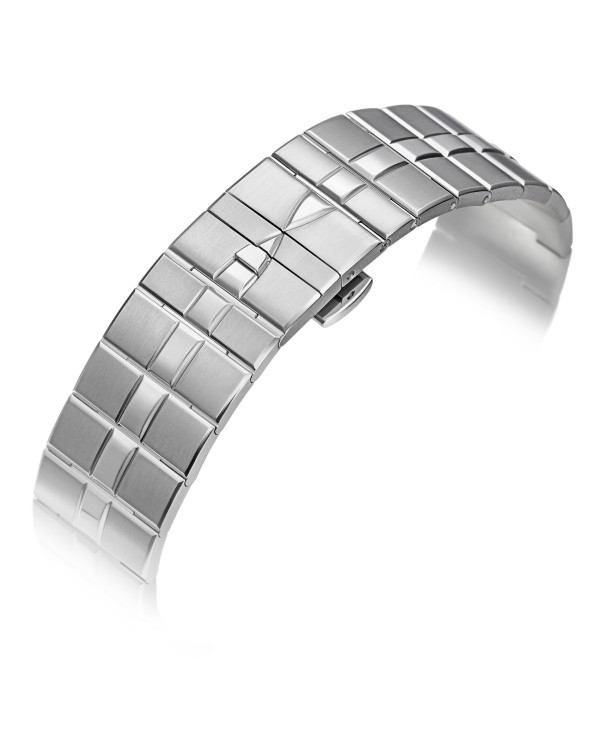
With its 40 mm diameter and its metallic bracelet – unique in the house collections – the Récital 12 is intended to be versatile and comfortable. Its deployant clasp includes a 3 mm expansion system to accommodate natural wrist variations. The alternations of polished and satin finishes, punctuated by Bovet's "V" forming the symbol of infinity when closed.
Between Nature and Culture
With these two limited editions of the Récital 12 (each limited to 60 pieces), Bovet achieves a fine balance: integrating the mineral aesthetics of malachite and tiger's eye into the time-measuring mechanics, while respecting each one's own identity. Unique by nature, these dials give each watch a singular character. Thus, the Récital 12 becomes more than a timepiece: a meeting between the Earth's geological forces and horological technical excellence.