
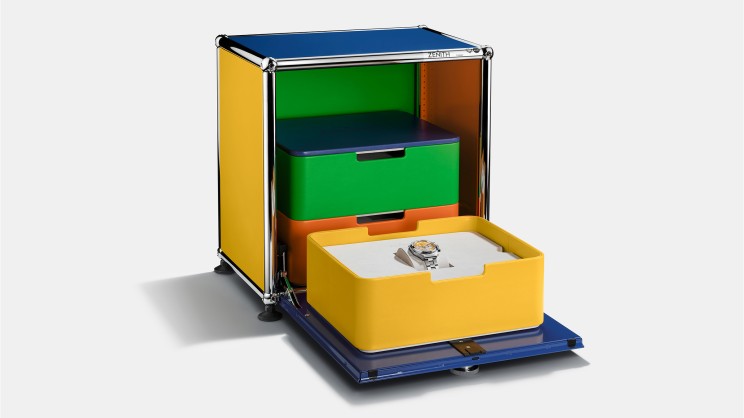
Zenith sets the tone: what if the original DEFY had been equipped with the El Primero movement back in 1969? And what if it had been influenced by the unique aesthetic of USM Haller? This collaboration was born from the brand’s imagination — but more importantly, from the historical relevance and the natural harmony between the worlds of Swiss furniture and watchmaking in the sixties, which weren’t so far apart. Housed in a spectacular case — USM, of course — this new Defy is one to remember: featuring a design carved straight out of 1969 (with its octagonal case and 14-sided bezel), the legendary El Primero chronograph movement, and bold, unconventional colors, all topped off with a small USM ball on the seconds hand.
USM and Defy, the Indestructibles
Both born in the sixties and tough as Swiss mercenaries, the USM Haller system and Zenith’s Defy bring together function and design with remarkable finesse. The former, launched in 1965, is geometric, modular — and ultimately unbreakable in the wilds of the modern office. As a bonus, its construction and design are the epitome of simplicity and functionality. The structure is formed by steel tubes that can be combined "infinitely" using simple chrome-plated steel balls, each drilled with six holes. Panels, made of painted steel or glass, can be added on any side as desired. Ir-re-sis-ti-ble! Especially since the system’s co-inventor, Paul Schärer, went to great lengths to make USM style truly timeless.
In 1969, the Defy made its mark for extreme toughness too. Nicknamed the “safe of precision,” the watch underwent shock tests during its launch that left a lasting impression. After being thrown from the third floor of Zenith’s manufacture, the gathered press could only marvel: neither the mineral crystal nor the movement had suffered any damage. Another anecdote: two Defy watches were twice strapped to a speedboat’s trunk to cross the English Channel. Both emerged unscathed.
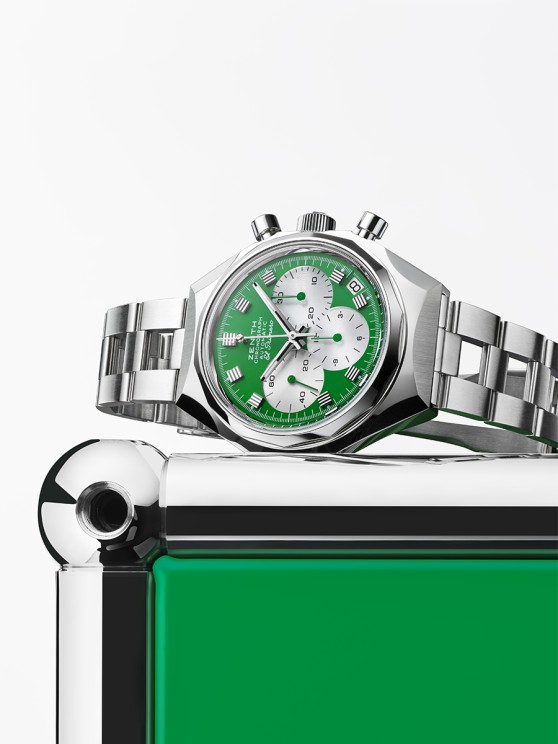
The design of the Defy — angular octagonal case and 14-sided bezel — served a purpose too: the union of function and form. In fact, its “cut facets” visually slimmed down the case. “The case in question, patented, included an elastic suspension on which the movement rested — enough to absorb shocks ‘that would have destroyed any other watch’, as period ads remind us. It also pushed Zenith’s designers to find creative ways to camouflage that added thickness,” explains Laurence Bodenmann, Head of Heritage Management at the manufacture. Moreover, “these numerous facets, reinforcing the watch’s ‘safe-like’ look, could also absorb impact in an almost organic way: one more shock, one more facet!” the historian adds.
A first, 56 years later
The original Defy A3642 shares its birth year — 1969 — with the El Primero, the first high-frequency automatic chronograph. That Defy, with its three-hand display, housed a Zenith automatic movement running at 3 Hz. In 1971, Zenith introduced the Defy El Primero, with a case design less angular than the model released two years earlier. That sharp-edged 1969 aesthetic was revived almost identically in 2022 with the Defy Revival A3642 — an extremely faithful tribute to the original, this time powered by the ultra-thin Zenith Elite 670 movement. The same year, Zenith launched the Defy Skyline, which beats to the rhythm of a variant of the El Primero 3600 — without a chronograph function. So pairing the original, “revival” lines of the Defy with the iconic El Primero movement — complete with full chronograph functionality — was a match written in the stars. Zenith stars.
Colorful Costumes
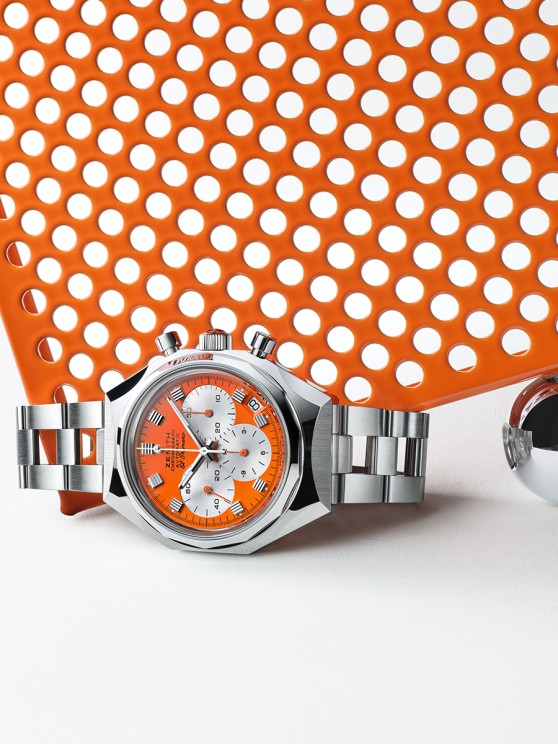
Thus came to life the dream collab between a trio made to get along — USM, the original Defy, and the El Primero caliber. The Defy Chronograph USM is limited to just 60 pieces per color (yellow, gentian blue, green, or orange). Each watch is available on its own or delivered in a bold leather case housed inside a USM furniture piece. Impact and durability guaranteed! On the watch (37.3 mm in diameter), all the classic Defy design codes are proudly present — from the case shape to the indices — with a perfectly integrated chronograph, featuring three sub-dials and two classic “pump” pushers. For the strap: the legendary “ladder” bracelet designed in 1969 by Gay Frères for Zenith.
USM’s DNA blends seamlessly with Defy and El Primero, symbolized by the brand’s signature colors on the dial and a chrome ball on the seconds hand — a nod to the chronographic precision of the movement.
A collection bursting with color, character, and horological and historical relevance — one that savvy collectors surely won’t miss.