What guidance did you give your teams in seeking to enrich the Tradition collection?
While the idea was to expand the Tradition collection, the starting point was actually the 7035 model launched last year to mark Breguet’s 250th anniversary. This limited-edition timepiece featuring a guilloché enameled dial marked a true turning point – or rather, a transition toward the collection’s future. It was also one of the first
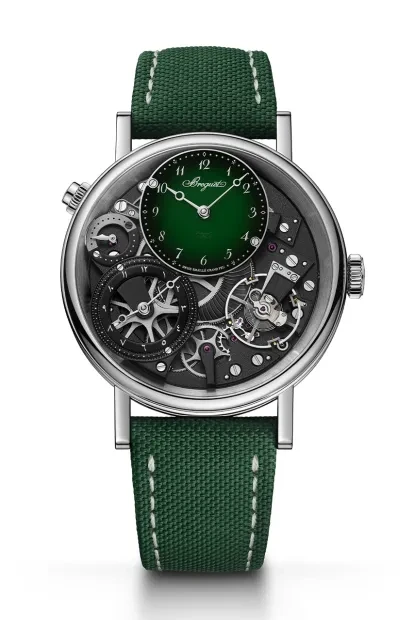
Tradition models to bear Breguet Arabic numerals, the first natural milestone in the expansion. The other direction I wanted to explore was the introduction of color on the movements, turning to new technologies to achieve that. Let’s not forget that here at Breguet we love to innovate by combining tradition and modernity. The novel techniques enabled us to color the mainplate and bridges. Ulti mately, combining a Grand Feu enamel dial with colorful movement components brings a true touch of modernity to the collection.
Which traditional artistic crafts were employed in developing the six new models?
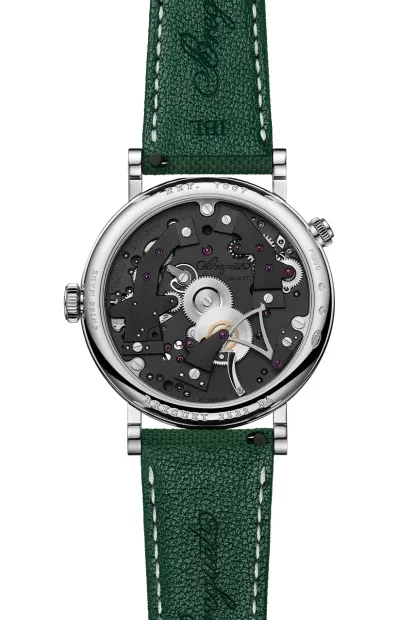
First, I would mention guilloché, which is ubiquitous in Breguet collections. We have in-house expertise in various types of guilloché, which we apply not only to the dial but also to different movement components. On the Tradition Seconde Rétrograde 7038, the barrel cover is decorated with a magnificent sunburst guilloché pattern, as is the rhodium-plated gold oscillating weight visible on the caseback.
The new models also feature exquisite enamel work on the dial…
It is often said that the dial is the face of the watch and the Tradition has two: the dial, of course, as well as the movement. On these time- pieces, we have chosen to highlight Grand Feu enamel, available in white or black on a base made of white gold, the ideal alloy for this technique. Between three and five layers of enamel are applied to the dial, which is individually fired at nearly 800 degrees Celsius after each application. On the two Tradition GMT models, we took this a step further by introducing a smoked effect through a green- to-black gradient designed to harmonize with the movement’s black PVD coating. A gradient effect is one of the trickiest to master in enameling, as it is even more demanding than a solid enamel.
Above and beyond traditional artistic crafts, what improvements have been made to the design of the new models?
Combining an enamel dial and colored movement components constitutes the main design evolution. We have introduced new technologies to color the mainplate and bridges, infusing the collection with a modern touch while remaining entirely faithful to Breguet’s expertise.

What about the movements? How do these models reflect Abraham-Louis Breguet’s technical heritage?
Tradition timepieces feature no fewer than 14 Breguet inventions, among which the Breguet balance-spring with its distinctive terminal curve – introduced here in silicon – is likely one of the most famous. The pare-chute shock absorber is also one of Abraham-Louis Breguet’s most iconic mechanisms; while the geometry of the oscillating weight on the 7037 and 7097 models references the per-pétuelle watch: an invention that Abraham-Louis Breguet was the first to render operational in 1780. Breguet was also the first watch- maker to use platinum, which is why some new models feature an oscillating weight made of this metal rather than gold.

© Anders Modig Davin
While the Tradition collection has borne this name since its creation in 2005, it exudes a highly contemporary look. Isn’t that a paradox?
It is a collection featuring a heritage in constant motion. The Tradition was launched in 2005, yet its contemporary expression is inspired by an extraordinary watch created by Abraham-Louis Breguet in the late 18th century: the Tact watch, invented in 1799. Designed not to tell the time but rather to feel it, this model offered a chance to admire the movement with its gears, oscillating weight and balance – the beating heart of the caliber. The Tradition is thus based on a blend of tradition and modernity: we’ve infused a fresh touch with dial animations and various finishes applied to the movement.
Do you think the Tradition collection now has all the ingredients for becoming an icon?
While 20 years of existence is doubtless too short a time to already be called an icon, I am convinced it encompasses everything required to achieve that status. It has the history, the living heritage, as I mentioned earlier, as well as the expertise and craftsmanship that shine through every component. I believe this collection has everything it takes to become a major icon for the House. Only time will tell!