

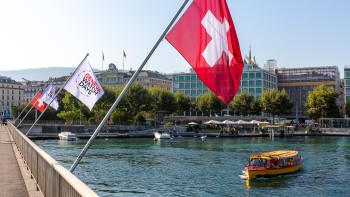
We are on the same scale as Watches and Wonders, which is the fair of the big and mostly well-known brands. The Geneva Watch Days offer diversity and discovery, showcasing a few major players and many emerging brands. These micro-brands rarely have the opportunity to benefit from collective visibility and, without the GWD, they would often remain in the shadows. The event opens doors to over 300 retailers, 500 medias, and 1,900 collectors. The latter love discovering – and, if possible, acquiring in preview – pieces they consider innovative, exciting, and complementary to their collections. For young brands, it is therefore a tremendous accelerator of visibility, reinforced by the credibility brought by the presence of globally recognized exhibitors such as Bvlgari, Breitling, TAG Heuer, or Zenith.
You also chair the LVMH Watch Division, which came in force this year. What was the main objective?
Indeed, Bvlgari had long been the only group brand to take part in the GWD, but that was just a coincidence. Our brands are independent, and they had already submitted their applications before my appointment. They had observed the positive results achieved by Bvlgari at this event and understood the complementarity with other watchmaking fairs. They also realized the relational value of this gathering, particularly the direct contact with major collectors, just before strong consumption periods such as Golden Week or Chinese New Year. Naturally, I am delighted, because I wanted to bring in more exhibitors this year to strengthen the GWD.
Do you set a limit on the number of exhibitors?
We receive applications every year, and we review them carefully. Our priority is to remain an exemplary organization in terms of transparency and authenticity. That is why we reserve the right to refuse brands that do not meet the standards of seriousness and trust expected by clients. The participation conditions are clear and fair: five well-established formulas, with no negotiation possible, where the larger brands contribute more to give smaller ones visibility they would not have otherwise. For them, it is a precious opportunity to gain notoriety.
Moreover, it is often young brands that encourage us to export the GWD concept abroad. But for now, our priority remains consolidating and further improving the Geneva edition, without seeking to duplicate it, especially as there are already other formats elsewhere.
After a decade of technical records at Bvlgari, what excites you most about the brand today?
After this sequence of records – both unexpected and carefully planned – I want to capture the essence of success. Because this is only the beginning for the Octo Finissimo, which has become a true icon in just a decade. It now has horological legitimacy that did not exist back in 2013, when I took over the brand. We would have achieved it sooner or later, but much more slowly without this demonstration of deep innovation across the fundamentals of the watchmaking chain. We had to completely rethink and reinvent it, reducing its volume and placing it into an ultra-thin case, thus offering clients a contemporary elegance that no other brand provides. Other ultra-thin players offer more classical watches. Bvlgari, however, is pioneering and modern. It speaks to today’s man – the one who dresses in slim-fit and lives in an apartment adorned with contemporary art, bathed in light through large bay windows.
The Octo Finissimo is instantly recognizable, even from ten meters away. Everyone knows it, yet few own it: its potential is immense. In my view, only two true watchmaking icons have emerged in the 21st century: Hublot’s Big Bang and the Octo Finissimo. It is our task to raise the latter even higher.
And we are doing the same with the Serpenti. It is indeed very rare for a Maison to wipe the slate clean of its previous models and start from scratch. Yet Bvlgari has succeeded in this bold move: since 2009, it has created watches that have become collectible pieces, arousing intense desire and strong recognition among both women and men. Creations that are at once different, elegant, and sophisticated.
How do you inspire clients to buy new watches in today’s complex climate?
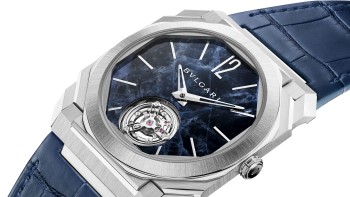
I believe innovation and novelty have always sparked desire in human beings, and there are multiple ways to innovate. It can come through materials, such as marble used in the Octo Finissimo. Its blue version is a true feat: it is extremely difficult to cut marble into very thin slices, and only the highest quality stone can be used, otherwise it becomes translucent.
Here, innovation lies in the use of a rare material that strengthens the watch’s differentiation while asserting its Roman heritage. The same goes for bronze, now dressing our Octo Aluminium, with a surface treatment that ensures an even evolution. But innovation can also come through collaboration. The example of South Korean artist Lee Ufan is emblematic: known for his sculptures combining mirrors and minerals with extraordinary reverberations, he created for us a mirrored dial, pure and legible, inspired by his technique. Most remarkably, he succeeded in “mineralizing” titanium, an exceptional feat that gives the piece a truly unique identity and rare artistic dimension.
At the same time, we are bringing innovation to retail, with new services. For example, we have installed small, quick, and free demagnetization systems, which avoid 30% of after-sales returns. That saves time and money for everyone. We also offer a polishing service for watches entrusted by clients, who can discover new products in the boutique while their piece is being treated.

If you had to choose a 2025 model from Bvlgari, Hublot, TAG Heuer, and Zenith?
From Hublot, I would pick the Big Bang 20th Anniversary, because it is a clever evolution of the original Hublot, which remains for me one of the two or three icons born in the 21st century – a fascinating piece to own. At Zenith, I find the Defy Skyline extremely contemporary and successful; it demonstrates the Maison’s mastery of movements. Its design, preceding most sports watches, dates back to the 1960s. It owes nothing to Gerald Genta, which makes it all the more interesting. My other choice would be the Chronomaster Sport Meteorite, about which I have read articles presenting it as an alternative to the Daytona given its dial. It certainly is – but in a more contemporary version, with the meteorite dial giving it added intrinsic value. Not to mention the El Primero calibre, which, by the way, once powered the Daytona. As for TAG Heuer, I would choose the Monaco Rattrapante chronograph. The collection is evolving remarkably, maintaining a strong vintage foundation linked to the legendary watch, while offering a forward-looking vision through very contemporary variations and sophisticated movements, all dressed in an unexpected way.
What about the movement industrialization projects you mentioned earlier this year during LVMH Watch Week?
The project is moving forward, and we are adopting a pragmatic approach regarding the benefits that brands can gain from using group movements. However, exceptional calibres must remain the property of each brand. Today, Hublot is already an important client of Zenith and will become even more so, for example with the Elite calibre. Zenith has considerable expertise in movement and component design, which we will leverage further. Hublot’s Unico is a completely original movement, which one could imagine being used in the Octo Roma, and Bvlgari’s Piccolissimo Solo Tempo automatic would be highly relevant for certain group models. Our philosophy is clear: to enhance the value of our watches in the interest of the client.


